

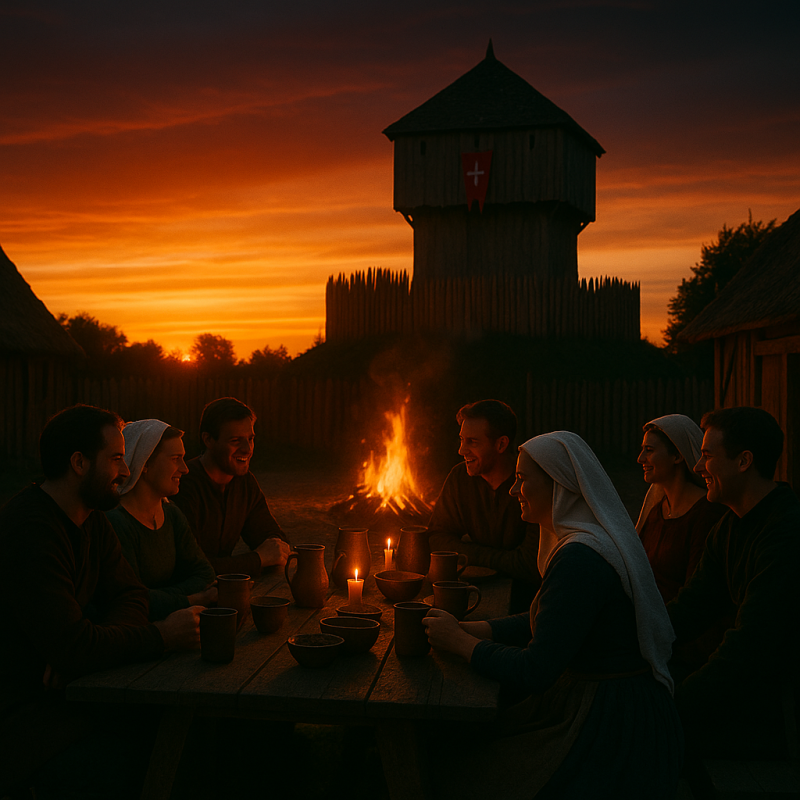
The sound of instruments ringeth out behind the palisades. The castle lieth bathed in a soft and pallid light of late winter. A table hath been set in the midst of the baile. Servants and men-at-arms rejoice for the young couple. Enguerrand and Fanzine rise and come to stand one before the other. Both wear new garments fashioned for the occasion by Marie. Fanzine hath let her chestnut-hued hair fall upon her shoulders. A crown of flowers adorneth her head.
The bridegroom taketh his wife’s arm and leadeth her gently into a round dance. Soon, others join them. Laughter resoundeth through the baile, stirred by the joy of the event. The vicar Gauzbert clappeth his hands after bringing a great spoon unto his mouth. The man swayeth upon the bench, his attention turned more toward the meats than toward the wedded pair.
Baudouin chooseth rather to remain apart, seated upon a stool beside the hall, and swalloweth another draught of pimen. The bitter savour of the drink stingeth his nose. He findeth it hard to rejoice for his young servant. His mind remaineth filled with doubts and questions. The three years that have passed have led him ever back to England, then unto the lands which Henri sought to subdue, desiring to secure the fealty of their lords. Never had he remained so long at Terlaze, and this unexpected respite leadeth him to ponder all this matter. Threads begin slowly to weave together, and new truths reveal themselves by degrees, allowing him to hope that one day he shall uncover the full truth of this enigma.
The vicar had sworn he had shut a man within the little church of Saint-Lézin. If his word may not be doubted, one might yet conceive that the intruder had secured a copy of the key. And only a few smiths may fashion such a thing.
Baudouin poureth himself more to drink and quaffeth it in one draught.
Thus, by this reasoning, someone sought to ensnare Aloïs—someone who knew her secret. Baudouin’s gaze falleth upon Enguerrand, yet he casteth aside the thought. Never would he betray his lord. Nor would Marie. Jehan, the road-warden? But for what cause? Aloïs had aided him in times past. He could not have laid such a snare with so grievous an end.
Raoul might be suspect: he came swiftly unto the church and spake of a woman who warned him, yet whom he never saw again. Yet how should he have known of Aloïs’s deeds? He knew naught, and the lady would not have confided in him.
There remaineth also that man, the leader of the band of thieves. Aloïs had told him that this man had, it seemed, taken her part and allowed her to be better treated, even freed.
Her words return unto his memory: “This man whom they called the master said they knew not whom they had wounded.”He had therefore known Aloïs, and by that same token discovered her secret. And yet, the thefts ceased soon after.
Peals of laughter ring out as one of the servants stumbleth. Baudouin riseth and staggereth in turn. He pauseth to steady himself, having doubtless drunk more than was meet.
The ground yet swayeth. The knight shaketh himself and maketh his way toward the well. He draweth forth a bucket of water and casteth it upon his face.
— Sire, is all well?
He turneth and findeth himself before Marie. Her gaze showeth both concern and sorrow. Baudouin sigheth.
— Thou liest to me, dost thou not?
The harshness of his tone driveth the maid to step back.
— Sire, I would not dare… Thou hast already shown me kindness in keeping me despite the loss of thy wife…
The man draweth near, swaying toward the chambermaid.
— Aloïs is not dead.
The woman’s eyes glisten suddenly.
— Would that it were so… I know how she is missed by thee…
— Nay! Thou knowest nothing!
The lord’s voice riseth and echoeth through the baile. The music ceaseth. None dare move.
— Thou knowest nothing, repeateth Baudouin. Aloïs dead of leprosy? I cannot believe it…
He thrusteth Marie aside and maketh toward the gates of the castle. Enguerrand and Macé stand before him.
— Sire, thou canst not depart, urgeth the servant.
— Let me pass. I must have air. I suffocate here!
He layeth his hand upon his dagger, his eyes dark with wrath.
— Stand not in my path.
The two men withdraw and yield, no longer seeking to hinder their lord from leaving the baile. Baudouin striveth against the effects of the drink to keep his footing. He feeleth his feet strike unseen obstacles, catch upon brambles and tall grass. Soon he beholdeth the church of Saint-Lézin. He goeth on, his eyes fixed upon the humble building. Many times hath he come thither, seeking to understand what befell, seeking to give meaning unto all this tale—seeking also to render justice unto Aloïs by finding that thief.
He staggereth, spent, overcome by the grief which the pimen hath loosed, and falleth upon his knees. With a cry, he uttereth the one question that gnaweth at him.
— Wherefore didst thou depart?
Sorrow and despair heave within his breast. Tears stream down his cheeks. His shoulders sink, so heavy all at once.
Softly, a hand is laid upon his arm. Baudouin turneth toward the figure beside him. He cannot discern the woman’s face, set against the light. Yet her voice returneth unto him at once.
— Come, Sire… thou must not remain here.
He riseth before Mélisande, who standeth upright before him. Baudouin standeth and wipeth his cheeks.
— Art thou come at last? I have sought thee for many weeks.
The healer remaineth silent.
— Knowest thou aught of my wife? Hast thou tended unto Aloïs?
Mélisande draweth a deep breath.
— Nay.
Once more, despair descendeth upon Baudouin.
— Then is she truly gone for ever…?
Mélisande inclineth her head.
— What maketh thee believe she yet liveth?
— Because… because Aloïs cannot die, not in such wise.
— To die whilst easing the sufferings of the afflicted—could that not have been thy wife’s destiny?
— Nay!
Mélisande noddeth softly.
— Or is it that thou canst not bid her farewell?
Baudouin fixeth his gaze within hers, she remaining still.
— Is it ill?
— Nay…
Mélisande turneth toward the church and the few huts nearby.
— I must needs depart.
As she turneth, Baudouin graspeth her by the arm.
— Stay! Canst thou truly not aid me?
— I cannot heal a wound that one refuseth to tend.
Baudouin feeleth Mélisande’s sleeve slip from his grasp.
— Yet, to know her fate, thou must read each page of thy book, even unto the last.
The young man parteth his lips, yet remaineth silent. Mélisande placeth an object within the knight’s hands and passeth away across the meadows. When he lowereth his eyes upon his palms, he knoweth it at once: the brooch that Aloïs wore at Chinon.
*
Baudouin finisheth the saddling of Jupiter. He is in no haste to ride unto Angers to answer Henri’s summons, yet he can scarce avoid it. Enguerrand accompanieth him once more, and the two men soon set forth at the break of day.
The sun striveth at times to pierce the darker clouds laden with rain and hail. Better not tarry, lest they be caught in a downpour. Baudouin casteth a glance toward his servant, who rideth in silence. The knight coughs, somewhat ill at ease.
— I would fain beg thy pardon for thy wedding…
The sergeant openeth wide his eyes.
— Wherefore, Sire?
— I bore myself ill. I drank overmuch and spake rudely.
— Sire, I can but thank thee for all the good thou hast done me, even unto granting me to wed Fanzine.
Baudouin smileth.
— I know thou yet sufferest for Lady Aloïs.
The knight sigheth.
— Aye, yet it is not for thee to bear the cost thereof. Thou didst what thou couldst.
The two companions exchange a look. Enguerrand gazeth upon his lord with a strange intensity. Baudouin’s eyes narrow.
— What is it? What aileth thee?
The young man openeth his mouth, seeming to hesitate to utter a word. Suddenly, two men burst forth upon the road. Baudouin stayeth his mount and questioneth them as to the cause of their haste.
— A woman, my lord—she is dead. None knoweth who she be.
— How came she by her death?
— Someone hath slain her.
Baudouin straightway draweth himself up, searching the underwood with his gaze.
— We went to fetch a cart to bear her unto the town.
Baudouin biddeth them go on and dismounteth, Enguerrand doing the same. They make their way toward a group of peasants gathered together. Upon the ground lieth a woman, not far from a small pool. A foul scent of mire taketh him at the throat. The sergeant bendeth and toucheth the victim’s cheek.
— She hath died but a short while since.
He studieth the damp earth.
— It would seem that someone pursued her. The mire must have slowed her flight. Other tracks show that they were at the least two in the chase.
Baudouin sweepeth his gaze over those gathered about the corpse.
— Hath any seen or heard aught?
Murmurs pass among them. Then Baudouin noticeth a woman who standeth apart, her face half-hidden beneath a broad hood. The cloak is of poor make, yet its pale grey hue draweth the knight’s eye. The stranger lowereth her head, which only deepenth his suspicion.
— I, Sire! crieth a peasant beside him. I saw two men flee toward the south.
Baudouin turneth toward the witness.
— What is thy name?
— Jules, Sire. I am one of the freeholders of the lord of Ponts-de-Cé.
— Canst thou describe them?
— Nay… They wore dark garments.
A sudden shudder runneth through Baudouin.
— Dark, sayest thou?
— Aye, Sire. They seemed like phantoms… I heard a cry whilst I was in the field. I came as swiftly as I might, yet it took me time to find where she lay. I glimpsed two men who let her fall when I cried out in turn.
Once more, uneasy murmurs rise, forming a troubling hum. Enguerrand lifteth the woman’s chin.
— Her neck beareth marks. They must have strangled her.
Baudouin examineth the hem of her gown. There is no blood upon her; perchance she was not otherwise harmed. A small mercy for the wretched soul. Her wide-open eyes yet reveal the terror that seized her at her last breath.
The cart is brought near, and two men bear away the body. The knight layeth his cloak upon the woman to hide her face. When he turneth once more toward those gathered, the hooded stranger hath vanished.
— Must I come as well? asketh Jules.
— Aye, the provost shall have need to question thee.
— I shall not be in trouble, say you?
— If thou hast done naught, thou needst fear nothing.
The old peasant’s gaze wandereth, as though lost in thought—and mayhap in reckoning such faults as he might have wrought. The knight mounteth once more, and they escort the dead woman unto the town. Baudouin asketh to see the provost. Raoul cometh swiftly and greeteth his friend.
— What bring you unto us?
— A most sorrowful matter—and perchance a new clue for thee.
The young man recounteth the events and presenteth Jules.
— A boon to have a witness.
— Yet his words bring little comfort. It may mean that the band of thieves striketh once more.
Raoul draweth near unto the cart and gently lifteth Baudouin’s cloak that covereth the victim’s head. The provost frowneth. He uncovereth more of the corpse and his eyes widen.
— But…
Baudouin steppeth forth in turn and regardeth more closely the features of the dead woman. She could not have seen thirty years; fair of hair, with a slender and comely face, though of common sort.
— Didst thou know her?
Raoul cannot tear his gaze away from the body. At last he uttereth:
— This is the very stranger who warned me of the thief of Saint-Lézin.
ns216.73.217.114da2

 and then Add to home screen.