

February 1156
A dry cold hath settled upon Anjou these past days, making the frozen grass crackle beneath the horses’ hooves. Vapours of breath rise from the lips of men. Baudouin and Enguerrand ride side by side, in silence.
The lord suffereth himself to be borne along by Jupiter, his palfrey, a bay of mighty haunch. Mars, his destrier, hath died upon their return from England after many months of struggle. A strange struggle it was, endured in that sorrowful year of 1153, wherein King Stephen and Count Henri ceased not to play at cat and mouse, refusing open battle. After the freeing of Wallingford, the Angevin laid siege to Crowmarsh Castle. Yet again, Stephen, though present, avoided the fight. His counsellors—his brother, the Bishop of Winchester, and Thibaut du Bec, Archbishop of Canterbury—had urged him to treat with Henri.
Their parleys brought forth a truce, on condition that the walls of Crowmarsh be cast down. Yet the king’s eldest son, Eustace, opposing this decree, rose in rebellion, but died shortly thereafter of sickness.
Thus the former foes sealed peace a few days before Saint Martin’s feast, on the sixth day of November, 1153, at Wallingford, whereby the Count of Anjou was declared heir unto Stephen. Baudouin remembereth still the noble’s entry into London in December, hailed by the crowd.
One year later, Stephen died, and Henri ascended the throne on the nineteenth day of December, 1154, becoming sovereign of England, Duke of Normandy and Aquitaine, and Count of Anjou and Maine.
Yet, as many had foreseen, the young man kept not his word: to yield Anjou unto his younger brother once crowned King of England.
For this cause doth Baudouin take the road toward the Angevin city: King Louis of France hath desired that an accord be reached, and hath summoned the two brothers thither in his presence. Yet, knowing Henri, the chance that it shall favour Geoffroy is but small. He passeth his hand over his beard, a token he hath worn since England.
Baudouin and Enguerrand pass through the walls and halt within the comital court, where many soldiers keep watch. The crowd seemeth troubled by this double royal presence. Merchants and townsfolk cast glances toward the palace, awaiting the sight of these great lords who yet debate their fate: who shall be Count of Anjou?
Baudouin leaveth Jupiter to his squire.
— Thou mayest go unto the tavern and await me.
— I would rather remain here, saith the young man.
Enguerrand hath grown in stature and in confidence these past three years. The loss of Aloïs hath also sorely touched him, yet he speaketh not of it. Baudouin hath laid no blame upon him. The guilty lie elsewhere.
— So be it, yet it may be long.
— I shall wait, Sire.
Baudouin layeth a kindly hand upon his shoulder and ascendeth toward the palace. There he meeteth Raoul at the entrance. They greet one another.
— Have the debates begun anew?
— They drag on. Henri showeth himself a cunning strategist. He hath offered Louis to do him homage for all his continental lands, should he side with him concerning Anjou.
— What answer hath the king made?
— He seemeth inclined thereto, which displeaseth Geoffroy sorely. The younger hath far fewer cards to play. Four days have they sought agreement—yet none hath been reached.
Baudouin noddeth and maketh his way into the great hall, where the harsh voice of Geoffroy ringeth out.
— God’s belly! I shall not endure such an affront! Our father, upon his deathbed, commanded that Anjou be given unto me when Henri should take the throne of England!
The younger pointeth at his elder brother, seated at the far end of the table. King Louis—called the Young—sitteth between them. Now past thirty years, he is easily known by his rich attire and his bearing: fair-haired, with eyes of azure blue, a long straight nose, and a full beard. His great piety showeth upon his cold and distant features, his steady gaze, and his restrained smile. Three years past he lost his closest counsellor: Abbot Suger, a most devout man who had been both tutor and trusted ear to the young sovereign, set upon the throne of France much against his will.
Other lords attend upon them, men of law, the seneschal of Anjou… at whiles whispering counsel into their masters’ ears. Henri stirreth not, doubtless full assured of himself. Now aged two and twenty years, there issueth from him a confidence and a pride most uncommon. The deeds he hath already wrought do but strengthen him in his choices. And to keep Anjou is surely the weightiest of them. To lose that land were to cleave his dominions in twain. Never would he commit such a fault of strategy, which granteth him advantage over the King of the Franks. The latter answereth without departing from his calm.
— Sire Geoffroy, we understand thy grievance. Yet may we not suffer such inward quarrels to weaken the unity of our realm. It would render us vulnerable unto the foes that watch at our gates.
The French sovereign turneth toward Henri and casteth upon him a look full of meaning. Beyond the bounds of France, Frederick, Emperor of the Holy Roman Empire, remaineth a sure threat. And if Louis consenteth to support Henri in his will to keep Anjou, he expecteth of him, in return, to stand as a true ally should fresh war arise.
Geoffroy hath risen, his clenched fists pressed upon the table. His reddened cheeks betray his wrath. His jaws grind one against the other.
— I can endure this affront no longer. An affront unto my father—unto his very memory.
The young lord departeth in haste, passing through the doorway beside the hearth. Baudouin turneth about and maketh for the entrance of the lordly lodging. He waiteth but a moment ere he espieth Geoffroy issuing forth from the hall. Anger is writ plain upon his countenance. He walketh toward Baudouin unseeing. The latter shifteth his place so as to come within the noble’s sight.
Geoffroy at last perceiveth him and slackeneth his pace.
— Sire Baudouin, I am in no humour to hear thee speak of thy loyalty unto my brother.
— Nor did I intend it.
Surprise driveth away the storm from Geoffroy’s face, softening his mien somewhat.
— I cannot suffer my father’s words thus to be dishonoured.
— I understand thee.
Baudouin steppeth aside, leaving the way open.
— Might I entreat thee to walk a while with me? ’Tis said such wandering doth ease a troubled mind.
Geoffroy assenteth with a motion of the chin. He signeth unto the guard that followeth him to remain behind, and goeth on beside the knight.
— How doth my brother dare act thus? How may he forswear his own promises?
— The games of power be oft but cunning guile.
— Yet I shall not yield!
— That is well spoken. Yet, should King Louis incline toward Henri, as it seemeth he doth, thou wouldst lack allies.
— Not so… Some do fear my brother’s wrath, for he hath already threatened to seize their fiefs because of these long-standing strifes.
Silence followeth Geoffroy’s words, and he seemeth deep in thought.
— It is true, continueth Baudouin, that certain men are loyal unto thee and have shown much discontent since the robberies that befell after thy father’s death.
— Aye. And I deem they might wholly be won unto my cause if—
The lord of Chinon casteth a glance at Baudouin, then draweth himself upright, his hands clasped behind his back.
— It were best I return unto my counsellors and unto the king. Perchance an accord may yet be found.
Baudouin boweth and watcheth the young lord go back toward the comital court. A breath of frustration escapeth his lips. He had not thought their discourse would end so swiftly… Another time, he must needs show greater subtlety with Geoffroy.
101Please respect copyright.PENANA00IFZEFxDs
*
101Please respect copyright.PENANAEP4lyjgjJ7
Baudouin remaineth turned toward the stone. Set at the edge of the woods—a place Aloïs held dear—this stele hath become his only refuge of mourning. There was no burial, as Enguerrand told him, no grave. Aloïs took the leprosy shortly after she was sent unto the abbey of Fontevraud. She gave herself at once to tend the afflicted. Yet her weariness, joined with the death of her father, left her weakened, and she succumbed full swiftly.
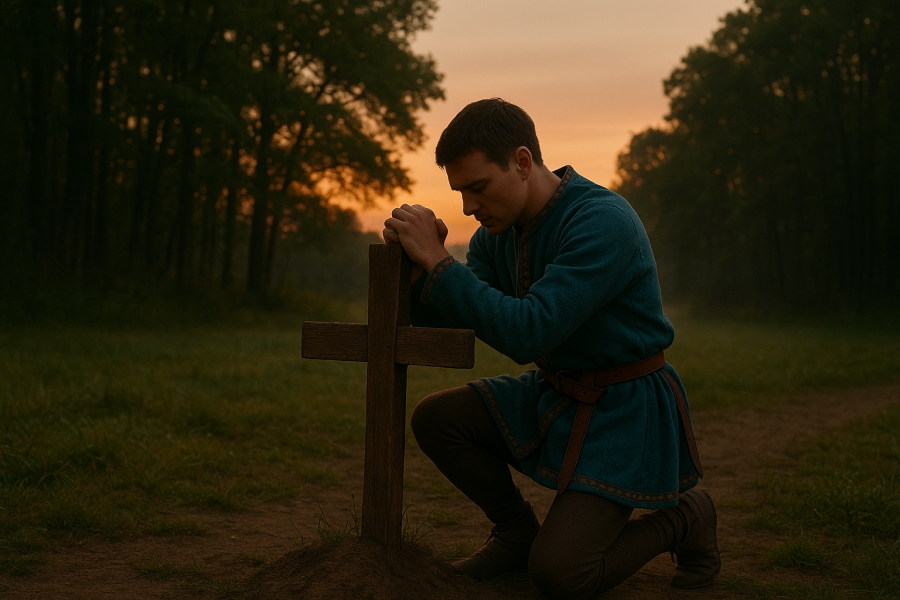
The knight kneeleth beside the stone of schist. He layeth his finger upon his lips, then gently traceth the name of his wife carved therein.
— Thou art sore missed… Had I but taken those thieves, as I did promise thee…
Emotion choketh him, and he closeth his eyelids.
— Had I not gone forth to war ere I had kept my vows, thou wouldst not have vanished, and Belle would yet be here…
Baudouin rubbeth his eyes and holdeth back the tears that seek to fall upon his cheeks. He riseth and readeth yet a moment the name of his wife, his heart full heavy. He setteth aright his cloak and turneth again toward the castle.
As he passeth through the gates, he espieth Enguerrand deep in discourse with Fanzine, the young laundress. Their closeness and mutual fondness are no longer a secret, and it bringeth a little lightness unto the heavy air he knoweth himself to cast about him. Baudouin turneth aside and goeth toward the hall of the milites when he beholdeth Marie crossing the bailey, her arms laden with linen.
He cannot forbear to think that the former chambermaid of his wife telleth him not all concerning the deeds that befell in that month of January, 1153. Marie had told him what Belle had reported unto her: the coming of the vicar, sore afraid, Aloïs’s departure, and her bidding Enguerrand to follow her. And then Raoul had burst into the church. A stranger had warned him that one of the thieves he had long sought was at Saint-Lézin. The provost had never seen that woman again thereafter.
Baudouin had been beside himself with wrath when he learned that Geoffroy had considered the annulling of their marriage. Yet the untimely death of Aloïs had brought all judgment to an end. He remembered still his discourse with Henri on that matter… the suspicions that weighed upon him, and the count of Anjou’s answer.
And then there was Belle: the child had not endured that her young mistress be shut within a convent, and had vanished shortly thereafter.
Vanished whither? A child of seven or eight years taketh not flight in such wise. Whither could she have gone? She knew herself safe here. Wherefore had she fled?
This double loss had shaken Baudouin unto the deepest root of his soul, and had made him see the place Aloïs held within his life—and Belle also. He lifteth his head and meeteth Marie’s gaze, which she turneth away forthwith. She seeketh ever to avoid him whensoever he returneth unto Terlaze. At first he deemed it guilt, yet more and more he doubteth that this be the sole cause.
Marie hasteneth into the lordly hall. Baudouin goeth thither also, when Enguerrand calleth unto him.
— Pardon, Sire, but Dame Havoise would speak with thee.
Baudouin lifteth a brow.
— Dame Havoise hath come hither, alone?
— With but one servant to attend her.
The knight maketh sign that she be admitted, and greeteth her within the bailey. The young lady boweth her head and offereth him a courteous smile.
— Thou hast travelled far; I trust thy husband fareth well.
— Full well. The provost prospereth greatly. Yet, since it hath grown most hard to meet thee in Angers of late, I took the liberty to come unto thee.
— And it is my pleasure to receive thee.
— In sooth, thy last visit unto the city brought thee little joy, I trow.
— The parleys indeed came to naught, and strife yet abideth between Henri and his younger brother. I pray God that accord may be found. Yet thou art not come hither to speak of matters of state.
Baudouin extendeth his arm and biddeth her follow him. A gentle warmth encompasseth them as they enter the aula. Marie hath made haste to set the braziers alight.
— I see not thy servant, the dark-hued man.
— Thou speakest of Yvain. I was not content with his service, and have… dismissed him.
Havoise inclineth her head, a faint unease glimmering in her eyes.101Please respect copyright.PENANAbdnReaOw2c
— I understand. It seemed to me his tongue did oft take overmuch liberty…
She seateth herself across from Baudouin, on the other side of the table.101Please respect copyright.PENANA0bYSrvydSi
— How fareth thy fief, Sire Baudouin?
— Right well. We endure the troubles that all men know. Some petty thefts have been marked by the voyer, yet naught to compare with the happenings of three years past.
Jehan hath from time to time come forth to inform Baudouin of the mishaps within the hamlets under his charge. Yet the man also seemeth strangely distant. Dame Havoise remaineth pensive.
— All this remaineth beyond ken. For what cause did these thefts cease as suddenly as they began?
— I cannot say.
— It came to pass shortly after the death of your wife.
— If memory serveth, the larcenies had already waned well before.
Havoise seemeth not to heed Baudouin’s remark and continueth:
— We might suppose that one among them was taken, and that this brought an end to their misdeeds. Taken… or slain.
He fixeth his gaze upon Havoise. Raoul had assured him that the suspicions concerning Aloïs had not been spread abroad. Yet one must expect all things. His dark eyes seek to fathom the thoughts of the provost’s wife.
— What would you imply?
The young lady foldeth her hands before her.
— I imply nothing; I but made the remark.
— I see that you taketh an interest in your husband’s labours.
A faint flush riseth to Havoise’s cheeks.
— Nay, I would not dare. I was but troubled for you. You have endured so many sorrows and disappointments…
Havoise seemeth to hesitate, yet at last she riseth and draweth near unto Baudouin. She layeth her hand gently upon the young man’s shoulder.
— Believe well that Raoul and I are here for you… that I am here for you.
Her fingers press lightly against the cloth of his bliaud. Baudouin riseth in turn, and they stand facing one another. The lady’s lips, full and soft, seem a summons unto delight. She leaneth her face close unto his. A sweet fragrance of flowers drifteth from her hair. Such nearness troubleth Baudouin, yet he findeth not the strength to thrust her away. He cannot deny that he feeleth a certain stirring toward her—her form, her curves… her skin like the velvet of summer fruit.
— I admire you, she whispereth at his ear.
Baudouin perceiveth her gown brushing against his legs. A shiver runneth along his spine.
— And your husband?
— Husbands part… even as Queen Eleanor and King Louis, she answereth with steady voice.
He regardeth her closely.
— Feel you then no affection for your husband?
A weary grimace shadoweth the young woman’s face.
— There is in my husband but little nobility.
— Nobility?
— He hath not ridden forth to conquer lands nor win a kingdom.
She layeth her hand upon Baudouin’s chest. This gesture suddenly wakeneth him from his torpor, stirring not desire but repulsion. He cannot. He cannot betray his friend—nor the love he beareth Aloïs.
He gently taketh her fingers and removeth them, then stepeth back to stand behind the table.
— I thank you for your concern. Yet I deem it wiser that you take the road again, lest night overtake you.
Havoise holdeth his gaze a moment longer, then turneth her head aside, displeased.
— You are right. I think I have naught more to do here.
One of the guards escorteth her out. She departeth without once looking back. Baudouin draweth breath. The presence of Havoise ever disquieteth him; now the reason standeth clear.
Enguerrand entereth in turn.
— Forgive me, Sire…
— Say not that yet another visitor awaiteth me?
— Nay, Sire. I would make a request of you.
Baudouin sinketh back into his seat, weary.
— Speak, so it be brief.
— Very brief, Sire: I would wed Fanzine.
ns216.73.217.114da2

 and then Add to home screen.