

— Hearest thou me, Baudouin?
The knight lifteth his head and starteth. Henri sitteth at his writing table within the lordly lodging. Before him lie charters and sundry scrolls, all in disarray.
— Forgive me, Majesty—what said you?
A faint smile stretcheth the lips of the suzerain.
— Whereon dwell thy thoughts?
— To speak plainly, upon the young woman who hath died.
Henri’s countenance stiffeneth at once.
— Aye, it is a grievous thing to see innocents thus slain without cause.
— The provost even now examineth the witness who beheld the murderers.
— I doubt not we shall soon lay hands upon those men. In the meantime…
He goeth round his table, above which hangeth a lamp of oil in ceramic.
— …we find ourselves in a most vexing plight. The parleys with my brother have come to naught, and certain lords lend him their support.
— You speak of Lord Thibault of Ponts-de-Cé?
Henri noddeth.
— Even so. The man was once squire unto Geoffroy. He hath been granted the fief of thy former father-in-law—without so much as my counsel.
Baudouin had heard somewhat of this upon his return unto Anjou after the accord with Stephen, yet the loss of Aloïs had then filled all his thoughts.
— We must needs expect open strife, growleth Henri.
— You seem weary, Majesty.
The king rubbeth his face.
— I had hoped to enjoy the company of my wife and my son. Little Henri hath now seen one year.
He casteth a glance toward Baudouin.
— It were time thou too hadst an heir. I have in mind a maiden, one of my wards, who would suit thee well.
— I thank you, Majesty, yet I have no wish at present to wed again.
— I seem to recall thou gavest such an answer upon first beholding thy betrothed. Yet thou canst not deny I judged aright.
— In truth, I deemed not that I could come to cherish Aloïs, saith he with bitter mirth… and I loved her more than mine own life. She is dead now, and I cannot forget her.
Henri draweth nearer unto Baudouin.
— I bid thee not forget, but to think also upon thy future. The maiden thou shalt wed may bring thee comfort—and perchance raise thee to greater station.
Baudouin meeteth the king’s gaze, yet answereth not. A knocking soundeth at the door, and a woman entereth, bearing a babe in her arms.
Aliénor of Aquitaine standeth before him, radiant. Her red bliaud is adorned with fine embroidery. A broad golden brooch fasteneth the collar of her gown. Ribbons of silk are woven through her long fair hair. She holdeth their son, a comely child of pale skin and his father’s eyes. Two attendants stand behind her, their hands folded upon their gowns.
Baudouin boweth before this woman, once Queen of France, who now beareth the heavy burden of the crown of England, along with the duchies of Aquitaine and Normandy, and the counties of Anjou and Maine.
Aliénor greeteth the knight with grace. Having received leave of the king, Baudouin withdraweth. He descendeth the steps of the lodging, his mind aflame. Henri cannot force him to wed—not now. Yet to confess the true cause of his refusal were to risk being thought mad.
He hasteneth across the court and beckoneth unto Enguerrand.114Please respect copyright.PENANAgCFVNbTpnc
— I go to see him. Await me here.
Baudouin passeth through the streets of the city and maketh his way toward the cathedral. Then he entereth the borough, where houses and humble dwellings of wood and thatch stand crowded together.
A familiar shape appeareth near a tavern: Yvain. Clad in worn garments, he sitteth with hand outstretched. When he beholdeth the young lord, he inclineth his head and remaineth watchful.
— What dost thou here, Sire? I looked not for thee ere ten days were passed.
— Henri desired speech with me.
— Ah? Had he aught new?
— Naught of weight. And thou—hast thou learned anything?
Yvain shaketh his head, full of regret. Baudouin letteth escape a sigh of disappointment.
— Then thou shouldst perchance return.
— Nay, Sire! Yet a little patience. It shall come…
The lord casteth an amused glance upon his servant.
— Must I deem that playing the spy wearieth thee less than serving me day by day?
A hint of mischief lighteth Yvain’s face.
— Thou knowest me better than I myself, Sire. And with my visage, folk keep their distance. Yet I pass unseen among beggars. But it stinketh, Sire.
Baudouin surveyeth the place about them, taking heed lest any spy upon them.
— One cannot have all… Yet since thou wouldst remain, I shall set thee another task.
— I hearken, Sire.
— Learn what thou canst of a woman who hath died not far from Ponts-de-Cé.
— Who is she?
— That would I discover.
Yvain shivereth and draweth his tattered cloak about him. Baudouin croucheth and secretly layeth a few silver coins in his hand.
— We must needs reach our end swiftly, ere thou be taken with the fever.
The man sneezeth and sniffeth loudly.
— I fear, Sire, it hath already taken me. Yet with a little mulled wine…
Baudouin pulleth lightly at his ear and addeth another coin.
— See thou drink not to excess; drunk, thou wouldst be of no use to me.
Yvain gathereth the coins and hideth them within his bliaud.
— I shall drink… I mean, I shall take heed.
His master maketh as though to rise, yet Yvain stayeth him.
— Sire, I must also speak to thee of Sir Raoul.
The knight frowneth.
— What passeth?
Yvain casteth another wary glance about and speaketh in a lower tone.
— I may be mistaken, yet I would rather tell thee…
*
Baudouin pondereth his servant’s words as he maketh his way back toward the comital palace. Yvain, though at times overbold, hath been of great use since his last return unto Terlaze. He hath agreed to remain in the city, feigning drunkenness, that he might watch comings and goings and gather rumours that could guide him in his quest. Yet thus far, naught of worth hath come of it. Until this day—mayhap.
Yvain is persuaded he hath seen the provost speak several times with the new lord of Ponts-de-Cé, Sir Thibault. The servant thinketh he saw the knight slip coins unto Raoul. To what end? This man beareth ill repute and hath, it is said, raised the tolls upon goods leaving Ponts-de-Cé.
Raoul might well aspire unto greater power, though his present station be honourable enough. Yet Havoise is no woman to be content with little. He might seek to forge alliances and thereby gain favour with the future count—but which one? Sir Thibault would likely incline toward Geoffroy, yet naught is certain.
Baudouin soon reacheth the lordly court and turneth toward the stables, when he espieth Anselme coming toward him.
— What dost thou here?
The archdeacon beareth a fierce smile.
— May I not greet mine own brother?
— How knewest thou I was here?
— I met thy guard, who told me of thy presence in the city. Did Henri summon thee?
— Aye.
Baudouin glanceth about him.
— The wind biteth hard without; I would sooner speak within, if it please thee. And I must inform Enguerrand that we shall soon return to Terlaze.
— As thou wilt…
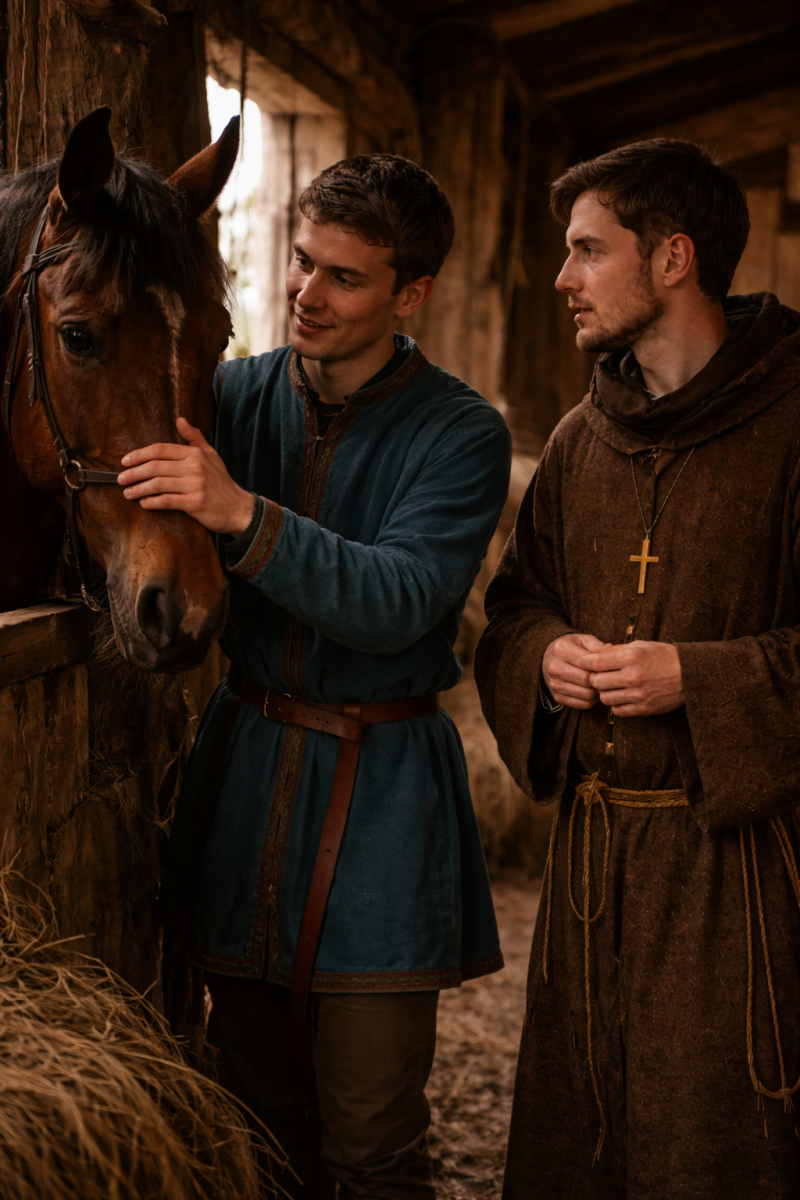
The two men enter the building, greeted by the neighing of a mare and the strong scent of hay and horse. They soon find the young servant, to whom Baudouin giveth orders for their departure. Then he turneth unto his brother.
— Thou wouldst speak with me? Thou seemest troubled.
Anselme claspeth his limp hand within his sleeve and shaketh his head.
— Nay, all is well. I did but wonder… wouldst thou have a young maid to commend unto me? I know certain honourable and devout Christian households who seek sorely for aid.
Baudouin clear eth his throat, taken aback by the request.
— I have no mind to part with my servants.
— Yet the child who ever followed thy wife…
— Belle?
— Aye. She must now be of an age to serve.
— Belle hath vanished.
Anselme’s eyes widen.
— She hath vanished? When came this to pass?
— Not long after Aloïs was taken.
The archdeacon’s cheeks grow pale.
— I knew it not. And thou hast never seen her since?
Baudouin foldeth his arms upon his breast.
— Anselme, what seekest thou herein?
— Naught. I would but aid certain worthy families.
— Then I am sorry, returneth the young man, yet I shall be of little help to thee.
— It mattereth not… And thou hast doubtless more to do with the king, I deem.
Baudouin noddeth.
— In truth. The strife betwixt the two brethren seemeth not easily resolved. We must prepare to take up arms anew.
Anselme draweth breath and fixeth his gaze upon his brother. His countenance softeneth somewhat.
— I am grieved to hear it.
Enguerrand appeareth, the two horses saddled.
— Sire, thy mount is made ready for the return.
Baudouin thanketh him with a nod and biddeth him wait without. The servant slipeth betwixt them and quitteth the stables. Baudouin watcheth the door close ere he continueth.
— I deem that, whatsoever betide, the discord may be brief. Henri is far better furnished than Geoffroy, who might suffer greatly from war.
Anselme casteth him a strange look.
— Thinkest thou the victory already won?
— Geoffroy must needs raise a mightier host, and that requireth much coin—which, to my knowledge, he lacketh.
— For those who truly desire it, coin may be found.
Baudouin regardeth his brother closely. Anselme turneth away.
— I shall not delay thee, since thou must return. I hope to see thee again ere long at Angers.
The archdeacon layeth his sound hand upon Baudouin’s arm, then departeth, leaving him doubtful: Anselme had ever taken care to keep apart from matters of strife since he took holy orders—yet his words now sound more like those of a man who hath pondered stratagems.
The fall of an object maketh him start. A stir in one corner of the stables draweth his eye. He standeth still and listeneth. Silence falleth once more. Yet something within him warneth him to beware.
The knight draweth near, softly, unto the place whence the sound arose, his hand upon the hilt of his sword. His steps fall light upon the hay, with the stealth of a cat. His gaze remaineth fixed upon the dark space behind the bales.
A figure suddenly riseth and fleeth toward the back door. Baudouin giveth chase. The woman slackeneth not and soon reacheth the exit. He cometh upon her as she draweth back to open it. He seizeth her by the arm, wringing from her a cry. When he forceth her to turn, doubt assaileth him.
ns216.73.217.114da2

 and then Add to home screen.