
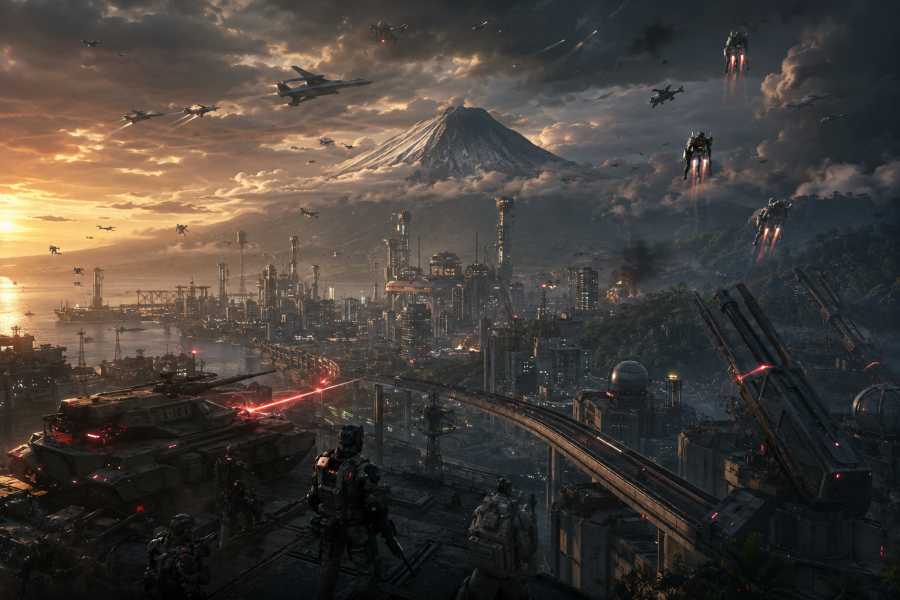
Cameroon, the principal Russian-aligned state in Central Africa, occupied a position every bit as strategically significant in the Third World War as the German Cameroons had during the First. Like its predecessor, it was surrounded on nearly every side by governments aligned with its enemies. To the west lay Nigeria, now a major NATO logistics hub and staging area. To the north stood Chad, whose airfields hosted Anglo-American aerospace detachments and long-range drone squadrons. To the east and south stretched a patchwork of allied Central African states through which NATO supply corridors, sensor grids, and mass-driver relay stations had gradually expanded during the years preceding the conflict. Only Equatorial Guinea, maintaining a fragile neutrality, and the waters of the Gulf of Guinea provided Cameroon with any meaningful access to the outside world. That neutrality, as in earlier wars, would prove enormously valuable to the defenders.
The concentration of Russian investment was greatest along the Atlantic coast. Douala had become one of Moscow's most important military-commercial ports in Africa, protected by layered anti-aircraft systems, coastal laser batteries, autonomous drone defenses, and hardened command bunkers buried beneath the city. Farther west, Limbe and Buea served as aerospace and communications centers, hosting satellite uplinks, long-range sensor arrays, and logistics facilities supporting Russian operations throughout Central Africa. High-speed transit corridors and maglev freight lines connected these coastal complexes to the interior, allowing troops, BEMP rifles, ammunition, replacement drones, and energy cells to be moved in hours rather than weeks.
Yet, as in the earlier conflict, the true strategic heart of Cameroon lay far from the coast. The western highlands remained dominated by the massive volcanic slopes of Mount Cameroon, whose elevated terrain hosted radar installations, laser-defense networks, and concealed missile positions. Northward, the plateau regions provided ideal operating grounds for armored formations, including Russian-supplied laser tanks and mobile mass-driver artillery batteries. South and east of the highlands, dense rainforest still covered vast stretches of the country, but twenty-first-century technology had not eliminated its military significance. The jungle complicated satellite observation, disrupted autonomous navigation systems, and limited the effectiveness of heavy armored forces. Beneath the forest canopy, infantry equipped with BEMP rifles, reconnaissance drones, and jetpack-equipped special operations teams could still maneuver with a degree of concealment unavailable elsewhere on the continent.
By 2020, therefore, Cameroon presented NATO planners with a challenge fundamentally different from that posed by Togo. Togo had been a swift political operation aimed at removing a vulnerable client regime. Cameroon was a fortified regional stronghold, protected by modern aerospace defenses, a substantial Russian military presence, and terrain that favored the defender. Although orbital reconnaissance could observe nearly every road, airfield, and power station, the country's immense size and geographic diversity ensured that any campaign to liberate it would become one of the largest and most demanding operations of the African theater.
Russian pre-war thinking regarding the defense of Cameroon evolved in response to the gradual expansion of Moscow's influence throughout Central Africa. The consolidation of Russian-aligned governments across the region during the preceding decade had been accompanied by continuing campaigns of pacification, counterinsurgency, and political integration, particularly in the remote eastern territories bordering the Central African Republic and the Congo Basin. Although the Russian Navy valued Douala as a major logistical hub for operations in the Gulf of Guinea and the South Atlantic, Moscow proved reluctant to commit the immense resources required to transform the city into an impregnable fortress. Orbital surveillance, aerospace power, and long-range precision weapons were widely believed to render traditional coastal fortifications obsolete. Nor did Russian planners place much faith in diplomacy. The neutrality of neighboring states appeared increasingly fragile as NATO influence expanded throughout West and Central Africa, and few in Moscow believed that any regional government would remain neutral once large-scale hostilities began.
The logical solution was to base the defense of Cameroon primarily upon its own military establishment and the Russian expeditionary forces stationed there, collectively known as the Afrikakorps, while preparing to wage a prolonged campaign from the country's interior should the coast be lost. Yet this conclusion was reached only reluctantly. President Paul Biya's government remained concerned about the political consequences of transforming Cameroon into an overt Russian military bastion while senior Russian commanders argued that sustained resistance would be impossible if access to Douala's ports, aerospace facilities, and supply infrastructure were severed. Consequently, despite years of contingency planning, serious preparations for an extended inland defense accelerated only after it became clear that NATO intervention in neighboring Togo had fundamentally altered the strategic balance in West Africa. By early 2020, Russian and Cameroonian authorities increasingly accepted the possibility that the decisive battles for the country might ultimately be fought not along the coast, but deep within the forests, highlands, and river systems of the interior.
The defensive doctrine adopted by the pro-Russian government in Cameroon during the years preceding the war reflected the changing geography of Russian influence in Africa. Unlike the coastal-focused security arrangements of earlier decades, Moscow's planners increasingly viewed the interior as the decisive theater. The ports of Douala and Limbe remained important for trade and resupply, but military strategists understood that fixed infrastructure on the coast would be among the first targets of NATO precision strikes, drone swarms, and orbital reconnaissance. The true strength of the regime lay inland, where difficult terrain, dense jungle, and established military facilities offered greater prospects for sustained resistance.
The strategic plan finalized in late 2019 accordingly centered not on the Atlantic coast but on the Adamawa Plateau and the highlands surrounding Ngaoundéré. Four brigades of the Afrikakorps were stationed in the central highlands, three more around Bertoua and the eastern transport corridors, two near Yaoundé, and additional formations in the northwest approaches. Together they formed an interior defensive belt protected naturally by mountains to the north, jungle to the south, and vast distances that complicated enemy logistics. The loss of coastal territory, while politically embarrassing, was not regarded as strategically decisive. Russian advisors calculated that if resistance could be maintained in the interior long enough, diplomatic negotiations might eventually preserve the regime even if much of western Cameroon fell under NATO occupation.
The consequence of this doctrine was that the Afrikakorps would be required to fight a conventional war against technologically sophisticated opponents. That was not the role for which it had originally been created. Its primary mission had been regime security, counterinsurgency, protection of Russian personnel and infrastructure, and maintenance of internal order. Its peacetime establishment consisted of several thousand professional soldiers supported by local auxiliaries, drone operators, engineers, and security personnel. Recruitment focused heavily on regions considered politically reliable, particularly around Yaoundé and the central provinces. Service was voluntary, but long enlistments and generous pay created a professional force whose cohesion compared favorably with many neighboring armies.
These strengths, however, concealed significant weaknesses. The Afrikakorps excelled at suppressing insurgents and securing fixed installations; it had far less experience conducting large-scale maneuver warfare against a modern coalition. Families often accompanied personnel assigned to interior bases, creating additional logistical burdens. Unit cohesion depended heavily upon Russian advisors and long-serving Cameroonian officers whose expertise could not easily be replaced. Although emergency mobilization plans existed, there was no reserve structure capable of rapidly expanding the force once hostilities began.
As war approached, quality rather than quantity remained the regime's principal advantage. NATO could draw upon British, French, American, Indian, Nigerian, Ghanaian, and other allied formations across West Africa. The Afrikakorps, by contrast, possessed only limited manpower. Mobilization, therefore, began almost immediately. Internal security forces were absorbed into military command, local militias were reorganized as auxiliary battalions, and Russian contractors were integrated into combat formations. Within months, the force had more than doubled in size. Yet expansion created strains of its own. Experienced officers became scarce, training standards declined, and newly raised formations often lacked the technical expertise required to operate advanced systems.
Firepower presented a similar dilemma. Russian aid had equipped the Afrikakorps with modern drones, mass-driver artillery, autonomous sensor networks, and sophisticated air-defense systems. On paper, these assets made Cameroon one of the most heavily armed states in Africa. In practice, however, the maintenance requirements of such equipment were immense. Spare parts were limited, technical specialists were few, and NATO's cyber and precision-strike campaigns threatened the logistical networks upon which the entire defensive system depended. The challenge facing the Afrikakorps was therefore not merely surviving the initial invasion, but preserving enough of its technological advantage to wage a prolonged campaign from the interior once the coast inevitably fell.
Limited in manpower, spare parts, and strategic depth, the Afrikakorps was compelled to adopt methods of warfare very different from those for which it had originally been organized. Before the war, its primary mission had been internal security, infrastructure protection, and counterinsurgency. Once NATO intervention began, those responsibilities became secondary. The objective was no longer victory in the conventional sense but the preservation of combat power, the prolongation of resistance, and the imposition of political and military costs upon the coalition.
The result was a doctrine that emphasized mobility, concealment, and attrition. Fixed defensive lines were avoided whenever possible. Concentrated formations invited destruction from orbital reconnaissance, drone swarms, and precision-guided munitions. Units dispersed into smaller battlegroups, relying on jungle cover, underground facilities, and decentralized command networks. Confrontations were avoided unless local superiority could be achieved. The priority was to inflict losses while preserving trained personnel and critical equipment. Territory could be surrendered; experienced operators, drone crews, and technical specialists could not.
The dense forests, broken highlands, and vast distances of Cameroon favored such an approach. NATO's lines of communication stretched from coastal lodgments toward the interior, creating opportunities for ambushes, raids, and strikes against logistics hubs. Autonomous reconnaissance systems and mass-driver batteries gave the Afrikakorps the ability to threaten advancing forces without exposing themselves to immediate retaliation. Envelopment, disruption, and interdiction became preferred methods of combat. The defense was active rather than static, but positional warfare remained at its core. Key river crossings, transport corridors, launch facilities, data centers, and hardened mass-driver installations formed the backbone of the defensive system. These locations, rather than cities themselves, became the principal objectives of both attackers and defenders.
President Paul Biya's government, together with its Russian advisors, embraced this strategy with increasing determination as the campaign unfolded. Unlike other Russian-aligned states that experienced friction between civilian and military priorities, Cameroon largely subordinated economic policy to the requirements of national survival. The preservation of the regime, the protection of strategic infrastructure, and the maintenance of Russian influence became inseparable objectives.
Cameroon's isolation from direct Russian reinforcement accelerated this transformation. As NATO naval forces tightened their control of the Gulf of Guinea and precision strikes disrupted external supply routes, Yaoundé was forced to rely increasingly upon domestic production and stockpiled resources. Emergency economic measures granted the government sweeping authority over transportation, communications, industrial facilities, and critical materials. What began as temporary wartime controls gradually evolved into a centrally directed mobilization of the entire national economy.
The consequences were visible throughout the country. Commercial manufacturing was redirected toward military needs. Universities and technical institutes supplied engineers and drone technicians. Mining operations were placed under military supervision. Agricultural production was expanded wherever possible to sustain both civilian populations and frontline formations. Unlike many analysts in Brussels and London had predicted, the regime did not collapse under economic pressure. Instead, wartime necessity revealed a degree of self-sufficiency that few observers had believed possible before the conflict.
Government authority was strengthened further by the limitations of centralized military command. The prewar defensive plan had envisioned regional commands operating with considerable independence. That arrangement was retained during wartime because the realities of the battlefield demanded it. Long distances, damaged communications networks, cyber warfare, and intermittent satellite coverage made direct control increasingly difficult. Local commanders were therefore granted broad discretion to conduct operations in accordance with conditions on the ground.
There were compelling military reasons for this decentralization. Large concentrations of troops presented lucrative targets for NATO surveillance and strike systems. Supply requirements increased dramatically with force size, while the territory to be defended remained immense. Most important of all, the speed of modern warfare frequently outpaced the ability of distant headquarters to collect intelligence and issue orders. Delegation was therefore not merely desirable but essential. By necessity as much as design, the defense of Cameroon became a war fought by autonomous formations linked by common objectives rather than by continuous command.

Cameroon's principal transportation and communications networks radiated outward from Douala, following the country's railways, highways, and fiber-optic corridors. In peacetime, Russian advisors and the Afrikakorps relied heavily upon satellite communications, encrypted military networks, and long-range drone relays linking major installations in Yaoundé, Ngaoundéré, Bertoua, and the eastern frontier. Those advantages proved surprisingly fragile once war began. NATO cyber operations targeted command networks from the opening hours of the campaign, while orbital surveillance and precision strikes systematically attacked communication nodes, relay towers, data centers, and power infrastructure. The capture of Douala further disrupted the western network and severed one of the regime's most important logistical hubs.
The Afrikakorps possessed sophisticated communications equipment by African standards, but it had never been designed to operate under sustained electronic attack from a technologically superior coalition. Satellite links were intermittently jammed. Drone relays were hunted by NATO electronic warfare aircraft. Fiber networks were repeatedly cut by air strikes, sabotage, and advancing ground forces. As the front moved inland, communications increasingly depended upon improvised solutions: mobile relay vehicles, autonomous communications drones, encrypted burst transmissions, and couriers transported by helicopter or armored vehicle through contested territory.
Even when messages could be transmitted, information was difficult to obtain. Cameroon's dense rainforest, mountainous terrain, and NATO electronic deception efforts limited situational awareness. Reconnaissance drones frequently disappeared from networks or were destroyed by coalition air defenses. Local civilian reporting proved unreliable, often distorted by rumor, fear, or deliberate misinformation. Satellite imagery provided snapshots rather than a continuous understanding. The result was that commanders usually knew an attack was coming long before it arrived, but rarely understood its full scale, direction, or purpose.
Under such conditions, centralized command became increasingly difficult. Strategic headquarters in Yaoundé could issue broad guidance, but detailed control of operations was often impossible. Maps, databases, and digital terrain models were abundant, yet information frequently became obsolete faster than it could be analyzed. General Oleg Frunze, the senior Russian commander attached to the Afrikakorps, found himself directing a campaign whose events routinely outpaced headquarters' ability to respond. Cyber disruption, communications delays, and the sheer size of the theater frequently left him reacting to developments rather than controlling them.
To compensate, an intermediate command structure was established. Six operational Gruppas were formed: one in the north guarding the approaches to Lake Chad and the Adamawa Plateau; one covering the Nigerian frontier in the west; one responsible for the southern rainforest belt; one in the southeast protecting the critical mass-driver infrastructure; one in the east defending the approaches from the Central African Republic; and a central reserve based around Yaoundé. Significantly, the strongest formations were concentrated not along the coast but in the interior, reflecting the strategic assumption that the decisive phase of the war would occur after NATO's inevitable seizure of the littoral.
Despite his difficulties, Volkov retained two important advantages. First, the Afrikakorps operated on interior lines. Forces could be shifted between sectors more rapidly than NATO formations advancing through hostile terrain and over extended supply routes. Secondly, the Russian-Cameroonian command structure was comparatively unified. Coalition forces, by contrast, represented a complex partnership of British, French, American, Indian, Nigerian, Ghanaian, and other allied commands whose political and military priorities did not always align.
Indeed, one of the defining characteristics of the Cameroon campaign was NATO's misunderstanding of its opponent's intentions. Although coalition intelligence assets far exceeded anything available to the Afrikakorps, they were optimized for finding targets rather than interpreting strategy. Analysts could identify mass-driver installations, air-defense sites, and troop concentrations, yet often disagreed about how those pieces fit together. Different NATO governments entered the war with different assumptions and different objectives. Some viewed the campaign primarily as a regime-change operation; others focused on eliminating Russian military infrastructure; still others sought to secure strategic transportation corridors across Central Africa.
As a result, the opening year of the campaign produced a remarkable spectacle. Coalition forces possessed overwhelming superiority in aerospace power, surveillance, and logistics, yet frequently struck at objectives of secondary importance while the Afrikakorps concentrated on preserving its core defensive system. The war's early phases became less a contest of firepower than a struggle to understand an enemy whose strategy remained only partially visible through the fog of modern war.12Please respect copyright.PENANAaBztDym91v
12Please respect copyright.PENANArotXDcsp9V
12Please respect copyright.PENANAy2GlihYOgN
The priorities of General Armand de Tréville, commander of French NATO Forces, West Africa, were initially defensive. Yet French planning had been thrown into confusion by the emergence of Russian-backed military infrastructure across Cameroon. The regime in Yaoundé occupied a position of strategic importance. To the north lay Chad; to the east, the Central African Republic; to the south, Gabon and Congo-Brazzaville; and to the west, Nigeria and the Gulf of Guinea. The principal roads, railways, river transport routes, and scarce electrical networks linking France's African partners passed either through Cameroon itself or within reach of its missile batteries, drone forces, and mass-driver installations.
Particularly troubling were the fortified installations constructed in eastern Cameroon. These facilities overlooked the transport arteries linking Bangui, N'Djamena, and Libreville and threatened to sever French communications across Central Africa in the event of war. The distances involved were immense, the frontiers poorly suited to rapid reinforcement, and the allied garrisons scattered across thousands of kilometers of difficult terrain. Reliable communications, therefore, became the foundation of any effective defense.
Accordingly, within days of the outbreak of hostilities, French and allied forces secured a series of critical border crossings, communications hubs, and relay stations along the Central African frontier. Simultaneously, General de Tréville organized four operational task forces intended to carry the war into Cameroon itself.
From the northeast, Group Athos, commanded by General Étienne Athos, would advance southward from Chad toward the Adamawa Plateau. From the east, Group Porthos, under General Lucien Porthos, would move from the Central African Republic toward Bertoua and the Russian installations beyond. From Gabon, Group Aramis, led by General Philippe Aramis, would push northward through the rainforest toward Yaoundé. A fourth formation, Group D'Artagnan, commanded by General Henri d'Artagnan, would conduct amphibious and airborne operations along the coast in coordination with British and German forces approaching Douala.
War thus arrived in Cameroon largely through local initiative. Paris and Brussels had granted broad political authority, and many of the first operational decisions were made by commanders on the ground responding to rapidly changing circumstances. Russian advisors and the Afrikakorps, their communications increasingly disrupted by NATO cyber operations, often possessed only fragmentary information regarding coalition intentions. Intercepted transmissions suggested heightened military activity but rarely revealed where the principal blow would fall.
Confusion was compounded by political disagreements among several neutral African states whose governments hoped to avoid becoming entangled in a widening conflict. Some restricted overflight rights, while others hesitated to permit coalition forces access to transportation networks that would inevitably make them targets for Russian retaliation. These disputes reflected calculations made in distant capitals rather than local military realities. The practical effect was to complicate French logistics and, in some sectors, temporarily isolate allied formations from one another.
By late summer, however, diplomatic resistance had largely collapsed. The increasingly aggressive actions of the Russian-backed regime persuaded neighboring governments that neutrality offered little protection. Railways, river ports, airfields, communications corridors, and logistical facilities gradually became available to coalition forces. These arrangements proved indispensable to General de Tréville's campaign.
French operations against Cameroon therefore acquired momentum before they acquired a unified strategic direction. In Paris, military planners were consumed by crises far closer to home. Russian nanolocust attacks had left portions of Europe's great capitals blackened ruins, overwhelming emergency services and forcing governments to divert enormous resources toward firefighting, rescue operations, reconstruction, and civil defense. Across the continent, citizens demanded to know how their governments intended to protect them from a second wave of attacks before committing scarce men and materiel to distant battlefields. NATO's attention was divided between the immediate task of national survival and a growing conflict in Africa, while President Harris's public commitment not to involve the United States directly in the new world war further complicated allied planning. Yet events in Central Africa were moving faster than political leaders had anticipated. The prospect of allowing Russia's strongest position in sub-Saharan Africa to remain intact became increasingly difficult to justify.
As a result, senior political leaders found themselves confronting a campaign that had already begun to develop its own momentum. During a series of crisis meetings in Paris—many held while smoke still hung over parts of the city and reconstruction crews worked around the clock across Europe—Foreign Minister Alexandre de Villefort, Defense Minister Henri de Morcerf, and senior military officials sought to transform a collection of local French and allied initiatives into a coherent strategy. What had begun as an effort to secure vulnerable communications routes and protect neighboring governments was steadily evolving into a campaign aimed at removing the pro-Russian regime in Cameroon altogether.
Both de Villefort and Defense Minister Henri de Morcerf were convinced that the survival of the Russian-backed regime in Cameroon represented an unacceptable threat to the stability of Central Africa. The war provided an opportunity not merely to remove a hostile government but to dismantle Russia's largest remaining military foothold south of the Sahara. Yet the objectives agreed upon in Paris were not purely military. France sought to secure its African partners, protect the transportation routes linking Chad, the Central African Republic, Gabon, and Congo-Brazzaville, and prevent the emergence of a permanent Russian sphere of influence stretching across the continent's interior.
The instructions delivered to General Armand de Tréville, therefore, contained two intertwined objectives. The first was operational: support the multinational coalition advancing from Nigeria, Chad, and the Gulf of Guinea while exerting pressure on Cameroon's eastern and southern approaches. The second was political: preserve the sovereignty and territorial integrity of neighboring African states while ensuring that any eventual settlement remained consistent with international law and existing African border agreements.
The apparent harmony between those goals proved deceptive. Coalition operations had already begun to develop independently of political direction. French forces, Belgian advisers, Dutch logistics units, Norwegian reconnaissance detachments, Czech electronic-warfare teams, Polish engineering formations, and British expeditionary elements were all responding to local military realities rather than a centrally coordinated strategy. The difficulty of communications across Central Africa, combined with the urgency of events on the ground, ensured that commanders frequently acted before guidance could arrive from Europe.
Nor were military considerations the only source of friction. Since the adoption of the Sahel–Equatorial Pastoral Transit Convention (1964), United Nations Resolution 2187 (1965), the Brazzaville Accord on Indigenous Territories (1971), the Yaoundé Convention on Transfrontier Communities (1973), and the UN Convention on African Pastoral Corridors (1978), large portions of Central Africa had been subject to legal protections governing traditional grazing routes, tribal territories, migratory peoples, and cross-border pastoral lands. Many of the avenues through which coalition forces wished to advance passed directly through areas covered by these agreements, transforming seemingly straightforward military operations into politically sensitive undertakings. Commanders found themselves balancing military necessity against obligations that had been established decades earlier to preserve the livelihoods and mobility of millions of Africans.
Meanwhile, events elsewhere continued to distort strategic priorities. Across Europe, governments were still struggling to recover from the devastation inflicted by Russian nanolocust attacks. Entire districts of major capitals had been burned, infrastructure remained damaged, and emergency services were stretched to their limits. France, Belgium, the Netherlands, Norway, Poland, and the Czech Republic were simultaneously rebuilding their own countries while contributing forces to an African campaign thousands of kilometers away. Every battalion dispatched to Cameroon represented resources that could not be used at home.
As a result, the coalition entered the Cameroon campaign without complete agreement regarding its ultimate objectives. France viewed the conflict primarily through the lens of African security. Britain remained concerned with maritime access to the Gulf of Guinea. Poland and the Czech Republic regarded the African theater as one front in a broader struggle against Russian power. Norway and the Netherlands focused heavily on protecting international shipping and preventing further regional destabilization. The United Nations, meanwhile, continued to press for the protection of civilian populations and the preservation of internationally recognized tribal and pastoral lands.
What emerged was not a single unified strategy but a coalition of overlapping priorities. The liberation of Cameroon had become both a military campaign and a political balancing act, conducted by nations whose own homelands remained scarred by war even as they sought to wage it abroad.12Please respect copyright.PENANAlYwhHV5RsQ
12Please respect copyright.PENANAkVWHGCPP6T
12Please respect copyright.PENANAenZBDsQxca
12Please respect copyright.PENANAy88xoUI0FP
Major General Richard Cunliffe's early offensives, however imperfectly conceived, served one important strategic purpose: they reinforced Russian confidence that the decisive battle for Cameroon would be fought inland rather than along the coast. As a result, the bulk of the Russian Afrikakorps remained concentrated around the highland bastions guarding Ngaoundéré and the interior communications network. This allowed the maritime coalition assembling in the Gulf of Guinea a degree of freedom that might otherwise have been impossible. Rear Admiral Sir Andrew Markham, commanding a mixed NATO naval force centered on Royal Navy corvettes and auxiliary riverine squadrons, coordinated operations with French, Spanish, Belgian, Dutch, Norwegian, Polish, and Czech contingents already active along the coast. Among the most unusual vessels committed to the campaign was the Spanish Navy flagship Príncipe de Asturias, extensively modified for shallow-water and river-support operations, whose aviation facilities, drone-control centers, mass drivers, and particle-beam weapons arsenals made her invaluable despite the primitive conditions of Central Africa.
By September 2020, the coalition fleet had established itself within the Cameroon estuary. Initial plans for direct landings near Limbe and the western approaches to Douala were frustrated by seasonal flooding, shifting channels, and the deliberate destruction of bridges and river crossings by retreating Russian forces. The Afrikakorps had not mined every approach, but they had obstructed major waterways with scuttled barges, demolished ferries, and improvised barriers designed to slow the advance. Progress, therefore, depended on flotillas of shallow-draft patrol boats, corvettes, and riverine craft capable of navigating the maze of creeks, mangrove channels, and flooded lowlands that guarded the coast. For weeks, the campaign became less a battle than a contest against geography itself.
Coalition engineers gradually forced passages through the waterways while naval patrols fought a series of sharp engagements against Russian gunboats, armed transports, and local auxiliaries. Once the channels had been surveyed and secured, NATO commanders issued demands for the surrender of Douala. The Russians had little intention of sacrificing their strength in a static defense of the city. Recognizing that the strategic value of Cameroon lay in the interior rather than on the coast, they withdrew eastward before the main assault arrived, destroying stockpiles, communications equipment, and transportation infrastructure they could not remove. When coalition forces entered Douala, they found a city abandoned by its defenders but heavily damaged by sabotage.
The capture of Douala achieved the immediate objectives sought by the Royal Navy and its allies: the elimination of Russia's principal Atlantic logistics hub in Central Africa and the opening of a maritime gateway into the heart of the country. Yet the campaign was far from over. Most of the Afrikakorps had never intended to make its stand on the coast. Its principal Gruppen had already withdrawn toward Edea, Bertoua, and the northern highlands, where terrain, distance, and the weakness of African transportation networks promised a far more difficult struggle. What appeared from Europe to be a decisive victory would soon reveal itself as merely the opening phase of a much larger battle for Cameroon.
By the spring of 2020, General Armand d'Aymery's intention remained that both coalition columns should converge on Nola, but the realities of warfare in Central Africa rendered coordination extraordinarily difficult. Despite the presence of satellite reconnaissance, long-range drones, and secure NATO communications networks, the destruction of major European infrastructure during Russia's nanolocust attacks, combined with the primitive communications environment of Central Africa itself, created persistent delays. Many forward formations operated beyond reliable relay coverage, forcing messages to pass through airborne command drones, mobile communications convoys, or riverborne command posts. Intelligence could often be gathered rapidly, but transmitting orders, updating logistics plans, and synchronizing multinational forces remained far slower than planners in Paris, Brussels, or Norfolk would have preferred.
When General Philippe Morisson first received instructions regarding the capture of Nola, his column's supply situation appeared so precarious that d'Aymery briefly reconsidered the operation. Yet conditions changed rapidly. By early October, Morisson's logisticians had established a workable supply chain using river craft, autonomous cargo vehicles, local labor networks, and aerial resupply by heavy-lift drones. Acting on the original operational concept, Morisson advanced northwestward toward Carnot and Bania. Carnot fell without significant resistance. At nearly the same moment, General Étienne Hutin entered Nola from the south. The two advances had succeeded, but not through deliberate coordination. Each commander possessed only a fragmentary picture of the other's movements, and reports often arrived after the situation on the ground had already changed.
Hutin soon became concerned by the burden of sustaining a large force so far forward. Russian drone reconnaissance and long-range strike systems operating from the Dscha basin threatened his lines of communication, while the fragile transportation network of the region limited the amount of fuel, ammunition, medical supplies, and spare parts that could be pushed forward. Leaving a single battlegroup at Nola to maintain contact with Morisson, he withdrew the bulk of his force toward Wesso, where supplies could be accumulated more securely.
Morisson, meanwhile, found himself advancing deeper into Russian-held territory with increasingly limited guidance from higher headquarters. Coalition planners in Paris and Brussels could issue directives, but the practical realities of terrain, weather, damaged infrastructure, and hostile action often left field commanders exercising broad discretion. Unable to remain stationary without exhausting local resources, Morisson continued westward. By December, his forces had reached Baturi. The farther he advanced, however, the more independent his campaign became. Information traveled slowly, conditions changed rapidly, and decisions that might once have required approval from headquarters increasingly had to be made by commanders on the ground.
Even greater difficulties confronted the coalition columns operating from Gabon. The movement of troops, fuel, engineering equipment, autonomous vehicles, and anti-drone systems through dense rainforest proved immensely complicated. Orders frequently passed through multiple headquarters before reaching their destinations. Commanders often found themselves acting on information that was days old by the time it arrived. General Charles de Meillour and General Lucien Miquelard therefore conducted much of their campaign with considerable operational autonomy.
The original coalition plan had placed significant emphasis on Miquelard's advance along the southern frontier toward the approaches to Equatorial Guinea, to sever Russian access to neutral territories and maritime resupply channels. However, in September, Russian Afrikakorps formations intercepted his advance near Mimbang. The engagement resulted in heavy casualties among coalition officers and forced a temporary withdrawal. The setback proved strategically significant. With Douala already threatened from the sea, Russian commanders increasingly relied upon southern corridors and neutral-border trade routes to maintain contact with the outside world. Supplies, electronic components, ammunition, fuel, and technical specialists continued to flow through these channels well into 2021.
By November, the Gabon-based forces were ready to resume operations. This time, the main effort shifted to de Meillour. His objective was Akoafim. Opposing him were multiple Russian Gruppen composed of regular Afrikakorps units, local auxiliaries, reservists, and drone detachments. Coalition planners hoped that Hutin's advance from the east would support de Meillour's right flank and stretch Russian defenses across a broader front.
The Russian commander, General Viktor Eymalov, recognized the danger. To strengthen the defenses around Bertua and Dume, he concentrated additional Gruppen in the east while accepting greater risk elsewhere. Yet coalition pressure continued to mount. New riverine routes opened. Additional supplies arrived. Hutin captured Molundu in late December, after which one portion of his force advanced toward Yukaduma while another moved westward to assist de Meillour's offensive.
At the close of 2020, Moscow could still take some satisfaction in the situation. The defensive core of Russian power remained intact. The northern highlands around Ngaoundéré continued to form the heart of the Afrikakorps position. Coastal losses had long been anticipated. Recruitment among pro-Russian local forces remained sufficient to offset casualties. Nevertheless, General Viktor Zimmerov, commander of Russian operations in Cameroon, faced two increasingly serious concerns. The first was Morisson's steady advance from the southeast, which threatened eventually to converge with coalition forces operating from Chad and Nigeria. The second was the uncertain future of the NATO maritime offensive. If coalition forces pushed beyond the coastal zone and penetrated the plateau, they could sever the vital connections linking Ngaoundéré with the southwest.
To relieve pressure, Zimmerov launched a series of counteroffensives during the opening months of 2021. Russian drone swarms, mass-driver bombardments, and rapid mobile Gruppen struck at coalition positions near Edea and along the eastern approaches. Several attacks achieved temporary success. Coalition commanders were forced to divert troops to protect their rear areas, and some planned offensives were postponed. In the east, coordinated operations by Russian formations succeeded in threatening Morisson's extended flank, compelling portions of his force to withdraw toward more defensible positions.
The coalition's own difficulties were mounting. Although early victories had encouraged ambitious plans, NATO resources were stretched thin. Across Europe, governments were still struggling to recover from the catastrophic nanolocust attacks that had devastated major cities, destroyed infrastructure, displaced millions, and consumed enormous military and civil-defense resources. France, Britain, Belgium, the Netherlands, Norway, Poland, and the Czech Republic all faced the challenge of fighting a war in Africa while simultaneously rebuilding parts of their own homelands.
The British contingent in particular found itself under increasing strain. Requests for reinforcements repeatedly collided with competing demands at home. Political leaders questioned how many troops could be spared for Cameroon while reconstruction and homeland defense remained urgent priorities. Similar pressures affected the French contingent, whose logistical system depended heavily on local procurement, river transport, and improvised infrastructure. Disease, climate, mechanical failures, and operational fatigue steadily reduced combat effectiveness.
By March 2021, coalition commanders recognized that the rapid collapse of Russian control in Cameroon was unlikely. The campaign had become a struggle of endurance fought across enormous distances, through difficult terrain, against an enemy operating on interior lines and supported by technologies that allowed relatively small forces to exert disproportionate influence. The original expectation of a swift liberation was giving way to the reality of a prolonged war.
The broader coalition strategy, however, had never fully aligned with the ambitious political and military visions emerging from Paris. The campaigns of 2020 demonstrated that effective command in Central Africa rested less with distant ministries and alliance headquarters than with the commanders of individual task groups, expeditionary columns, drone flotillas, and riverine formations operating on the ground. Orders transmitted from Paris, Brussels, London, Warsaw, Prague, Amsterdam, Oslo, or NATO's emergency command centers often arrived days or weeks after circumstances had changed. The result was a series of largely independent advances whose cumulative effects were frequently the product of opportunity rather than deliberate design.
General Joseph Aymérich's direct influence remained strongest over the formations operating along the Sangha and upper Congo corridors, and even there only because he repeatedly pushed his headquarters forward into the field. His absences created opportunities for political leaders elsewhere to shape events. President Merlin had hoped to achieve a degree of strategic coordination that had so far proven elusive. In practice, authority was divided among NATO commands, French expeditionary headquarters, Belgian and Dutch stabilization missions, Norwegian maritime detachments, Polish and Czech combat brigades, regional African partner governments, United Nations observers, and numerous local authorities whose cooperation was essential to any movement through the interior.
By February 2020, Aymérich had begun to accept that greater delegation was unavoidable. Yet the initiative increasingly passed to Merlin and the political leadership in Paris. Their objective was to impose strategic coherence on a campaign unfolding amid extraordinary global circumstances. Much of Europe was still recovering from the catastrophic Russian nanolocust attacks that had devastated major urban centers, overwhelmed emergency services, and forced vast resources into reconstruction, firefighting, civil defense, and refugee relief. France, Britain, Belgium, the Netherlands, Norway, Poland, and the Czech Republic were all fighting a global war while simultaneously rebuilding portions of their own homelands.
On 6 February 2020, Merlin convened a coalition conference in Brazzaville. The central concept was a coordinated advance from the south and southeast toward Lomié, Dume, and the approaches to Yaoundé. The intention was to sever the logistical arteries connecting the Russian-controlled territories of Cameroon. Morisson's force would advance toward Dume, while additional formations would push toward the Ntem basin and the southern approaches to Yaoundé. In the north, Czech, Polish, French, and allied African units were to coordinate operations aimed at the Ngaoundéré corridor while maintaining compliance with longstanding international agreements protecting pastoral migration routes and tribal territories.
When Aymérich departed once more to address mounting logistical difficulties, Merlin traveled west to meet Admiral Sir Andrew Markham and the coalition naval command. Markham remained skeptical. His preference was a strategy of attrition built around maritime dominance, drone interdiction, and economic isolation. Royal Navy corvettes, Dutch patrol vessels, Belgian river monitors, Norwegian logistics ships, and Spanish riverine aviation assets already controlled much of the Gulf of Guinea littoral. Tightening the blockade around Russian supply routes through neutral territories, he argued, might achieve more than an ambitious overland offensive.
Captured Russian communications reinforced these doubts. Intercepts suggested that the principal center of Russian resistance lay not in Yaoundé but around Ngaoundéré and the northern interior, where the Afrikakorps had established its principal logistical hubs, fabrication facilities, drone depots, and mass-driver support infrastructure. Some coalition commanders considered this intelligence decisive. Merlin remained unconvinced.
Eventually, a compromise emerged. Coalition forces would continue preparations for an advance on Yaoundé while maintaining pressure against the northern transport network. Yet the same problems that had plagued the campaign from the beginning remained unresolved. Communications depended on fragile radio relays, courier aircraft, river traffic, and vulnerable microwave links. Dense jungle, poor roads, seasonal flooding, electronic warfare, and Russian drone activity routinely disrupted coordination. Timetables agreed upon in conference rooms often became obsolete before they could be implemented.
Thus, as the coalition prepared for its next offensive, its greatest obstacle remained neither terrain nor Russian resistance, but the persistent difficulty of coordinating a multinational campaign across one of the most remote and technologically challenging theaters of World War Demi Lovato.
12Please respect copyright.PENANAQX3dzINfIq
12Please respect copyright.PENANAVQycAQz57d
The Second Duala Conference also devoted considerable attention to the southern theater. President Merlin and General Aymérich favored a major offensive launched from Campo along the Atlantic coast, intended to link with coalition formations advancing northward from Gabon and Equatorial Guinea. They had been encouraged in this direction by Jean-Yves Le Drian, who viewed the operation through both strategic and political lenses. Russian-controlled Cameroon not only threatened French interests in Central Africa, but also sat astride the approaches to Equatorial Guinea, whose security had become a matter of direct concern to Madrid.12Please respect copyright.PENANAtRIYi1QmcV
Spain's involvement in the war extended beyond alliance obligations. Although Equatorial Guinea was no longer a colony, Spain retained extensive economic, cultural, and security ties with the republic. Spanish energy firms operated offshore installations in the Gulf of Guinea, thousands of Spanish citizens remained resident in the country, and the ports and airfields of Malabo and Bata had become indispensable staging points for NATO naval and humanitarian operations throughout West Africa. Russian laser batteries, drone swarms, and long-range mass-driver installations in Cameroon posed a direct threat to these facilities. Madrid, therefore, regarded the defense of Equatorial Guinea not as an act of colonial nostalgia but as a vital national-security interest.12Please respect copyright.PENANA01yYfDcIQj
Le Drian argued that the coalition troops stationed around Campo should be given a more significant role than merely guarding borders, monitoring refugee flows, and protecting supply depots. However, he was thousands of kilometers away in Paris and ultimately had to defer to Admiral Sir Andrew Markham and the coalition command assembled at Duala. Markham, effectively the senior NATO commander in the Cameroon theater, preferred a concentration of force. He was supported by Lieutenant General Pierre Mayer, whose multinational corps advancing from the west was already struggling to secure sufficient reinforcements. Only months earlier, French leaders had reminded Mayer that although he served under NATO operational authority, he remained the principal representative of French interests in the campaign.12Please respect copyright.PENANApQigP61g6s
As political leaders debated strategy, General Aymérich increasingly assumed direct control of operations in the east. With Generals Morisson and Hutin now operating on adjacent fronts—and their personal rivalry becoming a serious impediment to coordination—Aymérich established a forward headquarters and directed the advance himself. His left wing, under Hutin, advanced along the Njong basin as Morisson's larger formation moved westward along the Sanaga corridor, probing northward in hopes of linking with General Henri Brisset's Franco-Polish task force.12Please respect copyright.PENANAZnN0BOCRqd
In practice, events unfolded differently than planned. Hutin encountered the strongest resistance from Russian forces, while Morisson's advance along the Sanaga progressed more rapidly. The hoped-for junction with Brisset remained elusive. Weeks often passed before reliable information arrived. Drone relays were routinely disrupted by electronic warfare, jungle weather, and Russian anti-satellite activity. Fiber networks scarcely existed in the interior, forcing commanders to rely on microwave towers, courier aircraft, river traffic, and even motorcycle dispatch riders.
By December, fragments of intelligence finally confirmed Brisset's position near the Nachtigal Rapids. Yet Aymérich remained almost entirely ignorant of developments elsewhere. His decision to move forward with the army improved tactical control but severed many of his links to neighboring commands. As his communications stretched farther and farther behind him, only two options remained: seize Yaoundé quickly or withdraw.
The gamble began to pay off during the opening days of January. Reports reached Aymérich that Brisset's forces had reached the Sanaga north of Yaoundé. Shortly afterward came even more dramatic news: NATO spearheads advancing from the west had entered the city itself. At last the coalition's various offensives had achieved the convergence planners had envisioned months earlier. Coordination had emerged not from efficient communications, but from the cumulative pressure of independent advances pushing toward the same objective.
In the west, General Markham's ground commanders had rebuilt their offensive strength during the autumn. Advanced logistics hubs established at Wum Biagas and Eseka were linked to Duala by armored truck convoys, autonomous cargo vehicles, river barges, and tactical airlift. Nearly ten thousand coalition troops—including French, British, Belgian, Dutch, Norwegian, Czech, Polish, Spanish, and African partner forces—were assembled for the final drive on Yaoundé.
This advance corrected many of the mistakes of earlier operations. Rather than moving along a single axis, the coalition pushed forward on a broad front. Reconnaissance drones screened the flanks. Counter-battery radars identified Russian firing positions. Electronic warfare units jammed hostile communications while riverine forces secured crossings behind the advancing columns. By mid-December the leading formations had emerged from the dense forest belt into more open terrain. The western spearheads entered Yaoundé shortly after the New Year.
Simultaneously, coalition forces advancing from the north cleared Dschang and seized the approaches to Banyo. The Russian defenses there were formidable. Hardened bunkers, underground drone shelters, autonomous gun positions, and layered trench systems dominated the surrounding heights. Nevertheless, superior coalition artillery, precision-guided munitions, and sustained drone reconnaissance gradually reduced the position. By early January, northern and eastern coalition forces linked up near the Nachtigal Rapids, effectively isolating the remaining Russian formations.
The Russian defense had not collapsed because of manpower shortages. Indeed, as their front contracted, the various Gruppen of the Russian Afrikakorps theoretically benefited from shorter internal lines and more concentrated logistics. The real problem was ammunition and industrial capacity. Months of blockade, interdiction, and attacks on manufacturing centers had steadily eroded their ability to sustain high-intensity combat. Many units were forced to rely on locally manufactured munitions of inconsistent quality. Drone stocks dwindled. Spare parts became scarce. Even sophisticated systems increasingly sat idle for lack of components.
Another factor proved equally important. The coalition's main thrust toward Yaoundé developed north of the Njong basin, while the principal Russian logistical centers remained concentrated farther south around Ebolowa and the routes leading toward Equatorial Guinea. Russian commanders repeatedly found themselves defending the wrong sectors. By the time coalition advances threatened the southern corridors, the available forces were insufficient to hold both fronts simultaneously.
The responsibility for closing the escape routes, therefore, fell largely upon the southern columns operating from Gabon and Equatorial Guinea. Coalition conferences had repeatedly emphasized the importance of sealing the border. Yet manpower and resources were consistently diverted toward the decisive battle for Yaoundé. The result was that Russian commanders retained a narrow but viable withdrawal corridor long after planners had hoped to eliminate it.
By late December, Russian General Nikolai Zimmerman concluded that continued defense of Yaoundé served no useful purpose. Like the German commanders a century earlier, he chose preservation of his forces over symbolic resistance. Orders were issued for a strategic withdrawal toward the south and southwest. The Yaoundé–Ebolowa–Ambam corridor became the critical lifeline through which personnel, equipment, technicians, civilian administrators, and loyal auxiliaries attempted to escape encirclement.
Although coalition advances steadily compressed the corridor, substantial numbers succeeded in crossing into neighboring territory before the route finally collapsed. The withdrawal preserved the core of the Afrikakorps as an organized force, even as Russian control of Cameroon disintegrated. For many local communities that had cooperated with Russian authorities during the occupation, the retreat was viewed not as a final defeat but as a temporary setback in a much larger war.
As in earlier conflicts, the struggle for Cameroon ultimately became inseparable from events elsewhere. The fate of the theater depended not solely on battles fought in Central Africa, but on developments across Europe, the Atlantic, the Arctic, and the wider Russian–NATO confrontation. Decisions taken in Brussels, London, Paris, Madrid, Warsaw, and Moscow frequently shaped events in Cameroon more decisively than the actions of local commanders.
The campaign demonstrated one of the central realities of World War: Demi Lovato: modern wars were no longer decided solely by battlefield victories. Satellite constellations, logistics networks, cyber warfare, industrial production, strategic communications, and international coalitions often proved as important as tanks, aircraft, or infantry. Russian formations in Cameroon repeatedly fought effectively at the tactical level, but found themselves increasingly constrained by shortages of precision munitions, replacement components, secure communications equipment, and drone systems. NATO, by contrast, could draw upon the combined industrial and technological resources of dozens of allied states.
For many participants, however, the campaign never appeared final. The evacuation toward the Equatorial Guinean frontier preserved much of the Afrikakorps as an organized force. Thousands of soldiers, civilian administrators, contractors, and local auxiliaries escaped encirclement and remained convinced that the wider conflict would eventually reverse Russia's fortunes. In their view, the loss of Yaoundé represented not the end of the struggle but merely another phase in a war whose outcome would be determined elsewhere.
At a conference convened shortly after the collapse of organized Russian resistance in Cameroon, NATO and African Union representatives confronted the same problem that had followed so many campaigns throughout World War Demi Lovato: victory on the battlefield had not produced a clear political settlement. Diplomats, military commanders, and development officials gathered around digital maps and satellite imagery to determine temporary administrative boundaries, security responsibilities, refugee corridors, and reconstruction zones. As critics later observed, the lines were drawn with remarkable confidence by officials whose understanding of local ethnic, economic, and tribal realities was often limited. Strategic considerations, transportation networks, and military logistics frequently carried greater weight than historical affiliations or traditional patterns of authority.
The provisional settlement followed the realities created by the campaign. Northern Cameroon, including the Ngaoundéré–Garoua security corridor and much of the territory secured by General Cunliffe's multinational force, fell under a British-led NATO stabilization command. The central and southern regions, including Yaoundé and the Sanaga basin, were assigned to a French-led administration operating alongside African Union institutions. Coastal areas around Duala were placed under a joint maritime authority responsible for reconstruction of ports, shipping facilities, offshore infrastructure, and the commercial networks upon which much of Central Africa depended.
Spain emerged as an unexpectedly influential participant in these negotiations. Throughout the campaign, Equatorial Guinea had served as a critical logistical hub for coalition operations. Russian missile systems, drone installations, and naval facilities in Cameroon had directly threatened Malabo, Bata, offshore energy infrastructure, and the sea lanes linking the Gulf of Guinea to Europe. Madrid therefore argued successfully that Equatorial Guinea's security could not be separated from the future political arrangement of southern Cameroon. Spanish advisers, engineers, and security personnel consequently assumed major responsibilities along the frontier and in reconstruction projects intended to prevent renewed Russian infiltration.
Yet the greatest challenge facing the coalition was not military but administrative. The Russian withdrawal had left behind devastated infrastructure, damaged communications networks, disrupted agricultural production, and millions of civilians dependent upon emergency assistance. Regional governments lacked the resources to assume immediate control over newly liberated territories. International organizations struggled to replace the administrative structures that had either collapsed during the fighting or departed with retreating Russian authorities.
The principal victims of the campaign were the people of Cameroon themselves. Entire communities had been displaced by years of warfare. Traditional migration routes had been disrupted. Schools, hospitals, telecommunications systems, and transportation corridors required extensive reconstruction. Many districts suffered from the departure of skilled personnel, while others experienced surges in criminal activity, local feuds, and competition for scarce resources. The spread of autonomous weapons, black-market drone technology, and surplus military equipment further complicated efforts to restore public order.
As throughout World War Demi Lovato, military victory proved easier than political recovery. NATO had succeeded in removing Russian control from Cameroon and destroying Moscow's principal strategic position in the Gulf of Guinea. Yet the settlement that followed reflected the realities of diplomacy and coalition politics as much as the realities on the ground. The maps produced in conference rooms across Brussels, Paris, London, Madrid, and Addis Ababa often bore only an imperfect relationship to the complex social and political landscape they purported to govern.
Nevertheless, the Cameroon campaign marked a decisive turning point in World War Demi Lovato. The destruction of Russia's Central African bastion deprived the Afrikakorps of its most important base south of the Sahara, severed critical communications networks linking Russian operations across the continent, and secured the approaches to Equatorial Guinea and the Gulf of Guinea. Although fighting elsewhere would continue, the fall of Cameroon demonstrated that even the most heavily fortified Russian positions could be overcome when NATO technological superiority, maritime power, coalition logistics, and African regional support were successfully combined. For contemporaries, the campaign came to symbolize both the possibilities and the limitations of coalition warfare in the 21st century.12Please respect copyright.PENANA6I0ZDZVKzG


 and then Add to home screen.