
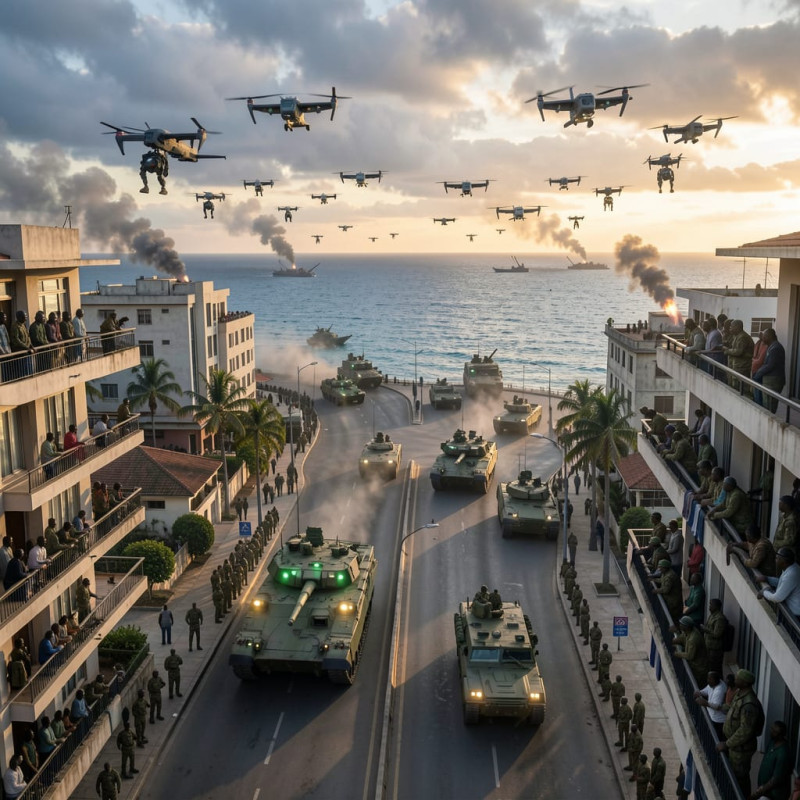
The first NATO victory of the African War was the product not of grand alliance planning but of rapid decisions taken by commanders already on the scene. The overthrow of President Faure Gnassingbé's pro-Russian government in Togo aligned closely with the objectives established by NATO's African Security Working Group during emergency consultations held in Brussels in March 2020. The operation relied primarily on forces already present in West Africa and sought to eliminate Russia's most important political foothold on the Gulf of Guinea. More significantly, it targeted the Russian-operated communications and surveillance complex outside Atakpamé, a facility that linked Moscow's African command network with allied governments, military contractors, orbital reconnaissance assets, and naval forces operating throughout the Atlantic approaches.
The initiative for action came not from NATO headquarters but from officers stationed in the region. Intelligence gathered by British, Indian, and American surveillance platforms indicated that Russian advisers had begun expanding their presence inside Togo while accelerating the deployment of advanced air-defense systems, mass-driver batteries, and long-range communications equipment. The prospect of allowing the network to become fully operational alarmed military planners in Accra, Abuja, and London. Although contingency plans for intervention had existed for years, they had been written for conventional peacekeeping scenarios and assumed lengthy diplomatic preparations. None anticipated the speed with which the strategic situation deteriorated during the spring of 2020.
Responsibility for the operation ultimately fell to an Anglo-Indian task force assembled from units already deployed across West Africa. British rapid-reaction formations based in Ghana were joined by Indian airborne and special operations elements flown in through alliance transport corridors. Their mission was straightforward: secure Lomé, neutralize Russian military infrastructure, remove the Gnassingbé government from power, and install a provisional administration before Moscow could react. NATO commanders understood that delay favored Russia. Every week, the number of Russian advisers in-country had strengthened the defensive systems protecting the communications complex.
Many senior officers urged caution. The Russian facilities were protected by modern integrated air defenses, electronic warfare systems, and locally recruited security forces. Some feared that a failed intervention might transform Togo into a permanent Russian bastion on the Atlantic coast. Others argued that speed itself was the key to success. Ultimately, the latter view prevailed. In late May 2020, supported by stealth aircraft, drone swarms, orbital reconnaissance, and Royal Navy assets operating offshore, Anglo-Indian forces crossed the frontier. Their objective was not territorial conquest but the destruction of a strategic node whose value to Russia far exceeded the size of the country in which it was located.
Events on the ground rapidly outpaced the deliberations taking place in Brussels and London. The 1st Battalion, Royal Gurkha Rifles, already forward-deployed in Ghana as part of a British-Indian rapid reaction force, entered a heightened state of readiness in May 2020, days before NATO formally approved intervention. Its commander shifted the focus of deployment from regional security operations along Ghana's northern frontier to offensive preparations aimed at Togo. Elements were concentrated near Ho and Aflao, while Indian airborne units and British special forces quietly assembled at forward staging areas. Across Togo's eastern frontier, French forces in Benin made similar preparations, largely unaware of the precise timetable developed by their allies. The speed of the Anglo-Indian mobilization owed as much to a desire to prevent unilateral French action as it did to the strategic importance of the Russian-backed facilities deeper inside the country.
The prospects confronting the Togolese government were not encouraging. Togo was geographically exposed, its narrow territory bordered by NATO-aligned states on every land frontier and vulnerable to blockade from the Gulf of Guinea. Although Russian advisers had helped modernize portions of the country's security apparatus, the armed forces remained modest in size and heavily dependent upon external support. The government possessed a limited number of air-defense systems, drone units, and armored vehicles, but lacked the manpower and infrastructure necessary to withstand a sustained NATO offensive. President Faure Gnassingbé was abroad when the crisis reached its climax, leaving much of the immediate response to senior officials in Lomé. In an effort to avert conflict, his deputy—Prime Minister Komi Sélom Klassou, still one of the regime's most influential figures, approached neighboring governments with proposals for neutrality and guarantees that Russian personnel would not use Togolese territory for offensive operations. The appeals found little sympathy. By then, NATO commanders had already concluded that the Russian communications network, not Togolese intentions, was the real issue, and the decision to act had effectively been made.15Please respect copyright.PENANAXpVZ5p1cK6

Klassou's proposal rested neither on international law nor on any formal treaty obligation. Instead, it appealed to the practical interests of all parties involved. Togo occupied a strategically important position on the Gulf of Guinea, serving as a commercial gateway for much of West Africa. British, French, Indian, and American firms remained deeply invested in the country's ports, telecommunications networks, and transportation corridors despite the growing Russian presence. Lomé's leadership argued that turning Togo into a battlefield would damage regional trade, disrupt energy supplies, and destabilize neighboring Ghana and Benin. Yet Klassou's appeal rested less on economics than on concerns about the survival of his government. The administration understood that much of the population regarded NATO far more favorably than the increasingly unpopular Russian advisers and security contractors operating inside the country. Thus, instead of exploiting NATO's vulnerabilities, the neutrality proposal highlighted the alliance's strengths. The prospect of intervention was viewed by many Togolese not as an occupation but as liberation from a government increasingly dependent upon Moscow.
NATO commanders interpreted the offer accordingly. Rather than viewing neutrality as a credible solution, intelligence analysts regarded it as evidence that the Togolese government lacked confidence in its own ability to resist. Satellite reconnaissance, drone surveillance, and signals intercepts confirmed that Russian communications facilities remained operational and that military advisers continued directing portions of the country's security apparatus. To planners in Brussels and London, Klassou's proposal appeared less an act of independence than an attempt to buy time for Russian reinforcements. The decision was therefore made to proceed.
Lieutenant Colonel Arjun Thapa, commanding the 1st Battalion, Royal Gurkha Rifles, displayed the sort of operational initiative more commonly associated with earlier frontier campaigns, advancing preparations for intervention before the final diplomatic exchanges in Brussels and London had run their course. Without waiting for the slower machinery of NATO consensus to finish its deliberations, British and Indian reconnaissance teams crossed into Togo from staging areas near Ho and Aflao. Simultaneously, French forces prepared to advance from Benin. Their primary objective was not Lomé itself but the Russian-operated communications and sensor complex near Atakpamé, whose quantum-encrypted relay stations linked Russian forces throughout Central and West Africa.
On the morning the operation commenced, NATO aerospace assets established dominance almost immediately. Carrier-based strike aircraft over the Gulf of Guinea disabled Togolese air-defense radars, while swarms of autonomous reconnaissance drones mapped defensive positions in real time. BEMP-equipped infantry units, supported by laser tanks and mass-driver artillery deployed in Ghana, advanced rapidly along the main transportation corridors. Resistance proved sporadic. Several government garrisons abandoned their positions without fighting, while others surrendered after their communications were disrupted by electronic warfare attacks.
The decisive action occurred outside Atakpamé. Russian advisers and loyalist forces attempted to hold a defensive perimeter around the communications complex, supported by automated gun systems and drone batteries. However, the defenders found themselves under simultaneous pressure from advancing Gurkha units, Indian airborne forces inserted by tilt-rotor transports, and French mechanized columns moving westward from Benin. Jetpack-equipped reconnaissance teams bypassed roadblocks and identified weak points in the defense, enabling precision strikes against command nodes. By the second night of the campaign, Russian personnel had begun destroying sensitive equipment and data archives.
The fall of Atakpamé effectively ended organized resistance. Before withdrawing, Russian technicians demolished key sections of the communications facility, rendering much of the infrastructure unusable. Nevertheless, NATO forces captured substantial quantities of equipment, encrypted servers, drone-control systems, BEMP rifles, and stockpiles of advanced munitions. More importantly, they secured extensive intelligence regarding Russian operations throughout Africa. Although fighting elsewhere on the continent would continue for years, the campaign's principal strategic objective had been achieved within days.
Klassou's government collapsed soon afterward. Like von Doering a century earlier, he had concluded that further resistance offered little prospect of success and substantial risk of destruction. Faced with converging NATO forces, uncertain domestic support, and the withdrawal of Russian assistance, he chose surrender over a prolonged insurgency. His failed bid for neutrality and his rapid capitulation were ultimately expressions of the same reality: the government recognized its weakness long before its opponents did.
15Please respect copyright.PENANAt5Xq1nMMcC


 and then Add to home screen.