

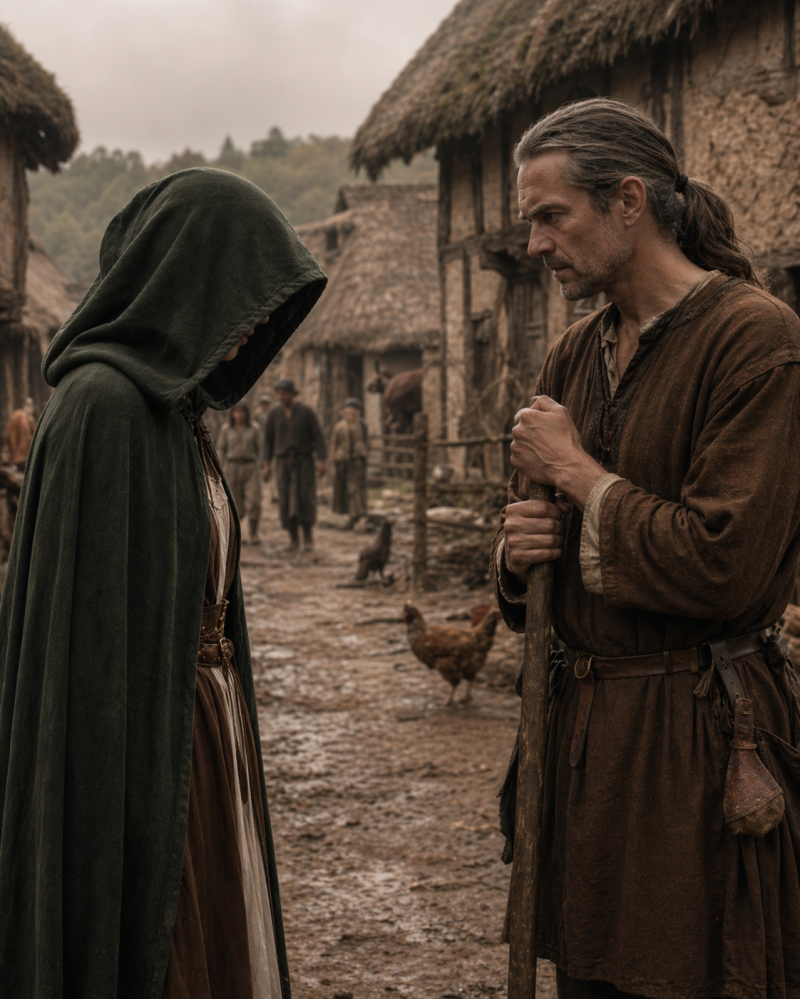
A fine rain hath fallen since the eve before, making the earth soft and clinging beneath Aloïs’s shoes. A well-known scent greeteth her as she draweth near unto one of the hamlets of Terlaze. Long hath she wavered, yet she knoweth she shall have need of a true ally at her side for the assault.
The young woman hath reported her findings unto the provost. She showed him the place of the house, on the condition that she might join him in the taking of these thieves. The bargaining was no easy matter, for Raoul remaineth what he is—a rigid officer of the law. Yet Aloïs yielded not.
And yet, to find herself alone with Raoul and his guards giveth her little comfort. She expecteth not that Yvain should take up arms. But a man—he may. And though he hath already done much for her in times past, she hopeth he will again consent to fight at her side.
As she draweth near unto the houses, disguised as a leper, she discerneth a familiar figure deep in speech with one of the peasants and the smith. The road-warden hath remained the same all this while, since that night when he came unto the gates of the abbey with Enguerrand and Belle to set her free. His hair hath whitened somewhat at the temples, yet his features are unchanged, with his long nose and high brow. His beard hath grown fuller, yet his form seemeth leaner. He marketh her not and continueth speaking.
Aloïs setteth her mask aright and goeth forward, stooping low. At last Jehan turneth toward her and leaveth his two companions. Aloïs can see naught but the lower part of his face and his breast, yet she guesseth his look—wary, yet curious.
— What bringeth thee hither, old woman?
The young woman holdeth forth her hand, half hidden by a mitten.
— I come to seek alms from good folk.
Jehan putteth hand to his purse, but she stayeth him, taking again her natural voice.
— Yet above all, I come to seek an ally.
She straighteneth and lifteth her hood a little. Jehan’s eyes meet hers and widen. Then a smile fixeth itself upon his lips.
— I feared to see thee here again one day…
Aloïs biteth her lip, somewhat troubled to endanger all the efforts the road-warden made to save her.
— Yet… I think I hoped for it also.
The young woman holdeth Jehan’s gaze, whose intensity abateth not. He lifteth his chin toward the villagers.
— Better not to linger here.
He leadeth her unto his dwelling and bringeth her within. The house, though modest, hath two stools, a bed, and a few nails in the wall where garments and tools of daily use are hung. The embers yet glow in the hearth at the centre of the room.
— It is far from the likeness of a castle.
— It needeth not be. I am glad to see thee again and to thank thee once more.
The road-warden turneth his head aside.
— I could not leave thee to waste away in that abbey.
— Thou knowest me well enough to know I should not have endured long in such confinement.
— I know thee well enough indeed…
A certain disquiet passeth through the man’s eyes, and Aloïs turneth to draw nearer unto the hearth sunk into the ground, above which a cauldron hangeth. Jehan sitteth after offering her a seat.
— I have perhaps no right to ask this of thee, confesseth the young woman, yet I have need of thee again.
Jehan frowneth.
— And how?
She telleth him of the latest events and of Raoul’s design to lay hands upon the thieves.
— The assault is set for the morrow.
Jehan riseth and taketh a few steps.
— And how many shall we be?
— Some twenty. The aim is to take as many of these criminals as may be.
— The chief among them?
— The chief among them…
He fixeth Aloïs with a thoughtful gaze.
— Wherefore art thou here?
— I have but now told thee: I had a request to make of thee.
— Nay, I mean—wherefore hast thou returned unto Anjou?
The lady’s mouth parteth as she keepeth her gaze upon him. Jehan lifteth his chin.
— Thou seekest vengeance.
The young woman presseth her lips, whilst the road-warden sigheth. Aloïs riseth and dusteth her cloak, in unrest.
— If thou wilt not come with me on the morrow, I shall not blame thee.
She turneth and goeth toward the door.
— Knowest thou wherefore I helped thee to flee?
Aloïs halteth and turneth toward the man, who hath not moved.
— I helped thee because from the first day I beheld thee, I knew I could give my life for thee.
The young woman’s breath faileth her.
— Believe well that this is no want of respect, but the contrary, saith the road-warden.
Jehan standeth upright, and upon his face is writ all the truth of his words.
— Thou didst not deserve to be so treated. Thou didst not deserve to be punished for a crime thou didst not commit. And thou wouldst have aided any in like manner, hadst thou believed in their innocence.
The road-warden continueth in a lower tone.
— Thou art one of true heart, and that is what I admire.
— I too have my secrets.
— We all have them. I deem that if they serve to uphold just values, then are they but tools in the service of good.
— I like thy manner of seeing things.
The road-warden smileth in return.
— Thou mayst count on me on the morrow.
The words of Jehan fall as balm upon Aloïs’s wounds. A great relief followeth them.
— I thank thee… To know thee at my side in this battle meaneth much to me. Meet me at vespers before the cross upon the road of the quarrymen.
— I shall be there.
Jehan boweth before the young woman. She giveth him a last smile ere drawing up her hood and departing the house.
*
The men have encompassed the house, sheltered by the trees that ring the thieves’ lair, their faces masked—both to know one another and to avoid mistaking friend for foe, and above all that Aloïs may take part in the fray without risk of being known or marked.
Belle hath remained with Yvain at the tavern. The young mistress yielded not to the child’s pleas: this time the danger is too great for her to follow.
At the appointed hour Aloïs met Jehan, and together they made their way unto Raoul’s band, set at some distance from the house. She then led them quietly unto the thieves’ refuge.
Night fadeth slowly, whilst a mist hath settled upon the sleeping fields. The cry of a cuckoo soundeth through the wood. Jehan remaineth beside her, crouched low. All await the signal of the provost. The man meaneth to take them without battle. Aloïs believeth it not, yet Raoul would hear none of it: as an officer of the count, he must follow the law.
She marketh the soldiers about her. All stand ready, loyal unto their provost and the king. The young woman feeleth a kind of pride to be thus among them. She can almost understand what Baudouin feeleth when he goeth to war beside his lord.
A whistle draweth her gaze toward the house. Two men keep watch. One hath gone toward a thicket and now calleth unto his fellow.
At that moment Raoul cometh forth from the trees, two soldiers at his side.
— I am the provost of Angers, and I command thee to yield.
The two guards draw their swords. One crieth aloud. At once their fellows issue from the house. They are more than ten in all, counting the two warders. Aloïs layeth her hand upon the hilt of her weapon.
He whom Yvain followed two days past appeareth in turn and standeth before the provost, who hath not stirred despite the daggers levelled at him. His soldiers likewise have not moved, still hidden in the wood, awaiting the signal Raoul must give.
The man who seemeth chief sweepeth the land with his gaze. Aloïs can scarcely hear his words, yet understandeth he demandeth of Raoul the cause of his coming. Words pass between them, unheard. Suddenly the man draweth back, unsheathing his sword. Raoul giveth the cry all await.
Aloïs heareth then the sound of steel drawn from the scabbard. All the soldiers rise in one motion and rush upon the house, ready to meet the outlaws in single combat, taking them unawares. The lady springeth forward, weapon raised, ready to strike. She meeteth a first brigand, whom she woundeth in the leg with a swift blow. Another man assaileth her. She swerveth aside, then wardeth a fierce stroke. Their blades clash. She feeleth the weight bear upon her arms. Suddenly she shifteth, breaking the pressure; her foe stumbleth, carried by his own force. Aloïs turneth and setteth her blade in his path, wounding him in the arm.
Jehan on his side fighteth one of the enemies. The lady would go to aid him when another standeth before her. She draweth back, knowing him—the man who stole Belle’s portrait, he who led Yvain unto this place. He too seemeth troubled.
— Thou?
Aloïs kniteth her brows. The man clench eth his jaw, anger burning in his cheeks.
— I should have slain thee when I had the chance.
The memory of her abduction returneth at once. He who struck her standeth before her. She knoweth again that imposing form, and that voice…
The assailant lifteth his sword to strike. The young woman moveth at the last instant and draweth back, yet feeleth her flesh part beneath her sleeve. She holdeth back a cry and setteth herself anew to attack.
Rage seemeth to guide her enemy’s blows, and she findeth it hard to withstand him.
Fear seemeth to creep into her soul and slacken her reflexes. The anger she deemed the stronger is overcome by the dread she felt erewhile, alone and shut within that chamber at the mercy of this criminal.
She swerveth aside once more, yet borne by her own motion, she falleth backward. He cometh toward her, almost taking his leisure, a wicked smile upon his lips.
— I should not have hearkened unto the master. Yet I may still amend mine error.
He draweth back his arm, ready to slay her. Aloïs cannot stir, frozen, unable to make the least motion. The sword is raised above her.
Suddenly the man standeth still, his mouth wide open, his eyes void.
A stain of blood appeareth upon his breast. The point of a blade hath burst forth from his chest ere it is drawn back. The man falleth at Aloïs’s feet, and she shrinketh yet further away. One of Raoul’s guards standeth before her and holdeth out his hand.
— Up, if thou wouldst not die.
The young woman casteth a last glance upon the corpse and riseth, aided by the man-at-arms. He turneth again to assail the remaining thieves. Aloïs gathereth herself and once more striketh down one of the outlaws. Little by little, the clash abateth, and the din of battle fadeth.
The cries of the victors soon drown those of the vanquished. The wounded are gathered before the house. Some men have been slain—only among the enemy. Aloïs returneth unto her tormentor, now harmless. Jehan cometh to her side and casteth a glance upon the dead man.
— Wilt thou be well?
— I think…
His brow furroweth.
— Thou art wounded!
Aloïs lifteth her arm. Dried blood covereth a wound of no great hurt.
— I shall live.
Raoul calleth his soldiers. Aloïs and Jehan go toward the house.
— We have found a number of stolen goods. It seemeth their deeds have begun anew of late. We have enough to bring them before the count’s court!
A light of satisfaction shineth in the provost’s eyes. Aloïs had not thought the man capable of such feeling.
Whilst the guards take up the spoils, Aloïs draweth near unto Raoul.
— We have not taken the master, I deem.
— Mayhap not. We must be certain he is not among the dead.
The young woman’s gaze falleth upon parchments that the road-warden holdeth.
— Are these writings part of the stolen goods?
A strange light gleameth in Raoul’s eyes.
— Not wholly…
Aloïs’s brow kniteth.
— Then what are they?
Raoul setteth the document beneath his arm.
— Thou shalt know soon enough…
ns216.73.217.114da2


 and then Add to home screen.