

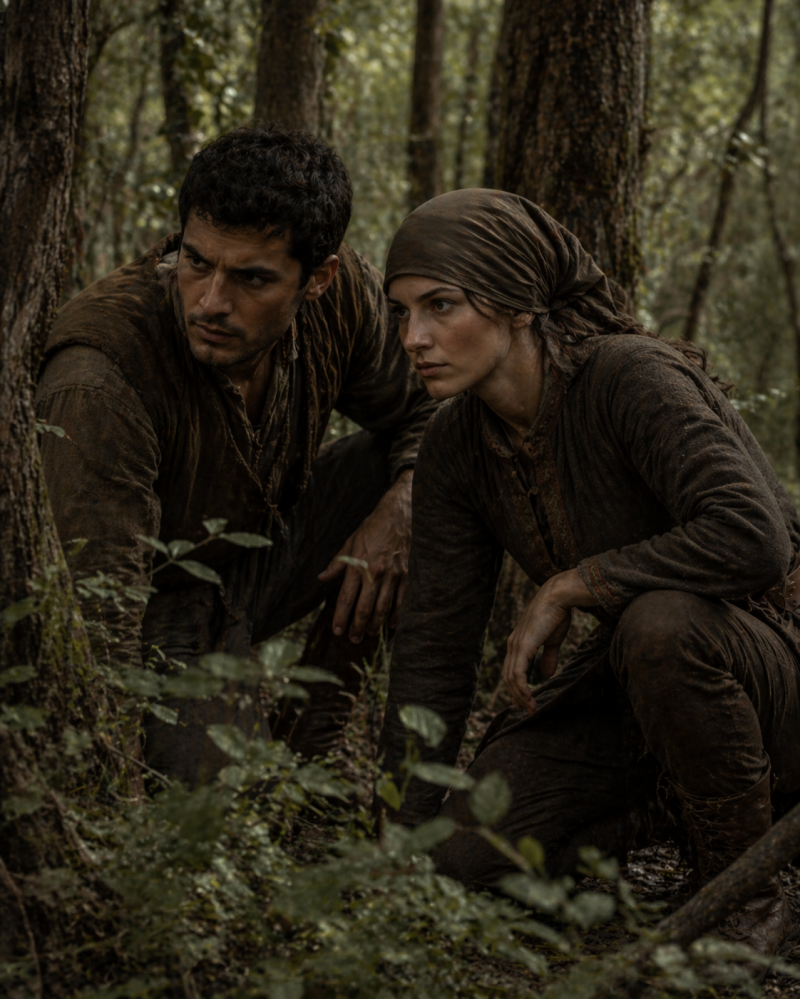
Yvain maketh sign unto Aloïs to stoop. The young woman croucheth beside the servant, hidden behind a tree. Before them a timbered house of fair size riseth in the midst of a small clearing. Might this be the place where the thieves held her captive? Or mayhap these men have many lairs. She could discern naught of this house, save that chamber wherein the stolen goods were gathered.
Aloïs leaneth upon her staff. She hath donned her male attire, which failed not to astonish Yvain; yet for once he held his tongue.
At dawn he had guided her unto the place where the man he followed yester eve had halted. Guards seem to keep watch about the house—a place that at first glance appeareth forsaken, yet for the presence of these men.
— Yester eve I counted five fellows, other than these.
Aloïs counteth five anew, which bringeth their number unto ten.
— It is vain to think to enter, saith the young woman in a low voice. Others may be within.
The guards set about the house all wear the same dark garb and bear daggers and spears, and some have swords at their sides.
— They have fair weapons, noteth Yvain.
— Which meaneth that the man we saw yester eve is not of necessity their chief. If all may bear such gear, it signifieth they are wealthy—yea, very wealthy.
The sound of horses compelleth them to crouch yet lower. Two riders halt before the house and dismount, bearing upon their shoulders sacks of some weight. Companions take their mounts in hand, whilst they bow before a man of stiff bearing.
— The one from yesterday, whispereth Yvain.
One of the riders openeth his bundle and draweth forth an object that gleameth in the sun. The lady knoweth it for a kind of chalice.
— Gold? asketh Yvain.
— I deem we have seen enough. Let us depart ere we be marked.
The two withdraw warily and gain sufficient distance to return unto a common pace.
— My lady, I think we may not go there with but the two of us, saith Yvain. The little one counteth not among armed strength.
— Nay. I have no intent to assail this band alone. Yet this giveth me a further advantage to go and meet the provost.
Yvain sigheth.
— I told thee, saith he in disquiet, I have heard naught of him. We must not draw near.
— And wherefore? If he be honest, he might aid us.
— But thou knowest not…
Aloïs falleth silent.
— And he is a friend to Sir Baudouin. He might tell thy husband thou art not beneath the earth.
— Raoul will seek to preserve Baudouin, of that I am certain. Yet to reveal my presence would set his friend in peril; he will not act thus. Moreover, we are no longer wed, since I am dead.
— Thou lookest not to me as one dead…
Aloïs casteth upon Yvain a deadly glance.
— And thou hast yet not learned to hold thy tongue.
— God hath given it us that we may speak what we think.
— Thou needst not utter thy thoughts that they be known. They show themselves in thine eyes.
Yvain toucheth his eyelids, thoughtful, then shruggeth. They return swiftly unto the inn, where Belle awaiteth them in the chamber. The servant recounteth unto her what they have seen, whilst Aloïs passeth behind a screen to change her raiment.
— Then it would mean ye have found the thieves, saith the child with eagerness.
— Let us not claim victory too soon, tempereth Aloïs. It is but a possibility. We shall see what the provost deemeth of it.
Belle exchangeth a silent look with Yvain, who shruggeth, wearied.
— Ye mean to meet Sir Raoul? asketh Belle in wonder.
— Aye, for he alone may help me learn who hath ensnared me… the more so if it be he himself.
— But if thou suspectest him, why cast thyself into the wolf’s jaws?
Aloïs cometh forth, clad once more as a leper.
— Because I shall face him in a place where I shall have the advantage.
114Please respect copyright.PENANApzOiE95xZM
*
114Please respect copyright.PENANAZek8d8d30s
Aloïs spendeth the rest of the day without the inn, informing neither Belle nor Yvain of her designs. She deemeth it better to keep them apart from this matter, for she knoweth not how the provost shall respond if she be driven to reveal her true identity.
From the moment she set foot again in Anjou, this meeting hath become her obsession. Seek as she might, Aloïs seeth no other thread to follow whereby she may learn what truly befell on that day of February when her life turned unto nightmare. She must know who betrayed her: the vicar? Raoul? Some unknown man? But who? The thought that Baudouin himself might have contrived this snare to hinder her from pursuing her deeds once crossed her mind in a moment of despair. Yet she cannot bring herself to doubt the feelings he hath shown her. He would not trifle with his wife; there is no cause.
But then—who?
Aloïs wandereth near the castle and innocently questioneth certain servants overmuch given to speech. She soon obtaineth the tidings she seeketh.
The evening seemeth endless unto her, the more so as Belle ceaseth not to question her. The child, in growing, hath gained a certain shrewdness and knoweth her mistress so well as to divine her plans ere they be spoken. Yet this time Belle shall not go with her—nor Yvain.
At early dawn, Aloïs stealeth from her bed in silence, waking not Belle. She hasteneth forth from the inn as the sun scarce breaketh the horizon. The young woman goeth up toward the castle to leave the city, then maketh her way unto the lists near the village of Esvière. She learned the day before that Raoul cometh thither at dawn to train—without any guard.
At that hour, naught but rabbits share the place. Aloïs setteth herself near the ramparts and waiteth. Time passeth, yet the place remaineth empty. Doubt creepeth upon her. Mayhap she misunderstood; mayhap the provost hath been stayed by some other need.
Aloïs findeth the waiting hard to bear—a waiting of more than three years. To know herself so near unto him who may hold the answers to her questions, and yet be unable to speak, is beyond endurance.
Suddenly, a shadow draweth near unto the abandoned field. Aloïs knoweth at once the tall form of the provost. She draweth up her hood; her cloak hideth her man’s attire and her weapon. The young woman fasteneth her mask. As she goeth toward him, Raoul turneth sharply, his hand upon the pommel of his sword.
— Who goeth there?
Aloïs standeth still and taketh the same voice she used with Baudouin.
— I come to bring thee tidings of the thieves thou seekest.
The provost draweth near unto the young woman.
— Wherefore comest thou hither and not unto the castle?
— I am a former leper. None would come near such in a city.
The man seemeth troubled.
— Art thou she who gave testimony unto Sir Baudouin?
— Aye…
— And now thou hast somewhat to tell me of these thieves. Thou seemest well informed for one who may not consort with others. I fear not scarred faces, and I would fain see thine.
— I came not to show my scars, but to bring thee knowledge. Yet I too would learn certain matters which thou alone possessest.
Raoul foldeth his arms upon his breast.
— Thou wouldst have me give thee tidings? saith he with mockery. And of what?
— I would know who warned thee of the presence of a thief in the church of Saint-Lézin three years past.
This time the provost laugheth no more.
— Wherefore desirest thou this?
Aloïs removeth her mask, then lifteth her hood, setting her father’s sword beneath the man’s chin.
— Because I have the right to know the name of him who hath ruined my life.
Raoul’s eyes open wide.
— Thou?
Aloïs presseth the blade more firmly, wrath filling her heart.
— I may bring thee my aid, yet I may also slay thee here, with none to come to thy help, as befell my father, who died of grief through thy doing. God shall forgive me for seeking to avenge him.
— I had no part therein. I did but my duty.
— I am no thief.
— I know it.
— Then tell me who warned thee. If this be no falsehood…
Raoul lifteth his head, his countenance yet unmoved despite the blade at his throat.
— The woman slain some days past.
Aloïs starteth.
— Claude?
— Thou art far better informed than I of her identity.
Raoul layeth a finger upon the sword and gently presseth it downward.
— Aloïs, I am in truth grieved for all that hath befallen thee, and the more so to have witnessed the sorrow of my friend, who deemed thee dead. But wherefore didst thou vanish, being innocent?
She casteth upon him an angry look.
— Doubtless for fear that he who laid this snare for me would not rest content with it and would seek to rid himself of me utterly. It is easier for one thought dead to make inquiry without dread.
He maketh a gesture of accord.
— If I understand aright, saith Raoul, thou and I each hold a part of the whole that might reveal both those who have wrought these crimes these many years and those who have wronged thee.
— It remaineth to be seen whether I have not already found them.
Raoul narroweth his eyes yet more.
— Thou hast cause to doubt me. Yet I deem there is but one way to prove my good faith.
Suddenly he sweepeth aside Aloïs’s wrist, forcing her to loose her weapon, and seeketh to cast her down; yet the young woman regaineth her balance and wardeth off his blows. Raoul evadeth a stroke and seizeth the lady’s arm, holding it fast behind her back. She restraineth a cry of pain, unable to move.
— Now then, I have two courses before me: either to release thee and aid thee in taking these thieves, or to bring thee unto the castle and arrest thee. In the first, I stand with thee; in the second…
Aloïs striveth to free herself, but in vain. Slowly she feeleth the pressure upon her arm lessen, and she turneth to face him. Before her, Raoul hath resumed his cold bearing.
— My sole desire is to bring an end to the deeds of these men and to see these brigands hang by the rope.
ns216.73.217.114da2

 and then Add to home screen.