

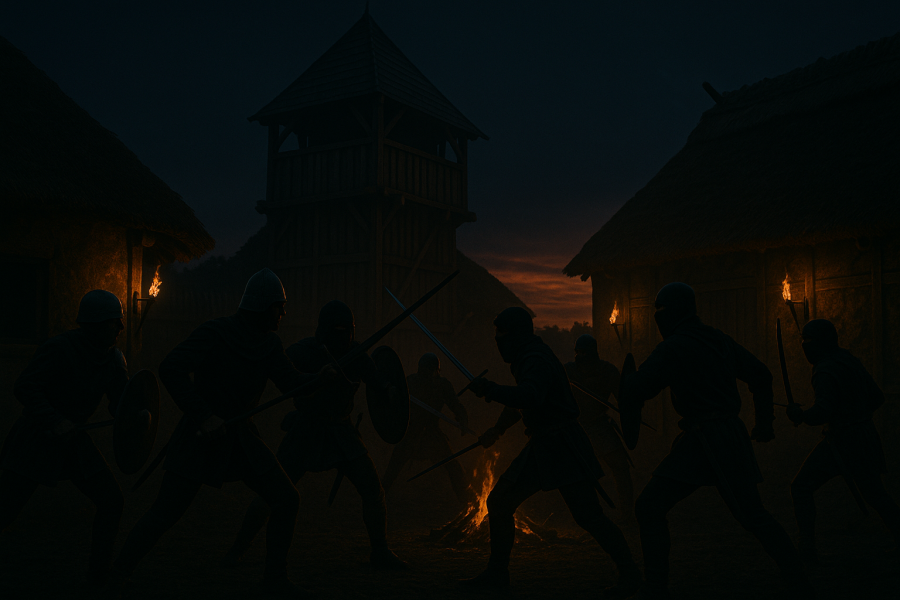
Pain claspeth her head and crusheth her whole body, so that the least movement is hard to make. Aloïs openeth her eyelids. She lieth upon the ground, upon the beaten earth of a dwelling. Sacks and sundry goods are heaped beside her. Where is she?
Memories return slowly: the castle, the snare laid for the thieves, that man who fled, and her meeting with his fellows upon the road. She seeketh to rise, yet her hands are bound behind her back. With great effort she sitteth up, and can but imagine the bruises that cover her legs. Sunlight filtereth through the chinks of the walls. Footsteps sound beyond the door.
A masked man draweth near. Aloïs striveth to draw back and presseth herself into the corner of the room. The man letteth out a short, harsh laugh and thrusteth her down. Then dealeth he a grievous blow unto her belly. Her breath is cut off. He striketh her again upon the legs, upon the back.
— A woman meddling in what toucheth her not—I have never seen the like. We shall teach thee a lesson…
Her assailant bendeth to drag her upright by the hair. Fear gripeth her, and she remaineth frozen before this looming form. He lifteth his arm and smiteth her sharply across the face. A thin stream of blood floweth from her mouth. A taste of iron spreadeth upon her tongue. The urge to cry out waxeth strong, yet vain—none would come to aid her. The silence about her telleth that she is in a lonely place.
Her tormentor bendeth toward her and lifteth a lock of her fair hair.
— I would have taken some pleasure of thee, yet we must first leave thee unto the master.
He riseth and falleth upon her with blows, seized by sudden wrath. Aloïs beginneth to long for an end: that she might die, or that he might weary—but that this torment cease.
He striketh her once more with such force that she falleth heavily upon her side. Aloïs striveth no more and sinketh again into darkness.
When she cometh back from the void, her tormentor is gone. Her body is but a heap of wounds. She suffereth so sorely that she can scarce draw breath. Yet she manageth to sit. The murmur of voices telleth her that men be in the next room.
Night hath fallen. How long hath she lain senseless? The shadows cast by lamplight flicker upon the walls she glimpseth through the half-open door. Aloïs striveth to gather her wits. The ever-present pain hindereth her from grasping clearly what passeth about her. She draggeth herself toward one of the sacks and seeketh to learn what it containeth. If she might find aught to cut her bonds, she could attempt escape. It is doubtless her sole chance to leave this place alive—to flee and to live.
Beyond, there is a stir. The men have fallen silent. Would that they come not into her cell. She prayeth God to grant her time to flee. If they lay upon her another torment, she would surely perish.
A shadow appeareth in the doorway. Aloïs lowereth her eyes, dazzled by the light of a lamp. Her gaze falleth upon her garments, stained with blood—her blood… The man draweth near. The young woman curl eth upon herself, hoping to lessen the pain. The stranger croucheth. He weareth a mask, a broad hat, and the cloth of his bliaud is of fine making.
— We deemed it better to await you, to learn what you would have done with her, saith one of the thieves standing by the door. She hath crossed us twice.
With effort, Aloïs lifteth her head. Her sight groweth dim. Her lips are dry and cleave together.
Their master bringeth forth a flask and giveth her to drink. The young woman letteth the liquid flow into her mouth and down her throat with a pleasure she hath never known. She closeth her eyes. A tear runneth down her cheek.
The man riseth, turneth toward his two fellows, and answereth in a low voice, muffled by his mask:
— I call not this waiting for me. Ye know not whom ye have mishandled!
Aloïs can scarce discern his words through the mist that seeketh again to enfold her. Yet the tone is stern. She striveth to remain awake.
The other two seem troubled.
— We thought it a young boy. Seeing it was a woman, we deemed you might wish to take your pleasure…
The man turneth toward Aloïs. He causeth her to lean, cutteth her bonds, and looseth her wrists and ankles. Aloïs sinketh back, yet her fall is stayed by a strong hand that guideth her gently to the ground.
— I would not have it thus…
Aloïs heareth not the rest. She falleth into a strange sleep, wherein Baudouin speaketh unto her. She seeketh to explain her deed, her resolve to set this snare, yet he seemeth not angered. She draweth near her husband and beholdeth upon his face the marks of blows. Yet he smileth still. Aloïs would call to him, but the words she formeth bear no sense. Then she seeth upon his side a red stain—the same stain as upon the monk’s garment.
Aloïs draweth back, stricken with horror. Is Baudouin dead? Shall he not return? If all this be true, she hath no cause left to strive. The young woman taketh a step back and feeleth the ground give way beneath her feet.
93Please respect copyright.PENANACvSDIOFp7I
Baudouin rideth slowly along the road, lulled by the steady pace of his palfrey. Mars, his destrier led by a cord, snorteth, wearied by the journey. Other men-at-arms follow behind, no less eager to return. Yvain goeth just after his lord, more silent than is his wont.
The young knight reineth in his mount and turneth to speak unto his servant.
— Art thou not talkative? I had thought that thy return unto our home, as thou didst tell me, would have loosed thy tongue.
Yvain draweth a faint smile.
— Aye, sire, I am glad to return…
— But… there is ever a but.
— But we shall soon depart again…
— Wherefore sayest thou so?
— The count hath warred against his brother and the king of France. Yet what he desireth is England. And he hath need of men, such as thou…
Baudouin holdeth his peace. Henri must needs hope soon to seize the throne of England. His quarrel with King Louis hath but delayed his designs. Yet now, with concord restored with Geoffroy, his younger brother, and peace more or less made with his sovereign, the count shall seek to renew his campaigns.
— We all fulfil our duty.
— I understand… Yet thou hast also thy lands.
— My lands, thou meanest.
— Aye!
Baudouin falleth silent. The matter spoken of some weeks past by Henri, touching the thefts upon their fiefs, hath not ceased to trouble him. Hath his castle been assailed by these men? Hath Enguerrand kept mastery of the domain? If Aloïs were harmed, he could not endure it.
— And thy wife shall be glad also to see thee again, addeth Yvain.
— What maketh thee say so?
— The lands, they be much labour.
Yvain’s words draw Baudouin into thought. To imagine that Aloïs might rejoice at his return seemeth hard to believe, though their last moments together had given sign that some bond was growing between them.
He had returned to the monastery at dawn after a night spent speaking of Henri’s plans of war. Aloïs had fallen asleep. He had watched her in the light of the rising sun. Never had he seen her thus before: calm, vulnerable, fair…
The young man had hesitated to wake her, yet had checked himself. What use had it been to rouse her? They could but have spoken farewell. It would have been but a courteous and awkward parting. And the flame within Aloïs’s emerald eyes would doubtless have faded the moment he left their chamber to be gone for many months.
At last, the ramparts of the castle of Terlaze rise before them. All seemeth still, which comforteth him. A strong desire seizeth him to set his mount at full gallop. A smile setteth upon his face as he entereth the baile, heralded by the sound of the horn.
His folk press forward to greet their lord. Baudouin casteth his gaze about the court, seeking his wife. Enguerrand cometh toward his palfrey.
— I see my domain prospereth well, proclaimeth Baudouin, and I am glad thereof. Where is my wife?
The servant boweth his head.
— Sire, I am sorry.
The lord narroweth his eyes. Once more, fear stealeth into his mind.
— What passeth?
— Dame Aloïs… hath vanished.
— Vanished? How vanished? Speak!
— Three days past, the band of thieves assailed the castle.
Baudouin’s blood rusheth to his temples.
— Dame Aloïs had gone unto the village to hide. Yet she departed thence and was taken.
Baudouin heedeth not the guilty mien of his guard.
— Have ye sought her?
— We have not ceased. The provost hath come to lend us aid. We know not where she is.
Baudouin sweepeth the baile with his gaze, as though he might discern beyond those walls the place where his wife hath been taken. He draweth upon the reins to turn his horse toward the gate.
— Whither go ye, sire? asketh Yvain.
— To find her.
— Thy horse can go no further, argueth the servant. And where wilt thou seek?
The lord clench eth his jaws.
— Saddle my wife’s mount. I shall search the countryside.
Enguerrand exchangeth a glance with Yvain, then obeyeth.
The palfrey is soon made ready. The sergeant leadeth forth his steed. The knight regardeth him with surprise.
— I go with thee, sire.
Baudouin consenteth, in truth relieved not to be alone. The two men pass out of the baile.
— I saw naught upon the road from Angers, saith he. I deem we should take toward the east.
The beasts set forth again at full gallop. Baudouin cannot conceive that his worst nightmare is even now coming to pass. An old phrase he once uttered in anger returneth unto his mind: he had sworn that ere a year of marriage were gone, Aloïs would die. It had been but idle words, spoken in the heat of passion. Bitterly doth he now repent of such a sentence.
The sun declineth slowly, and the weight of dread increaseth. How may he hope to find her here, now? Raoul must have searched heaven and earth. Baudouin’s chances be but slight.
Anguish driveth the knight to urge his horse yet faster. He scoureth the countryside, searching and probing the thickets and underwoods. Emptiness layeth waste to his heart and mind. The paths grow deserted as night falleth. The riders slacken to a trot to take a sharper turn along the woods.
— We shall take up the search again on the morrow, my lord, saith Enguerrand in a pale voice.
Baudouin clench eth his jaws. Before him, the shapes of dwellings turn slowly into ghostly shadows. A dizziness seizeth him, and he gripeth his reins the tighter.
— Sire? Art thou well? asketh the servant.
Baudouin maketh a sign of assent.
— Thou art right… We must return. We shall set forth again at first light.
The riders urge their horses at a brisk trot. The palisades of the castle show themselves upon the horizon, far too soon for Baudouin, who had yet hoped to grant himself a chance to find his wife.
The guard on watch openeth the gate, and both men dismount within the baile. Marie and Belle hasten toward them. The face of the maid betrayeth her dread. Baudouin doth but shake his head, and a sob escapeth the chambermaid.
— I shall not abandon the search, he declareth unto her.
Suddenly, one of the guards on watch calleth to Baudouin, who hasteneth toward the gate.
— Sire, someone draweth near.
Baudouin standeth at the threshold of the castle, watching the figure that showeth itself in the half-dark. The stranger, somewhat small of stature, weareth a short bliaud. The youth seemeth to stagger.
— Halt! commandeth Baudouin. Who art thou?
The figure stoppeth. His head lifteth with dreadful slowness. In a faint voice, he uttereth a single word:
— Baudouin…
The sight that then presenteth itself before the knight is as a waking nightmare. Before him, wounded and covered in blood—Aloïs.
The young lord rusheth unto his wife. Scarce hath he reached her when she falleth against him. Baudouin catch eth her in time and lifteth her into his arms. Her face beareth the marks of blows, the more stark upon her pale skin; a great bruise formeth a misshapen circle about her brow, and her split lip is swollen.
— Aloïs! Who hath done this unto thee?
The young woman striveth to meet her husband’s gaze, yet sinketh into unconsciousness, her head resting upon Baudouin’s shoulder.
ns216.73.217.114da2

 and then Add to home screen.