

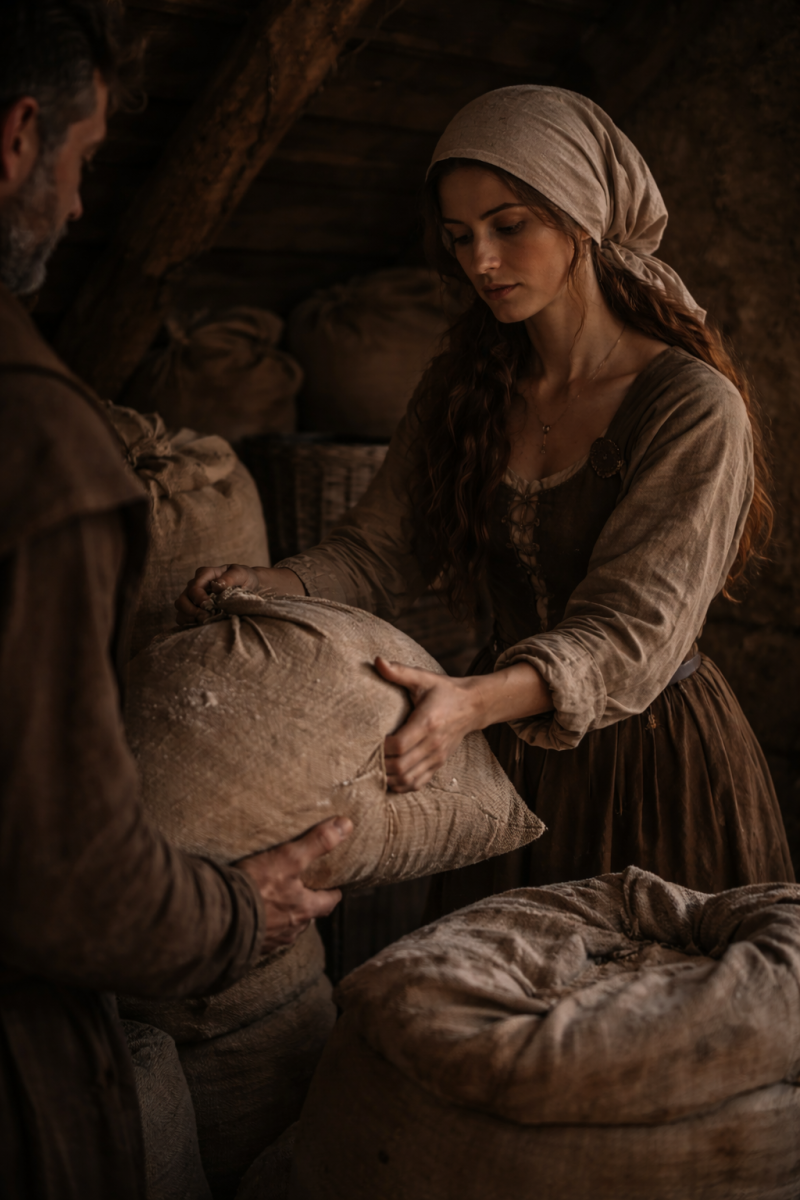
Aloïs taketh up a sack of flour and setteth it in a corner of the chamber set apart for stores. Bundles of beeswax candles lie heaped upon the other side. Set upon the ground floor of the castle tower, the place sufficeth to hold the provisions. A ladder leadeth unto the upper level, the sole passage from this enclosed space. The wooden walls letteth in the cold, and Aloïs represseth a shiver.
Rain hath fallen for two days upon the fief and maketh all labours hard. In some wise, this pleaseth her: she thinketh no more on her mother, nor on her kin. Busied with tasks and urgencies ere winter cometh, she hath no leisure to brood. And when evening falleth, she lacketh strength even to eat, and lieth down straightway when night descendeth.
The lady draweth breath and stretcheth her back as she riseth. Her loins ache her sore. She marvelleth at those men and women whose bodies be daily put to harsh trial. One of the serfs climbeth up in turn to set down his burden beside her. He straightway beateth his hands together to rid them of dust. He may be near thirty years, yet seemeth far older. A great gap showeth in his mouth where two teeth be lost, and his speech is marred thereby.
— Dame Aloïsss, ’tis not for you to d-do this.
The young woman rubbeth her hands to cleanse them of dust.
— It suffereth me to think on other things. Moreover, much yet remaineth to be done ere All Hallows. And night shall soon fall—this is no hour to falter.
She setteth herself again to the work and steppeth toward the ladder to climb, when a face appeareth suddenly above. Enguerrand looketh down and starteth upon seeing her.
— I sought you. A visitor asketh for you.
Aloïs holdeth back a sigh.
— Who is this visitor?
— The voyer, my lady.
The young woman standeth still a moment. She guesseth well what bringeth him unto the castle. Yet she hath no wish to render account of her present state. She wipeth her hands.
— Very well. Tell him I come.
Enguerrand vanisheth. Aloïs draweth a deep breath, then goeth forth from the tower. She hasteth toward the lordly house, quickening her step lest she be drenched.
Jehan waiteth within the aula. Water runneth from his long hair and trickleth down his face and cheeks.
— It must needs be grave, sire voyer, that you come abroad in such weather.
— It is so, my lady.
Jehan casteth a glance toward the sergeant who standeth by the entrance.
— First, I would offer you our most humble condolences, from myself and from the folk of the hamlets.
Aloïs’s jaw groweth tight.
— I thank you…
— And… I would also know what you purpose to do concerning the attacks.
The young woman lifteth her chin, her bearing closed and guarded.
— I deem it best to await my husband’s return…
— What?
Jehan’s countenance passeth in an instant from pity unto anger. Enguerrand draweth nearer in silence.
— Sire Baudouin shall be better able to—
— Sire Baudouin is not here! Jehan crieth. And he shall like not return in time to order the ambush you had conceived. The merchants come within three days.
Aloïs’s stomach knoteth, and she layeth a trembling hand upon it to still the pain.
— I have not the means to bring such a design to pass.
Jehan regardeth her, doubtful. He steppeth closer, his head somewhat inclined, his gaze heavy with misgiving.
— I know you not thus. You are stronger than this—stronger than mourning.
— It is for that very cause that I mourn, answereth the young woman, striving to keep her voice even, and I hold that I have the right to give you such an answer.
— And I hold that beyond your grief lieth that of the folk whom you took under your guard when you received these lands.
— I have promised naught at all!
The voice of Aloïs riseth suddenly. Her eyelids be swollen with tears and remorse.
— I have made no promise, nor did I ever desire this.
The man stepeth back, his mouth agape, as though struck by a blow that her words have dealt him. He noddeth slowly.
— Then I was in error.
— Aye, you were sorely misled.
Jehan turneth away and goeth toward the door. Yet ere he departeth, he turneth once more.
— I hope the youth who once came to my aid shall prove more loyal. I shall await him.
Jehan goeth forth from the chamber. Enguerrand followeth him with his gaze, then returneth unto the young woman.
— Are you well, my lady?
— Aye. I think I shall go and take some rest.
She withdraweth unto her chamber, her heart beating fast. She will not yield to such an appeal. She hath chosen to cease playing the heroine, to cast aside her man’s attire, and to hold her rightful station. She hath achieved naught whilst clad in garments of war—why should it now be otherwise?
Aloïs lieth upon her bed, her eyes turned toward the ceiling. Without, the rain yet falleth upon the thatched roofs. The wind howleth against the shutters in a cry as sharp as that of wolves. The voices of servants calling one to another from building to building reach her, muffled.
Slowly, sleep taketh her. Night enshroudeth her. Images return unto her—images of herself as a child, when she had vowed before Baudouin to protect the weak. He too was meant for such a path. He was meant to go forth and wage war against armies. But she?
At dawn, her choice is made. She maketh ready her belongings within a basket. Marie cometh as her mistress is about to depart.
— You are already risen?
— I would go forth to walk.
The chambermaid’s gaze falleth upon the hidden bundle and upon the staff in the young woman’s hand. A strange smile, mingled of fear and joy, lighteth her face.
— I see… I know not yet what I would rather: to see you here, yet sorrowful, or abroad, yet fulfilled.
Aloïs letteth out a small, amused laugh.
— For now, all I desire is to keep my word. And for that, I must leave the castle.
Marie claspeth her hands, barely containing her excitement.
— I shall at least make ready something for you to eat. The rain hath ceased—you should be free to… walk as you will.
The chambermaid departeth with swifter step. A sense of fullness suddenly filleth Aloïs: in so doing, she fulfilleth her duty.
She taketh once more the wonted path to meet Jehan, savouring the slice of warm bread her maid hath given her, and the honey cakes besides. The clearing must be soaked through, yet this shall not hinder their training. Aloïs doneth her attire and goeth on her way.
When she cometh to the meeting place, she soon beholdeth the voyer. He sitteth upon the fallen trunk, as on the first day she agreed to come hither. At sight of her, he riseth, and a frank smile confirmeth the young woman in her choice. He standeth and boweth.
— I knew it.
— What knew you, Jehan?
— That I might place my trust in you.
88Please respect copyright.PENANAyKTrrxa2O8
— The merchants shall make halt here?
The vicar Gauzbert openeth wide his eyes. Aloïs draweth lightly upon the reins to keep her mare at a stand. The guard that attendeth her remaineth at her side. The presence of the lady of the castle draweth the gaze of the villagers. Aloïs hath passed through the nearby hamlets, feigning a wish to inquire after her folk, and thus taking the time to spread word of this coming that very evening.
— Aye, surely. They shall rest here for the night ere they go to the fair. One of the ministerium hath gone to meet them and offer hospitality. With all these plunderings that befall, it seemed to me more prudent to ensure the merchants’ safety upon our lands.
Aloïs hath not truly had sure word from Enguerrand of the travellers’ coming. The young man must yet be upon the road returning. Yet it mattereth not: whether they come or no, what mattereth is that the thieves believe it. She hopeth only that such tidings shall reach their ears. And for that, she must be certain that the greatest number be informed. The vicar’s reaction hath not gone unseen by certain onlookers standing nearby.
— I understand, Dame Aloïs, and it is most charitable of you…
A smile lifteth the round cheeks of the churchman. He joineth his hands in a sign of piety.
— Your generosity and your care do you honour. And I am sure these good sirs shall greatly esteem the fare of your kitchens… Yet fear you not an assault upon the castle?
The young woman letteth forth a short, dry laugh, striving to appear as steadfast as she may.
— Even were these men so bold, they could not pass the gate of the baile.
The vicar wrinkeleth his nose.
— These be words of comfort. The provost is doubtless informed.
— I have caused word to be sent unto him.
The churchman maketh a contrite face and foldeth his hands within his sleeves.
— I must crave your pardon, my lady, yet my duties call me hence.
— Of course, Father.
The little man boweth low and departeth at a light trot. Here is one she deemeth she shall not see again at the castle ere the merchants’ leaving—and so much the better, for it shall lighten the burden of the kitchens. Yet, after all, she cannot blame him for fearing storms against which he can do naught.
She setteth her mare in motion once more, the beast eager to quit the place. Aloïs passeth through the last hamlet and doth as she hath done in the others, then turneth toward her dwelling.
The sight of the ramparts and the tower stirreth a strange feeling within her: a mingling of resolve and pride. Baudouin hath entrusted her with the care of his lands, and she will not fail. None shall trample and violate these places—now her world, her charge—without paying the price.
She shall take these men and drag them before the count’s justice, that they may be punished as they deserve.
Aloïs passeth within the walls and yieldeth her horse unto the guard. Marie telleth her that Enguerrand is not yet returned, yet the voyer awaiteth her before the lordly house. Jehan greeteth her and boweth low. She biddeth him enter the aula.
— Dame Aloïs, I have spoken with my fellows. We shall be seven to come this night. And their families may harbour the women of the castle, as you required.
— Good. With our soldiers, we should be enough. I shall go forth from here and join you, that Enguerrand may believe me one of the men of the hamlet. We shall take our places, as agreed, within the baile. They shall doubtless seek to cross the palisades where they be weakest. We must not miss them.
Jehan draweth nearer unto the young woman.
— I deem it not a good thing that you take part in this snare.
Aloïs feeleth vexation rise within her.
— I have devised this plan, and should I flee when the fighting cometh?
— That is not the matter. The aim is that you be safe.
— I think not that, in battle, the count hideth himself.
— You are not the count…
Jehan holdeth her in his gaze.
— And what would you have me do? she crieth. Go with the women unto the hamlet?
— Aye, for example.
— Not so!
The voyer seemeth sore troubled.
— If any harm befell you, I…
Aloïs looketh upon him; he wavereth not, despite his hesitation.
— I should hold myself to blame—and I should not be alone. Sire Baudouin would reach the same judgment.
Aloïs taketh a few steps, her mind in turmoil. She cannot but be present. Yet if she standeth amidst the fray, she knoweth well that Jehan may not be wholly at ease. Moreover, another fear cometh upon her: if Enguerrand should know again the young boy he hath twice seen before, he might seek to unmask her.
— Very well. I shall keep apart. I shall go with the women and make the sergeant believe I remain there. Yet I shall return and take my place about the castle. Thus, so soon as I espy movement without, I shall warn you.
Jehan’s shoulders sink.
— I deem that a fair compromise.
The sound of hurried steps cometh to them from without. Enguerrand appeareth in turn, out of breath.
— My lady, the merchants shall indeed come hither this night…
— Dame Aloïs, are you certain of this? whispereth Marie.
The chambermaid goeth on through a dim half-light beside her mistress.
— As certain as may be…, answereth the young woman. And I pray thee, speak not a word of it.
Marie’s shoulders lift in a gesture of vexation.
— I begin to be well used to holding my tongue.
Aloïs represseth a smile. Yet she knoweth she hath sorely tried her maid’s nerves. The tension hath but mounted with each passing hour ere their departure. The village where Marie, Belle, and the other women must pass the night lieth but half a league away.
They left the castle not long after supper was set before the three merchants who had come to seek shelter for the night.
Aloïs tarried not, but feigned weariness that she might leave the travellers to their meal. Other traders had refused their offer, choosing instead to go straight unto Angers, though it meant arriving after nightfall.
The three guests shall afterward take their rest within the sheepfold, there to be safe. They know naught of the design wrought by the young lady—and perchance it is better so. The wares have been laid up within the barn, where watch hath been strengthened. Not a single sack must be stolen—of this she is resolute.
Soon the thatched roofs come into view, bringing a faint easing to the young lady’s heart. She hasteneth to thank the villagers and maketh as though to settle within one of the houses, that she may slip forth unseen after changing her garb with Marie’s aid.
The latter stayeth her as she is about to depart.
— Be wary.
— I promise thee.
Marie taketh her mistress in her arms and holdeth her close a moment ere she letteth her go. Aloïs hasteneth away in the contrary direction. She draweth near unto the castle through the wood and taketh heed not to be seen.
Set behind a great tree trunk, she croucheth low, leaning upon her staff, and marketh the ground about her.
Night hath now fallen, and shadows blend one with another. Hard it is to discern whether it be man, beast, or but branches stirred by the wind. Aloïs’s mask lifteth faintly with the rhythm of her breath, which she striveth to master. Her cheeks grow warm, and heat stealeth between her shoulders. She gripeth the wood of her weapon the tighter.
The sounds of night mingle with those that come from the baile. The merchants must now be preparing to lie down within the sheepfold.
Aloïs feeleth her heart beat within her temples and her breast. Fear stealeth slowly upon her. Hath she chosen aright? The traders, the guards, and Jehan’s men shall be in peril if her foresight prove true. Shall she bear the weight should misfortune come?
She might yet send a messenger to warn the provost and call for aid. For a moment, she thinketh to run toward the gate. But how should she explain her garb unto Enguerrand? Her secret would be laid bare. And as for the thieves, she would surely not have another chance to seize them and end their deeds.
Suddenly, a whistle cleaveth the night. Aloïs starteth upright. Before her unfoldeth a sight both fearful and strange: without the least sound, shadows have shifted to sundry points about the palisade—places where the defences be weakest. At each place of assault, a figure is lifted upon another’s back to surmount the barrier.
Then a rope is cast, that the second may climb up. They be not three nor four, but a full ten.
By instinct, Aloïs riseth and whistleth in turn, after the sign agreed upon to warn the castle that the assault hath begun. Cries ring forth beyond the palisades. The battle seemeth joined. Excitement and dread strive within her breast. The young woman runneth toward the ramparts.
Suddenly, a sack flieth over the barrier and is caught by an accomplice without. A second spoil followeth the same path.
— Hold! crieth Aloïs.
The man crosseth the ditch, heeding not her command, and regaineth the path. He turneth his head toward her, then fleeth the other way.
The lady whistleth yet again and again, but in vain. The strife rageth within. None heareth her. She hesitateth. Yet she hath sworn it: not a single good shall be stolen from the merchants.
She springeth forth upon his trail and striveth to keep in sight the shifting shadow that glideth swiftly along the wood’s edge. Soon they reach the road that leadeth toward Angers.
Aloïs keepeth pace, taking heed not to stumble upon stones that might cast her down. Of a sudden, the man swerveth and leaveth the path. She hasteneth yet more, though weariness taketh hold upon her.
Suddenly, four brigands appear from the way the thief hath taken. They stand before the young woman and bar her path. Fear riseth anew. She is alone against these men, well arrayed for combat. Her pursuit hath drawn her far from the castle, leaving her without aid. The men draw nearer.
— Who be ye? saith Aloïs.
— It mattereth not who we be, crieth one among them. Thou shouldst not have meddled in our affairs. This is the second time we meet.
The thief maketh allusion to Jehan’s rescue. Aloïs stepeth back. The other three swiftly encircle her, cutting off all retreat.
— They say thou knowest how to fight. I long to see it.
The leader foldeth his arms upon his breast. Aloïs cannot discern his features. The lower part of his face is veiled, as is her own, and the darkness hideth his eyes. As for his voice, it is unknown to her.
The lady gripeth fast her weapon. The combat is now inevitable. Her breath quickeneth.
A cry forceth her to turn. One of the men assaileth her. She escapeth the blow. Aloïs striketh him upon the back and maketh him bend. A second is already upon her. A blow upon her arm wringeth a groan from her lips. She returneth the thrust and wardeth off another. Wrath riseth within her. She shall not be cast down so easily. Aloïs defendeth herself and striketh yet again.
The foe seemeth unyielding, returning ever anew. One after the other, these thieves drain her last strength. The assault ceaseth all at once. Beads of sweat glisten upon the young woman’s brow. Her breath lifteth her mask in fits and starts. A shadow riseth suddenly behind her.
— Enough sport.
A violent blow upon her head maketh her reel. A black veil falleth over her sight as she beholdeth the men rushing upon her. Aloïs falleth, senseless.
ns216.73.217.114da2

 and then Add to home screen.