

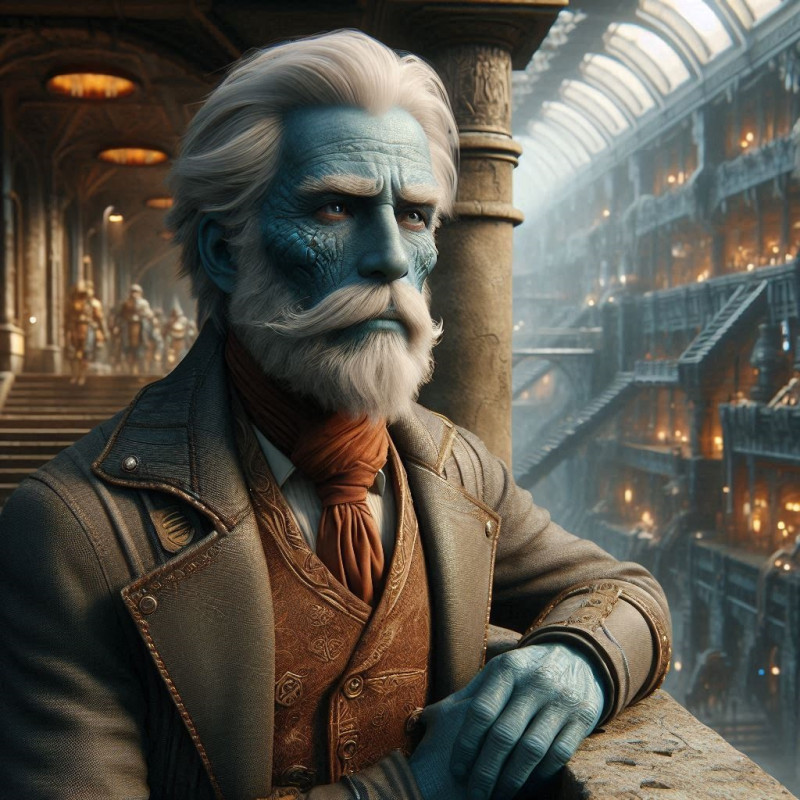
The Apollogon Archurch of Karkarus, the largest of all the capital’s twelve Archurches, lay just ahead. I had dreamed of returning to this place since I was a child. My old school. The Archurch grounds were forbidden, even back then. Tolerated by the establishment for centuries — but recently, it was not simply suppressed and marginalised, but sealed by decree of the Geotheocracy, with guards posted in shifts to ensure none but the High Faithkeepers entered. Inside lay murals and records of the Apollogon Fables; the stories of Lytheos and Apollo, of migration and disaster, of the mythical afterlife above that might have once been real.
As an adult, I had lost everything by chasing these questions. My privileges as a student, my place in the academies, the fragile safety of city life. They said I asked too much, that I gnawed at the foundations of order like a divrus at the grain vaults. And maybe they were right. But the whispers of the surface’s true nature took root in me, they grew like gangumoss in the dark.
The path widened as I neared the Archurch gates, the bronze doors towering out of the gloom, tarnished green and streaked with centuries of corrosion. My lantern’s globe licked across engravings of flames and rivers of lava, government sponsored graffiti meant to mock. I spotted no Quadral patrolling the exterior and hoped that most of the guard detail were attending The Silence.
At the Saturnium, I reached for the seam of the door, fingers trembling —
“Narkvosu!”
The voice froze me more than any quake had. I spun, the lantern jerking in my hand, and saw him.
Tarieven Acadamus. My teacher. My tormentor. My only father in knowledge.
He stood at the edge of the torchlight, robes gray with purple lustres, eyes sharp glinting like flint. His presence here was impossible. Tarieven should have been in the Inner Academy, lecturing obedient students about Lytheos’ eternal dominion. Instead, he stood between me and the forbidden Archurch, his expression unreadable.
“You shouldn’t be here,” he said, his voice low but steady. “These gates are sealed by holy decree. Do you intend to shatter your soul stepping within them?”
I swallowed hard, trying to find my voice. “My intentions have been your intentions for as long as I remember.”
“Which is what exactly?”
“To know the truth. To prove the truth. Isn’t that your stated profession?”
Tarieven revealed his disapproval with a grimace, yet he shoved at the giant door and pushed. I follow him inside, greeted by a heavily armed Quadral guarding the ancient stone courtyard. Helmets and armour jostled to intercept us, but Tarieven waved them away. The four troopers complied, as if he were a regular visitor, as if he held some authority.
The old Acadamus led the way into the Saturnium, the smaller, circular chamber remote to the main hall, pushing aside a heavy, moth-eaten curtain. The space within was utterly gutted. The usual panoply of glittering icons and devotional artifacts had been stripped away; niches stood empty and dusty, and the plinths where revered statues once stood were bare, bearing only the circular imprints of their bases. A few shattered pieces of carved stone—a fragment of a celestial sphere, the broken head of Cassiel—lay scattered in the corners, testament to a violent removal. The air hung thick with the ghosts of forgotten ritual.
"Come, Narkvosu," Tarieven said, his voice echoing eerily in the emptiness. "This chamber has served its purpose. Let me show you the Great Narthex; that is where the real truth is always found."
I needed to ask again, “Is it not your stated profession to prove the truth?
“So you asked it many times,” he said as we crossed the garden of dry mud and dead jururoot. “What it means to you, it’s come to mean something else to me now. I know, I’ve claimed things in the past, but our world is changing fast. As a truthseeker, even as an imperial academic, I don’t have the answers to most questions, but I definitely have become convinced that Lytheos prevails.” He looked at me waiting for my reaction and seemed to read me. “There were experiences, the timing of certain events made me think there was a hypernatural reality at work here.”
“You mean, Lytheos? Is that the creator? Thousands upon thousands of Fables claiming otherwise, yet your science points to Lytheos?”
“I never said science proved anything, there were experiences.”
“A lifetime living as a skeptarch to end up worshiping the wrong god?”
Tarieven stepped into the great narthex and turned towards me. “Yes. Maybe you are right.”
“No. You were right, always. Why change? What is happening with you?”
I could see the dread in his eyes. “Enter, young man.”
We walked into the main worship area, unused for magnaries, yet the grand mural remained as magnificent as he remembered as a child, even in the dimness. “I’ve asked myself that same question many times,” the academician said.
“Did you ever get a response?”
“Yes, many times, but I was never happy with the answer.”
“Why are you here, Acadamus?”
“You have no chance of succeeding in your little delusional quest. Sure, you could have bypassed the Quadral, slipped your way in here, but you would have never found it.” He noticed my reaction, “Don’t act so surprised.”
I looked at him, trying to calculate his words. Conversation after conversation, each had ended with a discussion or argument over the dimension of the earth, the geography of the world, on the existence of ancient maps that reside here in the shadowed halls of the Archurch, an ancient repository nestled in the misty valleys of forgotten lore. Whispers of the world’s secrets lingered here. The Grand Archurch harboured no ordinary archive; it was a labyrinth of basalt gilded with tomes, said to have been built by priests who mapped the tunnels and levels between the cities.
Here, amid the scent of aged stone and pulsating glow of gangumoss that invaded the interior, Tarieven smiled at me. “Seekers from distant lands ventured out, their questions, layered like the strata of the earth itself, unfolded in endless cycles—each one spiraling toward the inevitable heresy.”
“Why would you help me? You risk being carcerfied.”
“I am not here to help you, Narkvosu. Most tides, I don’t know what to believe. Back then I needed attention, I craved it. Just like you crave it now. Controversy pays great dividends, how else do I explain it? I don’t know! That’s what I should have said then, and by damnation, should say now. I don’t have a better explanation for our world or anything else for that matter. Whatever my interpretation of all this is… I’ve looked at the maps. Hundreds, as you know. I spent the best part of my life studying them, wanting to link them to the Fables. I found nothing. Again and again, nothing but an endless labyrinth of tunnels and cave systems. This caught me off guard and yet I persisted. Theory after theory, my fame, or infamy as some would put it, grew. Look at you, you worshiped me. I knew the truth, but I just leaned right into hiding it with this great dance of fantasy.”
“I am not hunting fame,” I told him as my mind processed his words.
“Are you not? I mean, you are about the same age as I was back then. I grew up in a world where people were allowed to talk freely about the Apollagon Fables. My father was a devout Terracava cultist. To him the world was not solid and flat, but round and hollow — and humanity lived inside it, its surface clinging to the inner walls. Growing up he always let us know that that was his personal journey and we were welcome to climb on board. He didn’t mandate it.”
“Yet the Geotheocracy is mandating it.”
“Yes,” he answered bluntly.
“And so, we are to live in ignorance and fear our entire life?”
“Yes.” he said with extra bluntness. “The truth is not knowable, so why suffer when we can all live under a stable doctrine. I see a lot of goodness with the approach. I see other aspects I don’t want to align with, but it works. The young don’t understand, I don’t expect them to. But, you…”
“I can’t do it… my whole life, I knew the whole story was kept from us. What kind of life is it to never say it in public, to know Apollogon Fables are real? That’s heresy now? You, skeptarch for the truth, who’s studied the Fables, who’s taught the Fables, of all should be outraged at what is happening.”
We approached the altar in the centre of the Archurch’s radiating halls, my ears and eyes searching for any sign of Lyra. I look up at the mural. Apollo. Radiant, painted in gold and white, a blazing orb over figures who lifted their arms to his light. Lytheos. A roaring god of fire and molten rivers, his arms outstretched to drag men downward. Then — Apollo, slain by mortal hands, his light extinguished. And humanity, clawing its way underground, teeth bared, eyes wide with terror.
Tarieven looked up at the hanging golden globe, its surface riddled with randomly-sized spikes, and said, “Navigating the current cultural context makes expressions of my faith, the orthodox faith, feel inauthentic at first, but witnessing profound changes in the world led me to a realization of Lytheos’s reality. Acknowledging this belief, despite initial embarrassment, brought about an internal change in me, though I feel unqualified to advise others based on my limited experience.”
“You don’t fear being wrong,” I said. “These are the lies we’re fed in lecture halls. The Fables speak of the surface, Tarieven. Of Apollo slain. Of mankind driven downward. You know it as well as I do.”
Tarieven stepped closer, the lantern light catching the deep creases of his face. “Fables, Narkvosu. A representation of the afterlife. Parables meant to instruct. Lytheos forged us, holds us, sustains us. The surface is for the dead. You still cling to these childish stories, even after all you’ve lost?”
I felt anger boil in my chest, but I eased off, letting my fury fade. I started to understand the old skeptarch. “What is the Geotheocracy so afraid of?”
Tarieven’s lips thinned, but he did not falter. “Because questions spread like rot. Curiosity breeds heresy. You ask why men are punished? It is because one spark of doubt can set fire to the whole world. Better few be silenced than a thousand cities fall.”
I shook my head. “Fear. You rather fear the very thing that keeps the cities chained. Why are you afraid of what lies above us?”
The silence between us stretched. My lantern dimmed, running out of the witchjelly fuel. Tarieven’s eyes softened, almost pitying. “You’ve always been stubborn,” he said. “Too clever for your own good. Perhaps… you need to see for yourself. I didn’t come here to stop you. Go, then. Step into the archives. Confront your shadows. Maybe you’ll find the cure to your obsession there.”
I should have known. I should have felt the snare tightening even then. But in that moment, his words felt like release, a crack in his iron wall of dogma. I turned from him, my pulse hammering, and headed down one of the halls, towards the chamber nestled at the far end, protected by ancient bronze gates. A history of quakes had loosened the stonework around them; the doors groaned as I pushed, a gap opening just wide enough to slip inside.
The air within was stale, untouched for centuries. My lantern threw light across murals that climbed the walls like living flame.
I staggered forward, breath caught in my throat.
My heart raced. Fear battled awe. To roam about these chambers was heresy; to access the library meant death. But I could not stop. My eyes devoured every detail, searching for the books, the cassettes, for the maps of Helvane Drakarum, the First Chartographer who charted the arterial tunnels beyond Karkarus and its satellite cities. His “Drakarum Tables” were said to measure distances by gangumoss bloom and seismic echo, a system still whispered among outlaw tunnel-runners. And that of the great Vaelith Kronomor, a renegade prospector turned folk-hero. Vaelith claimed to have journeyed into the “Ashen Vaults” — high levels where air grew thin and stone brittle. He returned with relics: corroded steel, shards of clear “sun-glass,” and skeletal remains twice the size of a man.
But the chamber did not breathe knowledge — it stank of cinders.
Stone ribs blackened, shelves of ash and charcoal, the floor littered with the twisted skeletons of books, data-drums, charred cylinders of memory scrolls. Whole magneries had been devoured by fire. The maps I had come for — scoured out of existence.
My lantern shook in my hand. The silence was too deliberate.
A sound behind me froze my blood.9Please respect copyright.PENANACzF5Mw9ZC1
9Please respect copyright.PENANAG53jdJSHFY


 and then Add to home screen.