

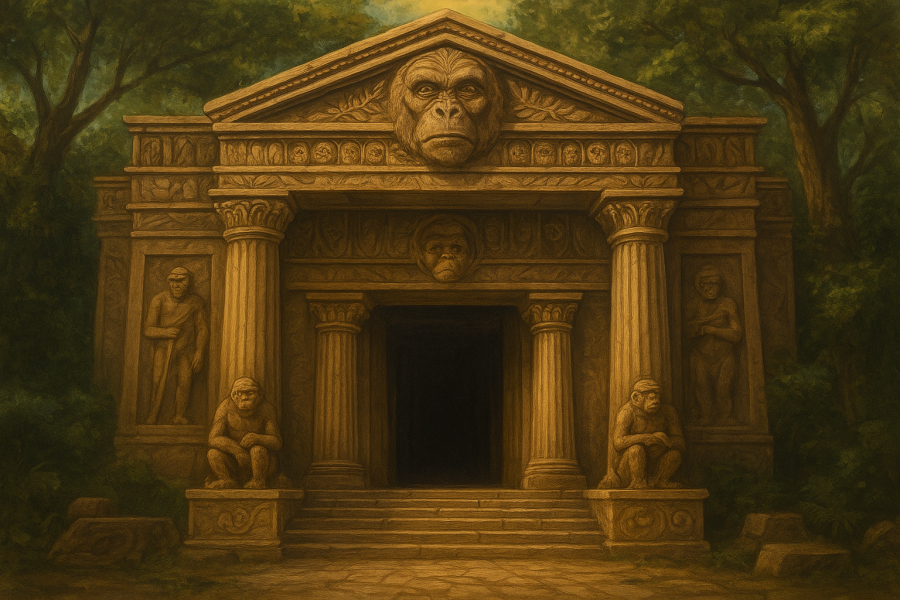
A buzz of subdued conversation filled the Great Hall of the Council of Elders, but this dwindled to silence when General Urko entered.
Dr. Zaius looked down from the high platform at the gorilla general and raised his eyebrows. "General Urko, we have called you back into this session of the Supreme Council after considerable debate."
"And what is your decision regarding my requests?" Urko said. His manner was only faintly polite.
"General, it is the opinion of this council that your military leadership leaves a great deal to be desired....."
Urko broke in angrily. "How dare you question my ability? I am a general in the great Ape Army---the product of the Simian Military Academy, the son, grandson, and great-grandson of gorilla generals!"
Zaius sighed and wavered down the murmurs of the council members. "That comes into serious question, general, when you spend a great deal of time publicly preparing to do battle with an enemy you can't even locate!"
Urko stepped closer to the Elder, his gloved fists balling and his deepset eyes flaring angrily. "Let the council only grant me permission to pursue the humanoid beasts. I will give you my oath--as a general---as a gorilla officer!----that I will take proper care to find and eliminate them!"
Zaius shook his head, making his long, fine golden-orange whiskers shake. "Frankly, we have absolutely no reason to place any confidence in your promises."
Urko raised a balled, leather-encased fist, "Let me give them chase! I shall hunt down the humanoids and make you eat your words! I'll not use boats, of course---since the Book of Military Procedure forbids that," he half apologized.
The smile that crossed Dr. Zaius's face was both sad and victorious. "If your recent performance is anything to go by, I rather doubt that."
But then Zaius looked down the line of Elders, reading their expressions. "Very well, General Urko, permission is granted....But, you had better live up to your promise!"
Urko's salute, a hard slap across his carved leather breastplate, was his only answer. He turned on his heel and marched out.230Please respect copyright.PENANA7Dt2BXgEOO
230Please respect copyright.PENANANFuAVWlmoE
230Please respect copyright.PENANAupJe8AeTvO
230Please respect copyright.PENANAStiLfyM8ML
As Steve and Dan opened up the Marintha's interior they were faced with a sea of wires and exposed control yokes. But the sleek grips on the yokes were starting to be revitalized. Years of disuse had left the grips scuffed but the pilots got them back in working order. Dan kept a section of cable steady while Steve screwed a joint together, both men completely absorbed in their task, recalling the calm composure they displayed on the Spindrift. Coming over to them with tools from the spares, Brent watched everything they did with a sharp eye.
Across the deck, Valerie and Betty checked circuit relays, and Fitzhugh grudgingly polished some corroded connections.
At the far end of the compartment, Barry still patiently tried to teach Nova how to dance. The girl looked mesmerized by his feet and slowly got the hang of the steps. For a second the gloominess of their situation was forgotten, and they all broke out into smiles, softening to the upbeat tunes from Brent's library, but Steve and Dan went back to work on the yokes, intent on getting the Marintha airborne again.
Steve wipes his sweaty forehead and gently pats the control yoke as if it's a living being, and says "she's coming back to life", and he says it in a way that makes you feel like the ship is listening to him.
Steve wiped a sleeve across his brow, then tapped the control yoke with a kind of reverence. “She’s coming back to life,” he murmured, his voice low but certain, as if the ship itself could hear him.
Brent stood back from the flurry of repair work, his throat tightening as sparks danced and panels flickered to life under Steve and Dan’s hands. For years he had only managed to keep the old transport breathing; now, before his eyes, it was being restored to purpose.
Steve pressed the P.A. switch, and the speakers hummed to life throughout the Marintha. His voice carried steady and clear: “All right, everyone—listen up. We’re closer than we’ve ever been. The Marintha is coming back together piece by piece, and every repair you’ve made counts. Keep at it, don’t slow down now. The sooner we finish, the sooner we’ll be leaving this world behind. Let’s push on—we’re almost there.”230Please respect copyright.PENANAt5dIGoMv3E
230Please respect copyright.PENANA3laxRokVtB
230Please respect copyright.PENANAOqtdJhmQUd
Dan crouched over an open panel in the cockpit, his hands smudged with grime as he pulled out a blackened, useless fuse. “That’s the third one burned straight through,” he muttered, shaking his head. Steve leaned in beside him, comparing the salvaged spares from Spindrift with the Marintha’s slots. None of them were a perfect match. Valerie and Betty, crouched on the deck with a small tray of parts, carefully sorted through the odds and ends while Brent scoured the engineering locker for anything that could be adapted. It was tedious work—shaving connections, filing edges, forcing together components that had never been meant to fit—but somehow, piece by piece, the fuses began to take shape. The Marintha creaked faintly around them, alive again in fits and starts, as if willing herself back to the sky.
“What’s next on the list?” Dan called across the cockpit, brushing metal shavings off his hands.
“Hydraulics,” Steve replied, his voice edged with both fatigue and determination. He knelt by the steering columns, prying open a maintenance hatch. A faint hiss escaped as one of the ruptured pressure lines was exposed, oil seeping down onto the deck. “If we can’t get these lines sealed, those yokes won’t move a centimeter.”
Brent, sleeves rolled to his elbows, was already dragging a coil of tubing toward them. Valerie and Betty knelt at his side, helping splice together patches from whatever lengths of conduit they could scavenge. It wasn’t pretty—clamps forced into place with jury-rigged brackets, resin smeared over seams—but as the system pressurized, one of the yokes gave a hesitant shudder, then slowly eased forward. The cockpit filled with relieved laughter. One system down.
“Now for the real headache,” Steve muttered, pointing to a bundle of frayed wires tucked beneath the console. Control circuits, the lifeline of the ship. Barry and Fitzhugh crouched in, the boy’s nimble fingers carefully stripping wires while Fitzhugh—grumbling, but steady—held a light over the mess. Dan followed each line with a diagram Brent had dug up from the Marintha’s tech archives, splicing Spindrift’s spare connectors into place. Hours blurred together. Every connection sparked the risk of failure—but gradually, the maze of wires began to glow with life, indicator lights flickering across the console for the first time in years.
The ship wasn’t whole yet, but each system brought it closer. And with every step, the castaways worked harder, driven by the same unspoken hope: the Marintha might just fly again.
“It’s… it’s…” Brent could only stammer, staring at the monitor as the first readout flickered to life.
“It’s power,” Steve whispered, scarcely daring to believe the glowing numbers climbing on the screen.
“Not Shangri-la,” Dan softly corrected, his voice hushed with reverence, “but the heart of the ship.”
The reactor bay hummed faintly, its cavernous space a maze of cables, patched conduits, and jury-rigged panels. Where once the chamber had been silent as a tomb, now indicator lights pulsed and gauges trembled, fed by energy coursing through repaired coils. A great lattice of shielding loomed overhead, patched with Brent’s makeshift reinforcements, holding together under strain it was never meant to bear.
“That core’s holding steady,” Steve asserted, checking the main dial. His hand hovered protectively over the emergency cutoff switch. “If she climbs too fast, we kill it. No risks.”
“The balance is…” Brent seemed stunned, unable to finish. His lips parted in awe as the deep thrumming sound of the reactor grew stronger, steady, almost alive.
“It’s working,” Dan breathed, stepping back to take in the glow filling the chamber. “After all this time… it’s really working.”
The Marintha’s interior seemed immense now, no longer a silent carcass but a vessel reborn. The once-dark corridors glowed with running lights, strip panels humming faintly overhead. From the galley to the crew deck, systems clicked back into a rhythm, consoles blinking in long-forgotten patterns. What had been little more than a hollow shell Brent had haunted for years now showed its bones of power and purpose, alive again under the pilots’ touch. The air itself seemed to vibrate with promise as the fusion of old engineering and desperate ingenuity bridged the ship’s broken systems into working order.
“That panel will hold steady now,” Steve assured, tightening the last connection. The lights flared brighter, steady, casting a soft glow across the faces gathered in the control room.
“The ship is…” Valerie’s voice trailed off, her eyes wide with awe. “It’s alive again. Simply alive…”
The castaways—Barry, Fitzhugh, Betty, Mark, and even Nova, who watched with uncomprehending wonder—stared as the consoles pulsed with energy, displays flickering back into order, the hum of restored systems filling the silence. The Marintha was no longer a tomb but a vessel breathing once more.
“This is everything we prayed for,” Dan said quietly.
“More!” Brent whispered hoarsely, his gaze sweeping the lit compartments. “Look—power! Heat! The ship’s heart is beating again!”
“I saw something that looked like a spark of auxiliary power before you got that circuit closed,” Dan said, peering over Steve’s shoulder.
“Now, if we can reinforce these junctions,” Steve added, “maybe this ship can finally give us some stability—and maybe even comfort.”
“Soon we’ll have to test the reactor output at the other end of the system,” Brent noted, “but for now, these restored panels are a cinch to stabilize.”
“Come on,” Betty urged, a sudden brightness in her voice, “let’s go see what else we can bring back online!”
The group fanned out through the narrow corridors of the Marintha, weaving past half-collapsed bulkheads and jury-rigged patchwork until they reached Brent’s improvised living quarters. With careful use of their salvaged tools, Dan and Steve opened access panels and, with a few decisive connections, coaxed fresh light into the galley. The weary castaways finally stood together in the glow of working lamps, surrounded not by shadows but by the living pulse of the ship.
The hum of the Marintha’s systems was faint at first, like the whisper of a breeze. Then, with a sputter and a low whine, the air circulation units stirred to life. A stream of fresh, filtered air drifted down the corridor, carrying with it the clean scent of ozone.
“Environmental controls are responding,” Steve reported with cautious optimism. “Give them a little time—they may actually balance themselves out.”
As the crew moved along the decks, Brent directed their attention to a cluster of access panels near the life-support bay. “These conduits link straight to the hydro systems,” he explained. “If water flow can be restored here, we could have taps running again.”
Moments later, a rattle and surge came from the pipes. Dan, crouched beside the valve wheel, twisted it slowly—then jumped back as a gush of water sprayed across the deck. Barry laughed and clapped his hands. “It works!” he cried.
Looking around, Valerie pointed to the glow of reawakened lamps in the galley. “With light, air, and water, this ship is already more than a shelter—it’s a home.”
Fitzhugh, straightening his jacket with a huff, sniffed at the dripping valve. “A home with indoor plumbing,” he said dryly. “Finally, civilization returns!”
As Betty directed Nova and Barry to set their salvaged bags of parts and supplies neatly under the mess tables, Steve, Dan, and Brent climbed up toward the bulkhead of the central power stack. Brent ran a hand over the patched metal. “If we adjust the output here,” he said, “we might be able to feed clean current to the rest of the ship.”
“I’ll set the fuse aligner to its tightest tolerance,” Dan explained, tools in hand. “That’ll give us the cleanest signal.”
For the first time since their arrival, the Marintha seemed to breathe again—alive, resilient, and ready to serve her weary passengers.
“Start with that line,” Steve suggested, pointing to a cluster of heavy breaker switches along the reactor control wall.
Dan steadied his hands and began resetting the first series of fuses, sliding each one into place with slow precision. Sparks spat once—but the circuit held. Brent and Steve exchanged a breath they hadn’t realized they were holding.
“Good,” Brent muttered, leaning over the diagnostics panel. “Feed in the next string. Let’s see if the load balances.”
By the time Barry had ferried a box of replacement coils up from storage, Dan and Steve had already reactivated two subsystems—the hum of circulation deepened, and one by one, the overhead lights flickered and held.
“I’ll take the engineering deck,” Brent said, moving toward the rear hatch. “Steve, you’d better get a human conveyor belt running here—parts, tools, anything that will keep us moving.”
“On it,” Steve replied. He directed Valerie and Betty to form a relay, passing cables, socket wrenches, and salvaged power cells from one pair of hands to the next until everything reached the control bay in order.
Within half an hour, the group was working like a living machine. Dan climbed up to reseat burnt-out regulators while Steve rerouted power lines, each test feeding more strength into the ship’s veins. Fitzhugh, despite his grumbling, ferried spent components down the corridor while Brent monitored the reactor’s pulse from the console.
Another team—Valerie and Barry—kept the supply line moving, their “bucket brigade” of parts making sure nothing slowed. Each subsystem that lit up on the control board was a cheer in itself, carrying them closer to the heart of the gamble: waking the Marintha’s reactor to full strength
In the reactor bay, Steve had lined up the last bank of relays, while Dan crouched under the console, tightening the final bolts to the steering yoke’s junctions. Another group—Betty and Valerie—were ferrying fresh fuses from Brent’s improvised stores, slotting them into the panels along the pattern Steve had chalked out on the deck. Brent had determined that each subsystem—navigation, life-support, environmental—would have to interlock cleanly, compactly, feeding into the reactor in a loop that could withstand a surge without burning out.
The relays clicked in order, one after another, the hum of the reactor deepening as the systems curved together, snug and self-supporting, finally aligning with the master board in the cockpit. The air smelled faintly of ozone; the decks trembled with stored energy.
“Main breaker’s primed,” Brent announced, stepping back from the panel. His voice was tight, almost reverent.
Steve glanced at Dan. Dan nodded.
“Do it,” Steve ordered.
Brent’s hand moved, slow at first, then firmly—he threw the switch.
For a heartbeat, silence. Then—
The Marintha roared awake. Lights blazed down the corridors, the deckplates vibrated with power, and the ship’s heart sang with a deep, steady thrum that none of them had heard in years. Console screens glowed. Indicators lit green across the board. Systems that had been dead for so long now pulsed with energy, alive again.
“She’s breathing,” Dan whispered, unable to keep the grin from his face.
“Not just breathing,” Steve said, looking around the humming cockpit. “She’s alive.”
The hum of the ship spread quickly from the cockpit, coursing down the corridors and into every chamber. Panels that had been lifeless for years flared with light, galley fixtures hummed, and a ripple of vibration ran through the deckplates as though the Marintha herself had taken a long, shuddering breath.
At first, the others only stared—Betty dropping the bundle of wires she had been carrying, Valerie gasping aloud. Then, all at once, the silence broke. Barry whooped and leapt into the air, clapping his hands. Fitzhugh laughed until his sides shook, pounding the bulkhead with one triumphant fist. Nova, startled by the sudden noise and the flare of lights, clapped her hands over her ears—then peeked out wide-eyed, almost enchanted by the glow.
Dan leaned back from the console with a grin that could not be contained, while Steve, steady at the controls, allowed himself the smallest nod of victory. Brent, overwhelmed, looked around in awe, his expression halfway between disbelief and tears.
The corridors filled with voices—cheers, laughter, shouts of relief echoing from wall to wall. For the first time in longer than any of them could remember, the Marintha was no longer a broken shell but a living ship, vibrant and whole.
“This might work,” Steve said softly, watching the lights steady into their rhythm. “It really might.”
And the crew—castaways, survivors, and new companions alike—let themselves believe it.
ns216.73.217.14da2

 and then Add to home screen.