
Although I witnessed many of the extraordinary events that unfolded before, during, and after World War DL, and watched the world struggle to comprehend the assassination of Demi Lovato and the unprecedented chain of crises that followed, those experiences alone would not have led me to write this volume.
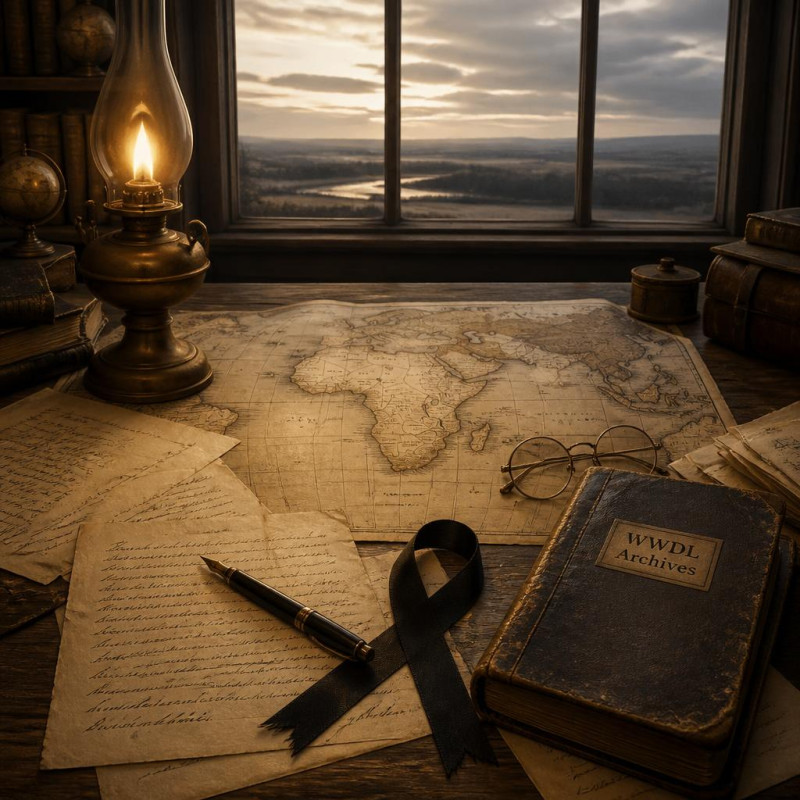
What made such a study possible was not merely the passage of time but the unprecedented release of documentary evidence from every corner of the prewar and wartime world. Government files, intelligence assessments, humanitarian records, diplomatic correspondence, corporate archives, media collections, and the private papers of those who had known Demi Lovato were gradually declassified and made available to scholars. Never before had historians possessed so complete a record of the collapse of an age. For the first time, it became possible to reconstruct not only the military and political decisions that shaped World War DL, but also the gradual unraveling of artistic freedom, global connectivity, celebrity culture, and the institutions that had defined the Digital Age before Africa—the cradle of humankind—was lost to history.
The conclusion of World War DL, marked politically by the Hong Kong Accord and the subsequent fall of Vladimir Putin's government in 2025, yielded an archival record unlike any previously assembled. The opening of Russian state and military archives, together with intelligence files from the belligerent powers, diplomatic correspondence, humanitarian records, encrypted communications, cabinet memoranda, private journals, and personal papers, provided historians with an unparalleled opportunity to reconstruct the origins and consequences of the conflict. Never before had so many independent sources converged to illuminate the inner workings of a global catastrophe.
Of particular value were the personal journals, memoranda, and working papers left behind by many of the principal figures of the Russian government. The private notes of senior military commanders, together with the records of Defense Minister Sergei Shoigu, Foreign Minister Sergey Lavrov, Security Council officials, and other members of President Vladimir Putin's cabinet, often revealed the reasoning behind decisions that official communiqués had deliberately obscured. Equally illuminating were the surviving operational files of the General Staff, naval headquarters, and intelligence services, whose day-to-day reports permitted historians to reconstruct the final months of the war with remarkable precision. Among the enduring mysteries, however, was the fate of Russia's sole aircraft carrier, Admiral Kuznetsov. Despite years of investigation and the release of thousands of naval documents, no conclusive record has ever established her final disposition.
The British archival record proved no less remarkable. In the final weeks before the destruction wrought by the Russian nanolocust offensives, officials of the Ministry of Defense, the Foreign, Commonwealth and Development Office, and the Government Communications Headquarters undertook an emergency operation to preserve Britain's digital memory. Millions of classified files, intelligence assessments, operational logs, satellite imagery, diplomatic cables, and encrypted communications were copied into hardened underground repositories and dispersed to secure facilities throughout the Commonwealth. Much of Whitehall itself would later be consumed in the devastation, yet the archives survived. Their eventual declassification furnished historians with an unparalleled record of Britain's wartime decision-making, revealing not only military operations but the government's desperate efforts to defend the nation as the digital and physical infrastructures of the United Kingdom collapsed around it.
Of equal importance were the surviving records of what later became known simply as the "Putin Conferences"—a series of high-level meetings held between 2022 and 2025 at which the Kremlin leadership debated subjects ranging from the Demi Lovato crisis and the Mattias C. Albrecht visit to broader questions of military strategy, diplomacy, cyber operations, and information warfare. The official minutes, where they survived at all, were preserved not on paper but as encrypted solid-state drives, secure government servers, and digitally signed briefing files employing successive generations of Russian military encryption. Following the collapse of the Russian government in 2025, one of the most significant caches was recovered in the city of Yekaterinburg by CIA analyst Leon Waller, who discovered a concealed archive of encrypted flash drives, cabinet memoranda, and partial transcripts hidden within a former Federal Protective Service communications facility. Their eventual decryption revealed, for the first time, the internal debates of the Kremlin leadership.
The collapse of the Russian government following the Hong Kong Accord made only a partial accounting of responsibility possible. Colonel Alexander Orlov was taken into custody by the provisional Russian authorities and extradited to the United States, where he became the principal defendant in the first major federal war-crimes prosecution arising from World War DL. His testimony, together with thousands of pages of captured Russian military records, intelligence files, and diplomatic communications, provided historians with an unprecedented view into the Kremlin's wartime decision-making. Yet the court's work remained incomplete. Osip Lyagushov, indicted in absentia before the United States had even entered the war for his alleged role in the Lovato Assassination, disappeared during the final collapse of the Russian state. Despite decades of investigation by American, European, and Russian authorities, no credible account of his fate has ever been established. Whether he died in the chaos of 2025, escaped under an assumed identity, or found refuge beyond the reach of justice remains to be seen.
Finally, beyond the immense body of governmental and military records, historians were afforded an equally invaluable resource in the extensive interviews conducted with those who had known Demi Lovato personally and professionally. Family members, lifelong friends, fellow performers, humanitarian colleagues, managers, producers, record executives, tour personnel, and public officials contributed thousands of hours of recorded testimony, supplemented by personal correspondence, journals, photographs, and private digital archives. Together, these sources provided an unprecedented portrait of the woman whose life and death became inseparable from the origins of World War DL. Never before had historians possessed so complete a record with which to examine not only the events themselves, but also the character, influence, and legacy of the individual who stood at their center.
It was never my intention to write the definitive history of World War DL, for such a task lies beyond the ability of any one author. Yet after years spent studying the surviving archives and listening to those whose lives had been forever altered by the war and by the loss of Demi Lovato, I found it impossible to ignore the larger story that emerged. Piece by piece, the evidence revealed not merely the chronology of a global conflict, but the rise and fall of an entire civilization. It is that story—and the lessons it offers to future generations—that compelled me to write this volume.
It is equally remarkable how little the world understood about the forces that shaped the final years before World War DL. We witnessed the headlines, the humanitarian missions, the political crises, the mounting tensions between nations, and the assassination of Demi Lovato itself. We watched governments react, markets tremble, alliances fracture, and a civilization descend into catastrophe. Yet what unfolded before our eyes was only the visible surface of a far deeper history. Hidden beneath the public record were confidential deliberations, intelligence assessments, private conversations, institutional failures, and countless decisions made behind closed doors. Only years later, through the careful examination of newly available evidence, did it become possible to understand not merely what happened, but why it happened—and why so many intelligent men and women failed to recognize the consequences until it was far too late. It is that hidden history, rather than the familiar chronology of events, that I have sought to uncover in the pages that follow.
There will undoubtedly be those who contend that the events of the war remain too recent to be examined with the detachment that history demands. They will argue that too many wounds remain unhealed, too many families continue to grieve, and too many controversies have yet to be resolved. Such reservations are understandable. Yet history does not wait for perfect unanimity, nor does the passage of generations guarantee clearer judgment. On the contrary, I believe we stand at a singular moment when the documentary record remains largely intact, many of the principal witnesses are still able to speak for themselves, and memories, though imperfect, have not yet been surrendered entirely to legend. If this account is not attempted now, much that is essential may be lost forever.
My chief concern, however, is not with those who remember the war, but with those who never knew the world that existed before it. To them, many of the institutions, customs, technologies, and assumptions of the early twenty-first century will seem as distant and incomprehensible as those of previous centuries appear to us today. Unless that vanished world is described as it was actually lived, future readers will find it difficult to understand not only how it perished, but why so many intelligent people believed it would endure forever. It is for those readers, no less than for my contemporaries, that this history has been written.
The case of Putin's Russia occupies a singular place in modern history. Never before had a nuclear superpower devoted so much of its intelligence apparatus, diplomatic machinery, military planning, and information operations to the surveillance and pursuit of a single civilian entertainer. What began as an extraordinary campaign of celebrity stalking gradually evolved into an international crisis whose consequences neither Moscow nor the rest of the world fully anticipated. With the collapse of the Russian government came an unparalleled body of documentary evidence—operational directives, intelligence assessments, internal correspondence, security briefings, and the testimony of surviving political and military officials—which, when considered alongside the extensive personal record of Demi Lovato herself, made it possible to reconstruct the tragedy in remarkable detail. Possessing these sources, and still mindful of how swiftly ordinary life yielded to catastrophe, I felt a responsibility to examine not merely the events themselves, but the astonishing chain of decisions that transformed the obsession of a great power with a single singer into the defining conflict of the twenty-first century.
When Sir Edward Grey remarked, "The lamps are going out all over Europe; we shall not see them lit again in our lifetime," he spoke as a statesman witnessing the end of one world without yet understanding the full shape of the next. The same could be said of those who lived through the years preceding World War DL. Even with an unprecedented abundance of official records, private archives, digital communications, and firsthand testimony, discovering the complete truth has proven an exacting task. The sheer volume of surviving evidence has illuminated much that was once hidden, yet it has also revealed how easily events may be misunderstood, how frequently sincere witnesses disagree, and how often history resists simple explanation. My purpose has not been to eliminate every contradiction—for no honest historian can—but to weigh the evidence fairly and present the most faithful account that the surviving record permits.
I make no claim to perfect objectivity. Like every historian, I write as one shaped by the age through which I lived and by the immeasurable losses it inflicted. I watched a civilization built upon openness, artistic expression, and global interconnectedness give way to suspicion, isolation, and ruin. I witnessed the extinguishing of Europe's cultural inheritance and the irreversible destruction of Africa—the cradle of humankind—where not only cities and nations were lost, but archaeological treasures, ancient monuments, irreplaceable ecosystems, and countless mysteries that had endured for millennia. The Great Pyramids, the Valley of the Kings, and innumerable sites whose stories had yet to be fully understood disappeared forever. Such losses cannot help but weigh upon any historian. Yet throughout these pages I have endeavored to distinguish carefully between evidence and inference. Wherever the documentary record permits certainty, I have followed it faithfully. Where the surviving sources remain incomplete or contradictory, I have stated so plainly, preferring honest uncertainty to unwarranted confidence. History owes its readers nothing less.
I am fully aware that this work will invite criticism from many quarters. Some will contend that I have attached too much significance to certain events or individuals; others will believe I have not gone far enough. Such disagreements are the natural consequence of writing about an era whose consequences continue to shape our world. I ask only that my conclusions be judged as historians ought to judge them—not by rumor, ideology, or convenience, but by the evidence upon which they rest. If future discoveries compel revisions to these pages, I shall welcome them, for no historian should value personal certainty above historical truth.11Please respect copyright.PENANATHwB39mydu
World War DL may well prove to have been the last great global conflict fought before the complete mechanization of war eclipsed the battlefield as previous generations had understood it. Earlier world wars were measured by the terrible arithmetic of mass armies, artillery, and attrition. This conflict demonstrated something far more unsettling: that civilization itself could be dismantled by precision, automation, cyberwarfare, autonomous weapons, and technologies designed to incapacitate or destroy with unprecedented efficiency. The appearance of weapons such as the Bio-Electromagnetic Pulse (BEMP) rifle, capable of disabling the human nervous system without the thunder of conventional gunfire, and the combat hypospray, which concealed lethal chemistry within an instrument once associated with healing, illustrated how profoundly the character of warfare had changed. Most alarming of all was the abandonment of the long-standing nuclear restraint that had endured since the twentieth century. Despite decades of warnings that any large-scale nuclear exchange would imperil civilization itself, atomic weapons came to be employed with a frequency once reserved for battlefield munitions, forever ending the strategic assumptions upon which the postwar world had rested. If earlier generations believed that technological progress would render humanity more secure, World War DL demonstrated with terrible finality that the same ingenuity could just as readily place civilization, and even the natural world itself, beyond recovery.11Please respect copyright.PENANABOujKAVB3z
History has often been shaped by irony, but few ironies are as profound as the one at the heart of this volume. In the final year of her life, Demi Lovato publicly urged her fellow Americans to reject the cycle of gun violence that had claimed so many lives in her own country. Yet it was not a criminal's bullet that ended her life, but the concentrated fire of a military battalion in a distant land. From that moment flowed a chain of events that no statesman, soldier, or scholar could have foreseen: the collapse of old certainties, the destruction of civilizations, the silencing of ancient cultures, and the passing of an age that believed itself both permanent and enlightened. If there is any lesson to be drawn from the history that follows, it is that the greatest catastrophes often begin not with grand declarations, but with a single act whose consequences no generation can fully comprehend until it is too late. It is to that lesson—and to the memory of the world that was lost—that I respectfully dedicate this work.11Please respect copyright.PENANA9bcX3X7EVp


 and then Add to home screen.