/story/215428/when-africa-burned/
When Africa Burned | Penana
arrow_back
When Africa Burned
more_vert share bookmark_border file_download
info_outline
format_color_text
toc
exposure_plus_1
Search stories, writers or societies
Continue ReadingClear All
What Others Are ReadingRefresh
X
Never miss what's happening on Penana!
PG-13
When Africa Burned
Paul Robison
Intro Table of Contents Comments (0)

Preface

This volume is intended as a companion to my previous work, WORLD WAR DL.

That book examined the origins, escalation, and consequences of the conflict that reshaped the twenty-first century. It explored the assassination of the American singer Demi Lovato on the Maasai Mara, the international crisis that followed, the diplomatic failures that allowed escalation, the emergence of new military technologies, and the profound political, environmental, and social transformations that emerged from the war's aftermath. It was, in many respects, a study of causes and consequences.

This book concerns itself with the war itself.

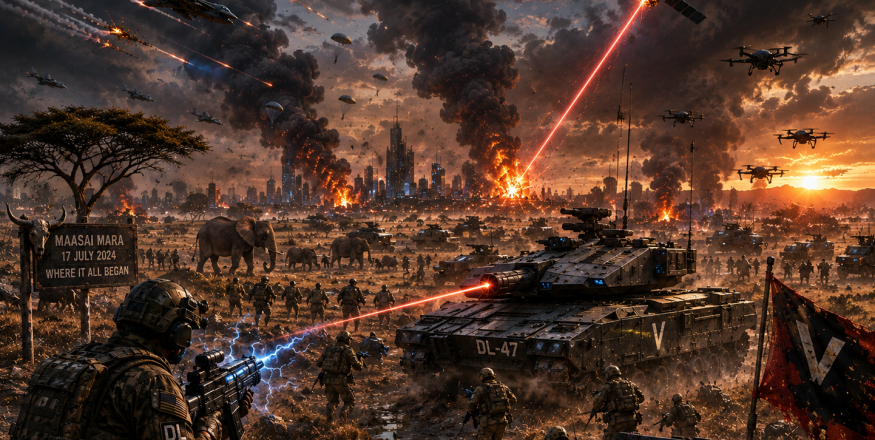
For many readers, the circumstances that produced the conflict remain difficult to comprehend. In August of 2018, Demi Lovato—one of the most recognizable entertainers in the world—was murdered while visiting the Maasai Mara in Kenya. Subsequent investigations established that the assassination was not the work of an isolated extremist or rogue actor but of personnel connected to the Russian military. What began as a crime rapidly became an international crisis. What began as an international crisis became a war. Within months, Africa had become the principal battlefield of the largest and most destructive conflict in modern history.

The story that followed is often told through its consequences. Historians write about the Second Great African Diaspora. They examine the collapse of large portions of Africa's already fragile infrastructure. They study the Fires that transformed vast regions of Europe following the deployment of autonomous nanolocust systems. They debate the emergence of Eurafrica, the transformation of the global internet, the expansion of security states, and the legal frameworks created to regulate autonomous weapons, environmental warfare, and artificial intelligence. These subjects deserve the attention they receive.

Yet they are not the whole story.

Between the assassination and the aftermath lay the war itself.

There were campaigns fought across deserts, savannas, rain forests, river valleys, mountain ranges, and shattered cities. There were armored offensives conducted by laser-equipped combat vehicles. There were infantry formations armed with Bio-Electromagnetic Pulse rifles, weapons whose effects often proved as psychologically devastating as their physical consequences. There were hypersonic strikes, orbital reconnaissance systems, autonomous combat platforms, railguns, and mass drivers whose destructive capabilities altered military doctrine throughout the world. Entire battlefields emerged around technologies that had existed only in theoretical discussions a few years earlier.

But wars are never defined solely by their machines.

World War DL's African Front was fought by soldiers, pilots, sailors, engineers, medics, relief workers, and civilians who found themselves caught within events larger than any individual could comprehend. Many fought in places that received little international attention. Some campaigns were recorded in detail; others survive only through fragmentary military archives, personal journals, after-action reports, and oral testimony. Entire units disappeared from the historical record for months at a time. Communications networks were often limited, unreliable, or nonexistent. In many regions, even the modest analog systems that had long sustained local administration—radio relays, telegraph circuits, and basic electrical networks—collapsed under the pressures of war. The result was a conflict that, despite its scale, remains incompletely documented.

This volume, therefore, attempts to recover those forgotten campaigns.

It examines the battles that unfolded far from the diplomatic conferences and strategic command centers that dominate most histories of the war. It follows the troops who fought in Cote d'Ivoire, the Congo Basin, the Great Rift Valley, the Horn of Africa, and countless lesser-known theaters. It explores not only the weapons that defined the conflict but the individuals who employed them. It seeks to understand how a war driven by advanced technologies was ultimately experienced by human beings.

Like all histories of the African Front, this one is necessarily incomplete. The scale of the conflict exceeded the capacity of any single account to contain it. Entire archives were destroyed. Vast regions became inaccessible. Many participants left no testimony at all. Nevertheless, enough remains to reconstruct at least part of what occurred.

If WORLD WAR DL was the story of how the world changed, this book is the story of how that change was fought for, endured, and survived.

It is the story of the African campaigns.

It is the story of the soldiers.

It is the story of the war.

Show Comments
BOOKMARK
Total Reading Time:
toc Table of Contents
bookmark_border Bookmark Start Reading >
×


Reset to default

X
×
×

Install this webapp for easier offline reading: tap and then Add to home screen.