

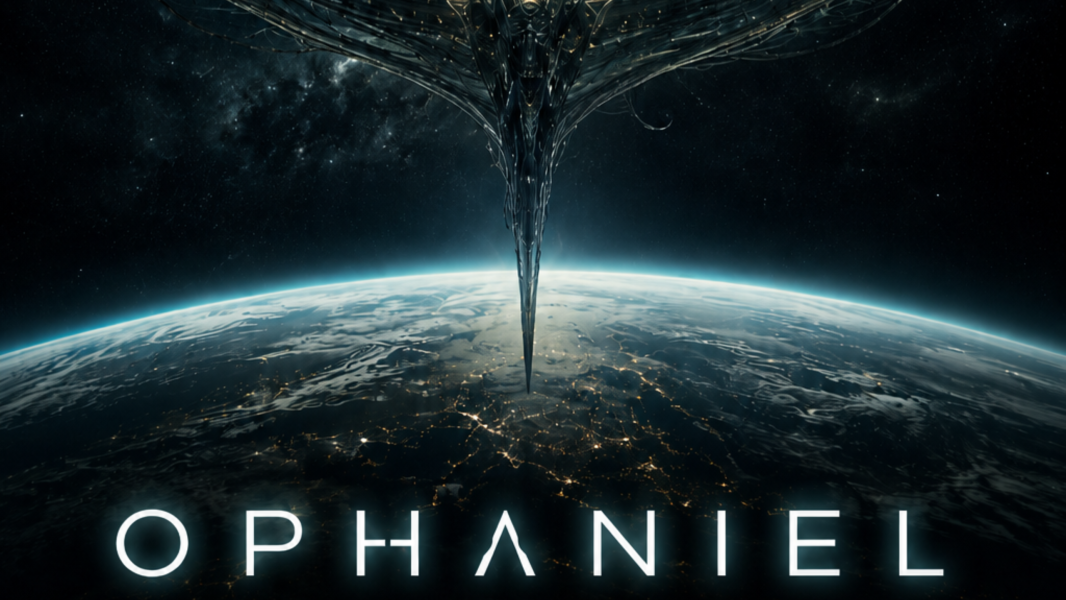
The first version of the public explanation died in a conference room.
Not dramatically. It did not collapse, bleed, seize, or stare too long at the wrong image. It simply failed to make sense.
On the central screen, inside a secure interagency call already crowded with too many agency logos, the draft guidance read:
MEMBERS OF THE PUBLIC ARE ADVISED TO AVOID PROLONGED DIRECT OR MEDIATED VISUAL FIXATION ON THE ATMOSPHERIC ANOMALY OR HIGH-FIDELITY REPRESENTATIONS THEREOF, PENDING FURTHER ASSESSMENT OF POSSIBLE OBSERVATION-ASSOCIATED NEUROVISUAL EFFECTS.
Colonel Hayes read it once.
Then again.
“No.”
On the screen, Marla Dent, the CDC communications officer, had been awake long enough to lose patience with rank. “No?”
“No one outside this room will understand that.”
“It is technically accurate.”
“So is a wiring diagram. I don’t send one to civilians during a fire.”
Lucas, seated now but looking no less restless for it, turned one of the sterile styluses between his fingers. “He is not wrong.”
Marla exhaled. “That is the public-friendly version.”
Aiden looked at the sentence again.
It was a perfectly constructed failure. Careful, defensible, and dead on arrival.
Miriam Cross stood at the end of the table, arms folded, watching six agencies, two scientific disciplines, one military chain of command, and an invisible international crisis attempt to agree on verbs through a screen that made none of them easier to manage.
“Try again,” she said.
Marla did not delete the sentence. She stared at it as if it had personally disappointed her.
“I need content before I can simplify it.”
“You have content,” Hayes said. “Don’t look at the damn thing.”
“That is not a public-health message.”
“It is if it saves them.”
Dr Helena Park remained in a separate NASA window, chin propped on one hand, looking as though she had begun to hate the English language almost as much as she hated the data.
“You cannot say ‘the damn thing’ in official guidance, Colonel.”
“I am willing to compromise on damn.”
Lucas leaned back. “The difficulty is that ‘look’ is imprecise.”
Hayes pointed at him. “There. That is the problem. Every time one of you opens your mouth, the sentence gets worse.”
Aiden almost smiled.
Cross did not.
“Dr Shen,” she said. “Plain language.”
Aiden looked at the blacked-out monitor on the side wall. Someone had taped over the reflection as well as the glass.
“The ring is not only something people see,” he said. “Seeing may be one of the ways it interacts with us.”
Marla typed, then stopped.
“That sounds like the ring is alive.”
“It may be.”
“Is that for public release?”
“No.”
“Then I need the version where I do not cause riots.”
Hayes muttered, “Too late.”
Cross ignored him. “Dr Han.”
Lucas stopped turning the stylus.
“The brain is a prediction machine,” he said. “It does not passively record the world. It locks onto patterns. It completes missing information. It synchronises with rhythm, shape, motion, contrast. Most of the time, that keeps us alive.”
“And this time?” Marla asked.
“This time the pattern may be too persuasive.”
Park looked up. “That is good.”
Marla glanced at her.
“Unsettling,” Park added. “But good.”
Lucas looked at the draft. “The warning should not say people can get sick from any image. That would be false, and impossible to enforce. It should say that direct viewing, magnified footage, enhanced images, and repeated exposure appear to increase risk.”
Marla typed quickly.
Aiden added, “And do not describe it as infection.”
“Why not?” Hayes asked. “People understand infection.”
“Because it is wrong.”
“That has not stopped public messaging before.”
Aiden looked at him.
Hayes shrugged. “I said what I said.”
Aiden continued. “If we call it infection, people will look for contagion. They will fear each other. They will avoid hospitals. They will blame patients. This is exposure, not person-to-person spread.”
“Exposure to what?” Marla asked.
Aiden paused.
That was still the question.
Park answered before he did. “To a structure. A pattern. A signal. We do not have the word yet.”
Marla rubbed her eyes. “You understand that I cannot put ‘we do not have the word yet’ in a federal advisory.”
“You should,” Lucas said. “It would be the first honest sentence issued all day.”
Cross said, “No.”
Vale, who had been silent by the door, looked up from her tablet. “A public statement with that line would cause markets to open in flames.”
“Markets are closed,” Hayes said.
“Not everywhere.”
“Of course not. God forbid the apocalypse respect trading hours.”
For one second, the room behaved like a room of people rather than a system of institutional functions. Someone laughed. Briefly. Improperly. Then stopped.
Cross allowed it to die on its own.
Marla tapped the table twice with one finger. “Here is my problem. If I make this too vague, people ignore it. If I make it too frightening, people test it. If I make it too technical, people screenshot the wrong part and argue about it for six hours. So someone needs to decide which failure mode we prefer.”
No one answered quickly.
That, Aiden thought, was the first useful silence of the last few hours.
Cross said, “Analogy.”
Park looked wary. “Must we?”
“Yes. People remember analogies.”
“People also misuse analogies.”
“Then choose one sturdy enough to survive misuse.”
Park sighed. “Fine. Imagine a three-dimensional object passing through a two-dimensional surface. The surface creatures do not see the whole object. They see the cross-section.”
Hayes stared at her.
“I knew this would happen,” Park said.
Lucas said, “Try water.”
Aiden turned to him.
Lucas continued. “Imagine something pressing through water from above. A fish does not understand the hand. It sees disturbance, pressure, shape. Maybe shadow. Maybe movement. Not the whole body.”
Hayes nodded slowly. “So the ring is the hand.”
“No,” Park said.
Aiden said, “The ring is the disturbance.”
Hayes frowned. “That is worse.”
“It is more accurate.”
“Accuracy is why people hate scientists.”
Marla pointed at the screen. “Actually, the fish analogy might work.”
Park looked offended. “It is terrible physics.”
“It is comprehensible communication.”
“That sentence is why engineers drink.”
Lucas said, “The second part matters more. Our eyes, cameras, telescopes, image software — they may reproduce enough of the disturbance to matter. Not perfectly. Not always. But enough.”
Marla typed.
Hayes folded his arms. “So the image can hurt people.”
“Some images,” Lucas said. “High-fidelity ones. Magnified ones. Enhanced ones. Stabilised ones. Anything that preserves too much structure.”
“Then why did sterile plates in Dr Shen’s lab start organising themselves?” Hayes asked.
Aiden glanced at him.
Hayes noticed. “Yes, Doctor, I read the summary. I do that sometimes.”
Aiden said, “Because this may not be limited to nervous systems. Living tissue is vulnerable because it processes pattern. But other ordered systems can also respond to imposed structure. Microbial films. Mineral substrates. Digital files. Possibly instruments.”
“That makes it sound like everything can catch it.”
“No,” Aiden said. “It means some systems can preserve enough of the pattern to become part of the interface.”
Hayes looked at Marla. “Can you make that shorter?”
Marla stared at her draft.
Then she typed:
DO NOT LOOK DIRECTLY AT THE ANOMALY. DO NOT WATCH MAGNIFIED OR ENHANCED IMAGES OF IT. DO NOT SHARE VIDEOS OR LIVE FEEDS. THE RISK APPEARS TO INCREASE WHEN THE IMAGE IS CLEARER, LARGER, REPEATED, OR PROCESSED.
She stopped.
“That is something my aunt would understand,” she said.
“Good,” Hayes replied. “Would she obey it?”
“No.”
“Then test harder.”
Cross moved to the screen.
“Add what to do.”
Marla typed again.
IF VISUAL SYMPTOMS, CONFUSION, FAINTING, SEIZURE-LIKE ACTIVITY, CHEST PAIN, OR UNUSUAL DISTRESS OCCUR AFTER VIEWING THE ANOMALY OR RELATED IMAGES, STOP EXPOSURE IMMEDIATELY, MOVE AWAY FROM SCREENS AND WINDOWS, AND SEEK MEDICAL CARE.
Lucas said, “Add children.”
Marla added:
KEEP CHILDREN AWAY FROM DIRECT VIEWS, LIVE BROADCASTS, AND SHARED IMAGES.
Aiden said, “Add animals.”
Marla looked at him.
“People will notice animals before they notice syndromic surveillance.”
She typed.
REPORT UNUSUAL ANIMAL BEHAVIOUR, DISORIENTATION, SUDDEN COLLAPSE, OR MASS BIRD DEATHS TO LOCAL AUTHORITIES.
Hayes read the final draft.
“Better.”
Park said, “Still incomplete.”
Cross replied, “Everything true is incomplete today.”
Vale’s tablet chimed.
“Madam President wants the revised language in four minutes.”
Marla looked at the guidance.
“Then this is what we have.”
Aiden stared at the words.
They were not enough. They were too late. They were still better than silence.
That, he thought, was public health more often than anyone admitted.
In the basement, Alec Shen had three conversations at once, which was one fewer than he considered sustainable.
On the laptop, Maya Sato was sending text-only instrument notes with the caution of a person passing explosives through a mail slot.
On his phone, several messages had accumulated while he was failing to be one person in three places.
On the sofa, his mother was trying to contact Aunt Christie in Hong Kong using an address book that appeared to have survived several wars, three house moves, and the invention of cloud storage without altering its principles.
“Alec,” his mother said.
“One second.”
“You said that five seconds ago.”
“Mum, that is how seconds work in emergencies.”
She gave him a look over the top of her reading glasses.
He returned to the laptop.
MAYA: Do you see rotational nesting in the metadata or am I losing my mind?
ALEC: You may be losing your mind independently, but the nesting is real.
MAYA: That is almost reassuring.
ALEC: Don’t get attached.
His phone buzzed.
FLORA: Finally home.
Then:
FLORA: Took forever from the clinic. Traffic was impossible. People panicking everywhere. Someone tried to break into the pharmacy near my block. Nothing makes sense any more.
Then:
FLORA: Also the stray cats outside the practice were acting weird and would not come near me, which is personally offensive.
Alec looked at the message for a second.
Flora loved cats. She had been feeding the strays near her dental clinic for years with the defensive air of someone who considered it charity rather than emotional dependence. The cats had never believed the distinction.
Another message arrived.
FLORA: Phone was on airplane mode charging while I showered. Just saw your messages. Are you and Mum actually in the basement?
He typed with one hand.
ALEC: Basement. Aiden called. No sky, no ring images, no videos. Can you get to Elisa if safe? She’s at Nari’s.
Flora responded almost immediately.
FLORA: I finally got home and now you want me to leave again.
Then:
FLORA: I’m a dentist, not a disaster taxi.
Then:
FLORA: Fine. I’ll try.
Then:
FLORA: Is Aiden safe?
Alec looked at the message for longer than he meant to.
He typed:
ALEC: He’s working.
It was not an answer.
In their family, that had often been the answer.
His mother said, “Is that Flora?”
“Yes.”
“Tell her not to drive if people are panicking.”
“I did.”
“You did not.”
“I implied it.”
“Imply less. Tell more.”
Alec added:
ALEC: Mum says don’t drive if people are panicking.
Flora replied:
FLORA: Tell Mum people are always panicking when I drive.
His mother, reading over his shoulder despite having apparently been across the room a moment earlier, made a disapproving sound.
“That girl.”
“She is thirty-seven.”
“She is still that girl.”
Another message appeared from an unknown number.
ELISA: This is Elisa. My phone died. Using Nari’s. I’m at her flat. We’re inside. We covered the windows with bedsheets. Is this actually happening?
Alec felt something in his chest unclench.
ALEC: Yes. Stay there unless Flora can get you safely. No videos. No live feeds. No sky.
ELISA: I only watched once.
Alec stopped typing.
His mother saw his face.
“What?”
“Elisa looked.”
She took one step closer.
Alec typed:
ALEC: Any symptoms?
The reply took twelve seconds.
ELISA: Headache. Maybe because I cried. Don’t tell Aiden.
Alec closed his eyes.
Of all the stupid sentences in the world, “Don’t tell Aiden” remained one of the most familiar.
ALEC: I will absolutely tell Aiden if you worsen. Any vision changes? Lights? dark spots? nausea? confusion?
ELISA: You sound like him.
ALEC: Answer.
ELISA: No. Just headache. Nari says I’m annoying, so cognition intact.
His mother sat down beside him.
“She is joking,” Alec said.
“That does not mean she is well.”
“I know.”
The laptop chimed again.
MAYA: Need help converting image-derived matrices into non-visual descriptors. I can’t send rendered files.
ALEC: Send raw numbers. I’ll build a parser.
MAYA: That fast?
ALEC: My brother gave me thirty seconds to prepare for alien data hygiene. I’m improvising.
Maya took longer to reply this time.
MAYA: He called you first?
Alec looked at the line.
Then typed:
ALEC: He called home.
He did not know why that mattered, except that it did.
His phone rang.
Iris.
He answered on speaker before he remembered there were too many conversations already.
“Iris?”
“I have forty seconds,” she said. “Radiology is a disaster.”
His mother leaned in. “Iris? Are you all right?”
“I’m fine, Mum.”
Alec said, “Switch off your screens when you can.”
There was a pause.
Then Iris said, “Are you crazy? I’m a radiologist. I need screens.”
Even their mother smiled, just once.
“Not ring footage,” Alec said. “No live news. No enhanced sky images. Patient imaging only.”
“Yes, Dr Basement.”
“I’m serious.”
“So am I. We’ve already covered the staff-room television with a lead apron.”
Alec blinked. “That works?”
“No idea. It made people feel better.”
“Any cases?”
Another pause.
When Iris spoke again, the humour had gone.
“Visual symptoms. A few collapses. One man seized in CT because someone showed him a clip while waiting. A nurse slapped the phone out of his daughter’s hand.”
“Good nurse.”
“Excellent nurse. HR will hate her.”
His mother said, “Can Flora pick you up?”
“I’m on shift.”
“Iris.”
“Mum.”
That was enough to carry years of family hierarchy.
Iris softened first. “If they release me, I’ll call Flora. I promise.”
“Do not look at the sky,” her mother said.
“I work in a windowless department.”
“Good. Stay there.”
“I never thought you’d say that.”
The line cracked with overhead announcements.
Iris said, “I have to go. Alec, if Aiden calls—”
“He won’t.”
“If he does, tell him radiology is collecting scans. Quietly.”
“You’re committing crimes too?”
“Apparently it’s a family project.”
She hung up.
For a few seconds, no one spoke.
Then their mother said, “Call Aunt Christie.”
Alec stared at her.
“Mum, I’m handling alien metadata, three sisters, and the end of ophthalmology.”
“She is with Grandaunt in Hong Kong.”
“I know.”
“They do not answer texts.”
“I know.”
“They will look if no one tells them not to.”
That was true.
Alec opened another call window.
Above them, somewhere beyond the basement ceiling, the sky remained unseen.
That did not make it absent.
By midnight, television had stopped pretending to have a schedule.
Morning programmes had become emergency panels before morning had arrived. Cooking segments waited behind casualty updates. Weather presenters stood beside maps they were no longer allowed to illustrate properly. Every channel had discovered, with visible resentment, that a crisis in the sky made the old grammar of broadcasting feel almost obscene.
NASA had spoken. CDC had updated its advisory. The White House had said less than it knew, which was enough to make everyone listen harder.
The first major network incident occurred because a producer believed in moderation.
He did not think of himself as reckless.
That was the problem.
Reckless people were easier to detect. Ethan Morrow was a senior producer at a national news network and had built a career out of making complicated things palatable before the second commercial break. Wars, elections, heatwaves, school shootings, markets, pandemics, celebrity divorces that somehow became moral referendums. Everything could be shaped if one understood the camera.
The new guidance said not to show live or enhanced images of the anomaly.
Ethan complied.
Technically.
He instructed the graphics team to create a simplified, cleaned-up, non-live visualisation based on publicly available stills. Low contrast. No central point. No motion. Soft edges.
“Informative but not scary,” he said, because television had survived for decades on phrases that should have been illegal.
The graphics editor, twenty-six, underpaid, and on his fourth coffee, asked whether they should run it past legal.
Ethan said, “We have forty seconds before the update.”
That was not an answer, but television often mistook urgency for permission.
At 00:12 Eastern, the anchor turned to Camera Two.
“Health officials are urging the public not to look directly at the object, and not to share magnified images. Following NASA’s late-night statement and the updated CDC advisory, we are showing a simplified representation only.”
The graphic appeared behind her.
A pale ring.
Soft edges.
No central point.
Safe, Ethan thought.
The floor manager stopped moving.
Not dramatically. His hand remained half-raised, fingers open, as if he had paused mid-countdown. The anchor continued reading from the teleprompter. The camera operator frowned and touched his headset. In the control room, one of the audio channels began picking up a low tone no microphone had been assigned to carry.
The graphics editor whispered, “That’s not my file.”
On screen, the soft ring sharpened.
Just a little.
Enough.
In a living room in Ohio, a woman watching while feeding her baby turned away because the baby began crying.
In a hotel lobby in Dubai, three travellers looked up at once.
In a care home in Bristol, an elderly man told the nurse that the television had found the shape behind his eyes.
The anchor stumbled over the word precautionary.
Ethan stood.
“Take it down.”
The director did not answer.
“Take it down.”
The audio tone deepened.
The floor manager lowered his hand and looked directly into Camera Two, though no one had asked him to.
The anchor stopped reading.
For a moment, the programme broadcast silence, the anchor’s composed face, and the pale ring behind her, now subtly more exact than any simplified graphic had the right to be.
Then the screen cut to a cooking segment recorded three days earlier.
A chef smiled beneath studio lights and said, “The secret is not to overwork the dough.”
Across the country, emergency call volume increased by six per cent in twelve minutes.
Not because people had all been asleep and woken by disaster.
Because they had not been sleeping.
They had been waiting for someone official to explain the sky, watching televisions, phones, laptops, tablets, and lobby screens with the peculiar obedience of frightened citizens who no longer trusted their own eyes but still trusted a news anchor to tell them where to place them.
Ethan vomited into a bin and then asked whether they were still on air.
At Department Seven, the network incident arrived as three separate alerts before anyone called it a single event.
Lucas saw it first.
“Broadcast cluster,” he said.
Vale crossed the room. “Where?”
“National network. Breaking update. They used a simplified graphic.”
Park’s face appeared on a side screen. “Define simplified.”
“That is the question.”
Aiden joined them as the incident package loaded without visual preview. Metadata only. Audio analysis. Viewer reports. Studio medical logs. Broadcast timing. Emergency call correlation.
“No rendered image,” Aiden said.
“We know,” Vale replied.
“Everyone says that now.”
Lucas reviewed the audio data. “The tone emerged after broadcast, not before.”
“From the studio?” Cross asked.
“From the broadcast chain. Or from devices receiving it. Or from both.” He rubbed his forehead, then immediately stopped when Aiden looked at him. “Still mild. Do not start.”
“I had not started.”
“You had begun internally.”
“That is different.”
Cross entered fully. “Was guidance violated?”
In the CDC window, Marla Dent looked like she wanted to resign into a hole.
“Not explicitly,” she said. “They used a non-live, simplified representation.”
“Then our guidance failed,” Cross said.
Marla flinched.
Aiden said, “No. Our guidance was incomplete.”
“That is not better,” she replied.
“No.”
Hayes looked at the data. “How does a simplified graphic become hazardous?”
Lucas answered. “If the simplification preserves the wrong features. Edge ratios. Symmetry. Central absence. Spatial relationships. The brain does not need a photograph. It needs a persuasive pattern.”
From the NASA window, Park said, “And apparently the broadcast pipeline may sharpen or stabilise features automatically.”
Marla’s face changed.
“Every network uses automated enhancement.”
No one spoke.
She continued, faster now, as if the full horror had moved into her field rather than theirs.
“Compression, scaling, contrast correction, noise reduction, motion smoothing, thumbnail generation. Social platforms do it too. Video apps. Phones. Newsrooms. Everything optimises images to make them clearer.”
Lucas said, “Clarity is the problem.”
Aiden looked at the failed broadcast data.
Clarity is the problem.
It was a sentence that would have sounded absurd yesterday. Today it was almost mercifully simple.
Cross turned towards Marla’s window. “Update the guidance.”
Marla was already typing. “No representational graphics based on the anomaly. Abstract diagrams only. No circular geometry?”
Park groaned. “We cannot ban circles.”
Hayes said, “Can we strongly discourage circles?”
Park stared at him from the NASA window.
“What?” he said. “I am contributing.”
Aiden said, “Not all circles. The dangerous features are likely relational, not symbolic. Ring structure, central point or void, symmetry, rotation, contrast, repetition.”
Marla typed.
Lucas added, “Avoid anything that lets the eye settle.”
Marla looked up from the CDC window. “That is not regulatory language.”
“No,” Lucas said. “But it is the mechanism.”
Cross said, “Make it regulatory.”
Marla deleted an entire paragraph with visible anger and started again.
Aiden watched her work.
He was beginning to understand that civilisation was not a monument or a law or a flag. It was a chain of people rewriting sentences while the dark widened around them.
In the basement, Alec’s system flagged a new public trend before the radio mentioned it.
#SHOWUSTHESKY
He stared at it.
“Mum,” he said, “do not look at your phone.”
“I am not stupid.”
“I know. I am saying it anyway.”
She was sitting on the sofa now with the old address book open on her lap, one finger resting on a page of names in English, Chinese, and Japanese, written across decades in different pens. Beside her, the wind-up radio continued in its calm end-of-days voice.
“Your Aunt Christie did not answer,” she said.
“I’ll try again.”
“They may be sleeping.”
“Good.”
“They may be looking.”
Alec did not answer.
Another message arrived from Flora.
FLORA: I got Elisa. She looks fine. Annoying, but fine. Going to try for Iris if hospital lets her out. Roads are bad. People are driving like idiots. More than usual.
Then Elisa, from the borrowed phone:
ELISA: Tell Mum I’m okay, hungry, but fine.
Alec almost laughed.
His mother looked at him.
“They found Elisa,” he said.
The relief changed her face before she could hide it.
“Good,” she said. Then, immediately, “Flora should not drive too fast.”
“I’ll tell her.”
“And tell Elisa not to argue.”
“I cannot perform miracles.”
For the first time since the basement door had closed, his mother smiled properly.
It disappeared when the radio interrupted its own advisory with breaking news of a broadcast-related medical cluster.
Alec muted it.
His laptop showed Maya typing.
MAYA: We need a rule for safe diagrams.
ALEC: I’m not a neuroscientist.
MAYA: Today no one gets to stay in their field.
ALEC: Fair.
He looked at the trend again.
#SHOWUSTHESKY
It was spreading fast.
People wanted proof. They wanted beauty. They wanted rebellion. They wanted to decide for themselves whether danger was danger. They wanted, above all, not to be treated like children.
Alec understood this.
He also understood, with increasing resentment, that some children survived because adults blocked the window.
He typed to Maya:
ALEC: The problem is not that people don’t understand the rule. The problem is that understanding it makes them want to break it.
Maya replied:
MAYA: That sounds like immunology.
Alec frowned.
ALEC: Wrong brother.
MAYA: Maybe. But I think he would agree.
Alec looked towards the ceiling.
For a moment, he imagined the house above him from outside: ordinary, darkened, windows covered, a family hiding underground from something in the sky no one was supposed to see.
A new message appeared in the larger family chat.
ANDY: I’m in Japan. I’m fine. Don’t worry. Already indoors, curtains closed, no live feeds. Unlike half the internet, I can apparently follow one instruction.
Alec stared at the message.
Then typed:
ALEC: Good. Stay that way.
Andy replied:
ANDY: Obviously.
Then his phone vibrated again.
Unknown number.
He answered before thinking.
A woman’s voice spoke in Cantonese, breathless and frightened.
“Alec? Your mother said not to look at the sky.”
He closed his eyes.
“Hi, Aunt Christie,” he said, switching languages clumsily but fast enough for fear. “Yes. Please don’t look. Not tonight. And don’t let Grandaunt look either.”
“She says she only wants one small look.”
“No,” Alec said. “Tell her Aiden said no.”
There was a pause.
Then Aunt Christie said, “Ah. Then she will listen.”
Alec looked at the laptop, the radio, the covered basement windows, and the impossible geometry waiting inside files he had not opened.
“Good,” he said. “Tell her I said thank you.”
Before the hour was out, the revised guidance had been translated, shortened into headlines, misquoted by politicians, denounced by preachers, read aloud in subway stations, printed on hospital doors, and copied by parents onto paper signs taped across bedroom windows.
DO NOT LOOK DIRECTLY AT THE ANOMALY.
DO NOT WATCH OR SHARE IMAGES OF IT.
DO NOT MAGNIFY, ENHANCE, LOOP, STABILISE, OR RECREATE ITS STRUCTURE.
USE ABSTRACT DIAGRAMS ONLY.
KEEP CHILDREN AWAY FROM WINDOWS AND SCREENS.
For a while, it almost sounded simple.
Then the hashtag spread faster.
#SHOWUSTHESKY
People posted blank blue squares in protest.
Then stylised circles.
Then altered circles.
Then safer circles.
Then unsafe ones.
Then deliberately unsafe ones, shared with warnings that made people click faster.
On the central screen at Department Seven, the trend map bloomed across continents in shades of red.
Hayes looked at it and said nothing for once.
Lucas stood behind Aiden, too tired to hide the pressure behind his eyes.
Aiden watched the map spread.
The problem was no longer only Ophaniel.
It was humanity’s need to see what it had been told might destroy it.
Outside, beyond concrete, earth, atmosphere, satellite, camera, screen, retina, and thought, the ring remained open.
Silent.
Beautiful.
Patient.
ns216.73.216.67da2


 and then Add to home screen.