

The vehicle had no internal handles.
Aiden noticed this before he noticed the smell: synthetic leather, recycled air, and something faintly antiseptic beneath it, as though the car had been cleaned not for comfort but for evidence.
Lucas noticed the same thing. He did not look at the doors. He did not have to. His eyes moved once, briefly, to the edge of the window, then to the partition separating them from the driver.
Bullet-resistant glass.
Signal shielding.
No visible locks.
Aiden knew that look. Lucas had worn it in hospital corridors, outside intensive care rooms, and once in a hotel lobby in Prague when a drunk man had begun shouting at a young woman in Russian. It was the expression of someone quietly building a model of danger.
Eleanor Vale sat opposite them, knees together, black case between her shoes. Her colleague sat beside her, silent, large enough to make silence feel like part of his job description.
The car moved away from Saint Elias University.
The windows were darkened almost to black from the outside, but from within they allowed a filtered view of the city: flattened colours, reduced glare, a sky dimmed to something nearly bearable.
Nearly, Aiden thought, was doing too much work.
Whatever coating Department Seven had applied, it did not remove the ring. It only made it easier to pretend looking was safer.
Outside, the campus receded through tinted glass. Students remained at the gate, some still filming, some crouched near the fallen pigeons, some looking at the sky as if disbelief were a muscle that could be strengthened by use. Emergency lights washed the brick buildings in red and white. The ring turned above everything with intolerable patience.
Aiden looked away first.
Lucas did not.
“You should not keep watching it,” Aiden said.
“I am not watching the ring.”
“What are you watching?”
“The people watching it.”
That was Lucas. Where Aiden saw tissue, Lucas saw behaviour. Where Aiden asked what a thing was, Lucas asked how the nervous system had already begun to accommodate it.
Vale’s eyes moved between them.
“You two do this often?”
“Sit in unmarked vehicles after birds fall from the sky?” Lucas said. “No.”
“I meant complete one another’s observations.”
Aiden said, “We have worked together before.”
“That is one description.”
Lucas turned from the window.
“Is this going to be a security interview or a medical briefing?”
Vale did not smile. “Both, eventually.”
“Efficient.”
“Necessary.”
The car turned onto a service road, bypassing the main entrance to the campus. A police cordon had formed around the north gate. Two news vans were already there. One of the reporters was speaking into a camera with the posture of someone trying to make history fit inside a two-minute segment.
Aiden’s fingers tightened against his coat.
“My postdoc stays on campus,” he said.
“For now,” Vale replied.
“That was not reassurance.”
“No.”
“She is not to be threatened.”
Vale looked at him for a moment.
“Dr Shen, by this time tomorrow, every person who has touched relevant data will either be under protection, surveillance, or both. Dr Sato is more useful to us if she continues to behave like a postdoctoral researcher rather than a detained witness.”
“Useful to you.”
“Yes.”
At least she did not insult him with moral language.
Lucas said, “And what are we?”
Vale glanced at him. “Irreplaceable, until you prove otherwise.”
The large man beside her gave the smallest possible exhale. It might have been amusement. It might have been a respiratory function.
Aiden looked down at the black case. Their phones were inside it, along with whatever part of their ordinary lives could still be reduced to metadata.
“Where are we going?”
Vale removed a slim card from her jacket. No emblem. No name. Only a grey surface with a narrow metallic strip.
“A secure facility outside Boston.”
“That is not an answer.”
“It is the only one I am authorised to give in transit.”
“You realise how absurd that sounds.”
“I do.”
“Does that trouble you?”
“Less than the birds.”
That silenced him.
The car entered an underpass.
For three seconds, the ring disappeared from view.
Aiden felt the absence before he understood it. Some small internal pressure released. The world became ceiling, concrete, sodium light, the ordinary dirt of infrastructure. He had not realised how much of himself had been braced against the sky.
Then the car emerged.
The ring was still there.
It had acquired the point.
From ground level, through the filtered glass, the point at the centre was almost too small to be seen directly. But every time Aiden tried not to look at it, his vision seemed to know where it was. The eye did not demand attention. It organised it.
Lucas leaned back and closed his eyes.
“Are you all right?” Aiden asked.
“No.”
Vale said, “Symptoms?”
Lucas kept his eyes closed. “Mild headache. Pressure behind the eyes. A sense of directional pull when looking at the central point. No nausea. No visual aura.”
“Onset?”
“Within thirty seconds of sustained visual attention, through filtered glass.”
Vale looked at the man beside her. He had already taken out a small recorder.
Lucas opened his eyes. “You are recording this?”
“Yes.”
“Then record the next part. Do not allow personnel to stare at the central point for longer than ten seconds without interruption. Rotate visual tasks. Use peripheral viewing where possible. No enlarged images without medical oversight.”
The man looked to Vale.
Vale nodded once.
The instruction was accepted.
That, more than the car, the case, or the armed escort, told Aiden what Department Seven was: not merely secretive, but hungry. It consumed expertise as soon as it recognised it.
Vale said, “This is why I told you to step away from the window.”
Aiden looked at her.
“At the time, you had not explained why.”
“At the time, you had not obeyed.”
Lucas gave a soft sound that might have been amusement if he had looked less unwell.
Aiden said, “How many cases do you have?”
Vale did not answer.
Lucas said, “If you brought us here, you already have cases.”
Again, silence.
Then Vale said, “Thirty-one confirmed neurological events under direct observation. Hundreds of probable events. Too early to count unverified public reports.”
“Deaths?” Aiden asked.
“Yes.”
The word entered the car and stayed there.
“How many?”
“Confirmed? Fewer than ten.”
“That means more.”
“Yes.”
“Mechanism?”
“That is why you are here.”
It was a neat sentence. It placed responsibility in his hands without giving him authority.
Aiden had heard variations of it for years. A patient is deteriorating, doctor. A culture is positive, doctor. The family wants to speak with you, doctor. The mechanism is unclear, doctor.
That is why you are here.
“Are they all neurological?” Lucas asked.
“No.”
Aiden looked up.
Vale’s gaze held his.
“Tell me.”
“Not here.”
“Tell me something.”
“Two deaths in animal facilities. Multiple unexplained losses in avian populations. One aquarium event in Melbourne. Several human cases with autonomic instability. One suspected fatal arrhythmia during observation of the anomaly. One case of acute bilateral retinal injury without apparent phototoxic exposure. Your laboratory mineral plates. Dr Sato’s preliminary note has been flagged.”
Aiden processed the list clinically, because to do otherwise would be useless.
Retina.
Autonomic nervous system.
Neural synchronisation.
Animal orientation.
Signal perception.
Mineral deposition.
No direct contact.
No obvious toxin.
Not infection, not in any conventional sense.
And yet the pattern felt biological. Not because it behaved like an organism he knew, but because it had entered the living world through vulnerability rather than force.
“What do you call it?” he asked.
Vale looked at him.
“Internally.”
“We do not have an agreed designation.”
“That is a lie.”
“That is a managed truth.”
Lucas gave a soft laugh. “Oh, she is good.”
Vale ignored him.
The car slowed.
They had left the city’s recognisable edges. The roads widened, then emptied. Industrial buildings appeared behind fences: logistics depots, data centres, anonymous warehouses whose architecture expressed the moral ambitions of cardboard. Beyond them, the land dipped towards a low complex of concrete and smoked glass built into a slope of dark trees.
There was no sign.
The first gate opened before they reached it.
The second required a retinal scan.
The third had armed guards.
At the final barrier, the driver lowered his window. A guard looked inside, not at their faces but at a tablet.
“Vale, Eleanor. Clearance confirmed.”
His eyes moved to Aiden.
“Shen, Aiden. Provisional.”
Then Lucas.
“Han, Lucas. Provisional.”
The guard did not ask whether they consented to the arrangement.
Inside, the facility was larger than it had appeared from the road. Most of it was underground. The visible portion was low and horizontal, more bunker than laboratory, designed by someone who believed windows were a concession to weakness.
They were taken through a side entrance.
The air changed at the threshold. Drier. Filtered. Overmanaged. Aiden recognised the environmental logic immediately: not a hospital, not a biosafety laboratory, not a military command centre, but something that had borrowed from all three without trusting any of them fully.
A wall-mounted camera tracked them down the corridor.
Lucas looked up at it.
“Does this place have a name?”
Vale said, “Yes.”
“May we hear it?”
“No.”
Aiden said, “Department Seven is not the name?”
“Department Seven is what people call us when they do not know what we are.”
“And what are you?”
Vale stopped at an interior checkpoint and turned.
“Underfunded, overclassified, and late.”
For the first time, Aiden believed she had told the truth.
They surrendered their coats. Their bags were taken. Their shoes passed through a scanner. Blood pressure, pulse oximetry, retinal photographs, baseline neurological examination, a rapid cognitive screen. Aiden endured it with the resignation of a physician becoming a patient against his will.
The nurse who performed his observations was young and pale. Her hands were steady.
“Any visual disturbance?” she asked.
“No.”
“Headache?”
“No.”
“Nausea?”
“No.”
“Unusual auditory perception?”
“You mean apart from every phone in my lecture theatre singing in unison?”
She looked at him, uncertain.
“No,” Aiden said, softer. “No current symptoms.”
She recorded it.
Lucas underwent a more detailed neurological screen in the adjacent bay. He performed finger-nose testing, visual fields, saccades, gait assessment, digit span, serial sevens. He did not complain. That worried Aiden more than complaint would have.
When Lucas returned, he said, “They are frightened.”
“The nurses?”
“The protocol.”
Aiden understood. The examination was too broad, too frequent, too improvised. It had the flavour of medicine being invented in real time by committees with insufficient sleep.
They were led into a briefing room.
It had no windows.
There were twelve people already inside. Some wore military uniforms. Some wore suits. Two wore white coats, which irritated Aiden on principle. A man in clerical black stood near the wall, speaking quietly to no one.
At the head of the table sat a Black woman in her late fifties or early sixties, though the exact decade seemed less relevant than the authority she had clearly survived into. Her hair was black, softly curled, and cut just below the ears, shaped with enough care to look deliberate rather than ornamental.
Aiden suspected the colour owed more to discipline than nature. Her makeup was precise: dark eyeliner, warm pink lipstick, and a finish so controlled that it gave her face less expression, not more.
She wore a pale stone-coloured skirt suit with small gold earrings and a silk scarf pinned at one shoulder. The effect was not glamour. It was command, assembled piece by piece, as if she had learned long ago that rooms full of powerful men noticed appearance before authority and then resented both.
She did not rise when they entered.
She did not need to.
A second figure sat two seats from her: Colonel Hayes, according to the nameplate. He wore his uniform jacket over the back of his chair and had rolled his sleeves to the forearms. He was broad without softness, perhaps mid-forties, with close-cropped hair, a square jaw, and the expression of a man who had spent his adult life being rewarded for reducing fear into plans. His eyes were not cruel.
That made Aiden trust him less, not more.
Cruel men were easy to oppose. Competent men with frightening options were the real problem.
On the main screen was a live image of the ring over the Pacific.
Not the ring seen from the ground.
This was orbital.
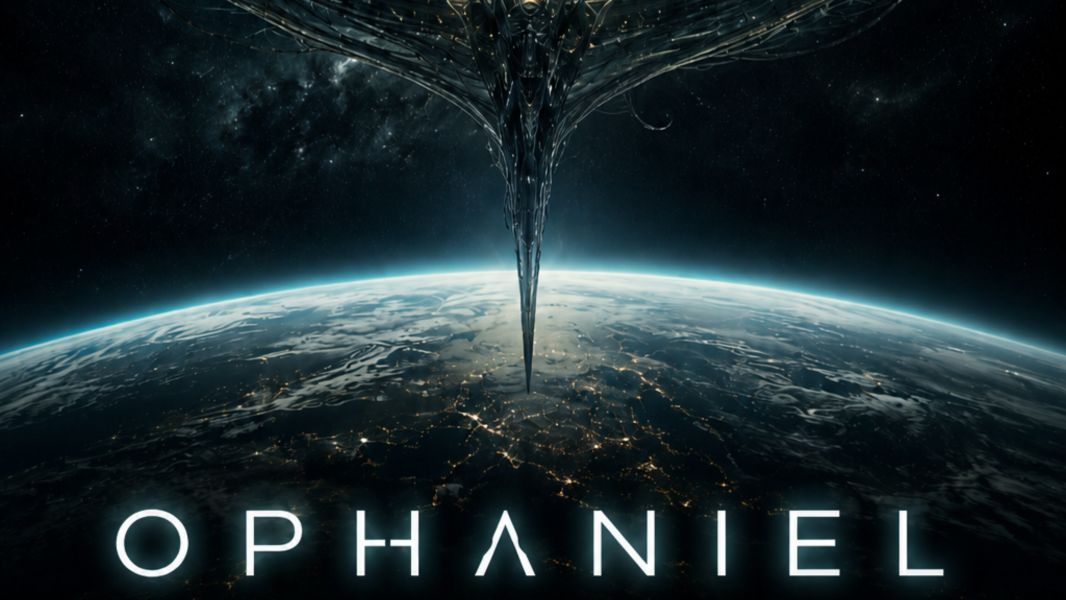
The Earth curved below it, cloud systems luminous along the terminator. Above the planet’s atmosphere hung the structure Aiden had seen only in fragments: three vast intersecting rings and a central point of darkness so exact that it seemed to have been imposed upon the image rather than captured by it.
“Turn that off,” Aiden said.
The room looked at him.
The woman at the head of the table did not. She watched him as if she had expected the objection and wanted to know how long it would take.
“Dr Shen,” she said.
“You extracted us under visual-exposure precautions. Your operative told us to step away from the window and close anomaly files. Now you have enlarged the same structure on a wall.”
“The image is filtered,” one of the white coats said.
Aiden did not look at him. “Filtered is not the same as safe.”
Beside him, Lucas had gone very still.
Aiden turned.
“Lucas?”
“Pressure,” Lucas said quietly. “Mild. Behind the eyes.”
The woman at the head of the table looked towards a technician.
“Image off.”
The screen went black.
In the sudden absence, Aiden realised how much of the room had been holding its breath.
Vale stepped forward, as if the room still required permission to understand who had entered.
“Dr Aiden Shen,” she said. “Board-certified infectious diseases specialist, clinical microbiologist, and associate professor of medical microbiology and clinical pathology at Saint Elias University, with a conjoint appointment in astrobiology and pathobiology.”
Aiden did not react, though he disliked hearing his career reduced to evidence.
“Dr Lucas Han,” Vale continued. “Board-certified neurologist, clinician-scientist, and associate professor of neurophysiology and cognitive systems modelling.”
Aiden glanced at Lucas.
Associate professor. That was true, though Lucas had once described the title as “a polite way of saying old enough to be blamed, too young to be listened to.”
Vale continued, “Both have received preliminary exposure. Dr Shen remains asymptomatic. Dr Han reports mild visual-pressure symptoms after central fixation and enlarged-image exposure.”
Aiden looked at the black screen.
“Which is exactly why that image should not have been projected.”
The woman at the head of the table said, “Agreed.”
Only then did she introduce herself properly.
“Dr Han, Dr Shen. My name is Dr Miriam Cross. I direct this facility.”
Her voice was measured, warm at the edges, and entirely unsuitable for interruption.
“A facility without a name,” Lucas said.
“A facility with several names. None useful.”
Aiden looked at the black screen. “How long have you had that image?”
Cross folded her hands.
“Longer than the public.”
“That is not an answer.”
“No,” she said. “It is a boundary.”
“There are patients in hospitals and animals dropping out of the sky. Boundaries are becoming less persuasive.”
A few people shifted.
Cross did not.
“Dr Shen, we are past the stage at which anyone in this room believes secrecy will survive intact. But premature disclosure of partial information is not transparency. It is ammunition.”
“For whom?”
“Everyone.”
That, too, was difficult to dismiss.
Vale placed the black case on the table but did not open it.
Cross gestured to the dark screen. “We will proceed without live imagery.”
“Generous,” Lucas murmured.
Cross glanced at him.
“Prudent.”
Aiden almost approved of her.
Almost.
Cross opened a paper folder. “Vale has told you some of what we know.”
“She has told us what she considers operationally convenient.”
“That is her job.”
Vale did not react.
Cross continued. “We detected the first anomaly seventy-three hours ago.”
Aiden turned to her.
“Before the ring appeared.”
“Yes.”
“What anomaly?”
“Not one. Several.”
She nodded to a technician. The dark screen remained off. Instead, a printed packet was passed to Aiden and Lucas, each page stripped of images and converted into tables, text, and line descriptions.
Aiden looked at the first page.
A narrow band of signal noise, repeating at irregular intervals.
“Deep-space monitoring arrays recorded a weak non-random pattern across multiple frequencies,” Cross said. “It was initially classified as solar interference, then equipment artefact, then hostile spoofing. By the time we excluded all three, the first visual manifestation had begun.”
“Manifestation,” Lucas said.
“That is the least committal word available.”
Aiden looked at the signal description. It was almost nothing. A whisper in instruments designed to hear storms.
“What did it say?” he asked.
Cross did not answer immediately.
Vale placed another page in front of him.
A text description only:
INTERFERENCE PATTERN: ANNULAR / MULTI-AXIAL / CENTRAL SIGNAL ABSENCE
Aiden felt a slow, unpleasant recognition move through him. Not surprise. Something worse. Confirmation of a thought he had not allowed himself to complete.
“It was not communicating with us,” he said.
Cross looked at him. “What makes you say that?”
“Because no one sends a message before establishing whether the receiver exists.”
Lucas said quietly, “Unless the message is the test.”
Aiden looked at him.
Lucas did not look away from the page.
Cross said, “That is one of our working hypotheses.”
Colonel Hayes spoke for the first time. His voice was low, level, and built for rooms where people preferred direct lines to elegant ones.
“Another is that we are dealing with adversarial technology. Unknown origin. Potentially terrestrial.”
Aiden stared at him.
Hayes did not flinch.
“We cannot exclude it,” he said.
“No,” Aiden said. “But there is an ethical difference between not excluding something and wasting time pretending it is plausible.”
The room chilled.
Lucas leaned back very slightly, as though amused despite himself.
Hayes’s jaw tightened, but he did not raise his voice.
Cross raised one hand. “Colonel Hayes is correct that terrestrial spoofing was considered.”
“For how long?” Aiden asked.
“Too long,” Vale said.
Cross allowed that to stand.
The next packet was worse.
A flock of birds over São Paulo, described frame by frame: altered course, spiral formation, glass-tower collision.
An operating theatre in Seoul: surgical lights flickering as everyone in the room turned towards the same blank wall at the same second.
A school playground in Lisbon: children stopping mid-game and drawing circles in the dirt.
A motorway outside Vancouver: six drivers in separate lanes braking simultaneously under open sky, causing a chain collision without visible road hazard.
An aquarium in Melbourne. The octopus, black against pale sand, its mantle pattern described rather than shown.
Maya’s file.
Aiden said, “Where did you get that?”
Vale said, “From the aquarium.”
“No. That specific clip.”
Silence.
Aiden looked at her.
“Maya sent that to me less than an hour ago.”
“We have parallel access.”
“That is what we are calling theft now?”
“We are calling it national emergency.”
“So when you said parallel access, you meant my lab, my postdoc, and half the world’s hospitals.”
“We meant the data pathways relevant to the event.”
“That is a sentence designed to survive a hearing.”
“And yours is designed to win one.”
Cross interrupted before Vale could answer. “Dr Shen, we did not bring you here to litigate information governance.”
“Then you misread my CV.”
Lucas turned his head and coughed once into his hand. It might have been laughter.
Cross’s expression did not change.
“We brought you here because your work anticipated a class of life or life-like systems that do not fit conventional biological containment,” she said. “Yesterday, that was theoretical. Today, we have neurological cases, animal events, instrument distortion, and your own sterile mineral systems behaving as though the same structure matters across different media.”
Aiden said nothing.
Cross continued. “Dr Han is here because the phenomenon is producing measurable effects on neural processing before any identifiable physical contact. Between you, we need a language for what is happening.”
Aiden looked down at the packet.
Then at Lucas.
Then at the black screen where the image had been.
“If it only affected people, I would think neurology,” Aiden said. “If it only affected animals, I would think environmental exposure. If it only affected instruments, I would think signal interference. If it only affected mineral plates, I would think contamination, chemistry, or artefact.”
Cross waited.
“But it is touching all of them just enough to make each explanation fail.”
Lucas said, “Different systems failing in similar directions.”
“Yes,” Aiden said. “Human visual cortex. Animal orientation. Retina. Phone tones. Laboratory substrates. Instruments. Those should not belong to the same disease.”
Cross said, “But they may.”
“No,” Aiden said. “That is the frightening part. They may belong to the same contact.”
A few people in the room wrote that down.
Aiden disliked that immediately.
The man in clerical black crossed himself near the wall. Aiden saw it in the reflection of the dark screen.
That small gesture unsettled him more than the military hardware, more than the underground facility, more than the secrecy. Faith, in a room like this, did not look like comfort. It looked like a man using an old tool because no new one had yet been issued.
Lucas said, “Show us the deaths.”
No one moved.
He continued, voice clinical now. “You would not have taken us if this were still a visual phenomenon and some frightened animals. Show us the deaths.”
Cross held his gaze for a moment.
Then she nodded.
No images appeared.
Instead, four printed case summaries were passed across the table.
Case One.
A middle-aged woman in Madrid. Found dead in her flat after livestreaming the ring for forty-two minutes. No trauma. No toxin. No obvious cause on external examination. Facial expression neutral. Eyes open. Phone still recording. Final audio: a low tone not produced by the phone’s speaker.
Case Two.
A pilot over the North Atlantic. Reported “loss of horizon” despite clear instruments. Aircraft landed safely by co-pilot. Pilot later developed refractory seizures and died in intensive care. MRI showed diffuse cortical abnormalities not matching hypoxia, encephalitis, stroke, or toxic injury.
Case Three.
Laboratory macaque in Kyoto. Implanted with neural recording array for unrelated visual processing research. At 12:04, electrodes recorded synchronised discharge across visual cortex, auditory cortex, and hippocampal formation. Animal entered cardiac arrest ninety seconds later.
Case Four.
Unidentified at first.
Then Aiden reached the descriptive appendix.
A deer in a forest clearing, found with legs folded beneath it as if resting. Eyes open. Surrounding herd motionless, all facing the same direction.
No gross trauma. No evidence of poisoning. Bloods pending.
Post-mortem retinal photographs described tiny haemorrhages arranged in a partial arc.
Aiden leaned forward.
“Do you have the retinal image?”
Vale looked at Cross.
Aiden saw the hesitation and hated that he understood it.
“I do not want it projected,” he said. “I want to know whether you have it.”
Cross said, “Yes.”
“Histology?”
“Not yet.”
“Who is handling the tissue?”
“A veterinary pathology unit under instruction.”
“Under whose instruction?”
“Ours.”
“Then you need to change the fixation protocol.”
Several people looked at him.
He spoke without waiting.
“If this is field-mediated or structurally induced, standard formalin fixation may destroy the relevant interface. You need parallel sampling: frozen, glutaraldehyde for electron microscopy, RNA preservation even if I doubt RNA will be the answer, mineral mapping, trace metals, magnetometry if possible. Retinal tissue, optic nerve, visual cortex, vestibular apparatus, heart conduction system. Same for birds. Same for any animal that falls without trauma.”
Cross turned to someone at the side of the room. “You heard him.”
The person was already typing.
Aiden looked back at the summary.
The deer’s eye was not visible.
That was somehow worse. His mind supplied enough.
For a moment, the ring in the retina and the ring above Earth became the same idea.
Not identical.
Rhyming.
That was worse.
Lucas said, “It is using the visual system.”
“Or the visual system is where we first see the damage,” Aiden replied.
“Fair.”
“Do not be fair yet. It wastes time.”
Lucas looked at him then, properly, and Aiden saw the fatigue beneath his composure.
This was how they worked. Not in harmony, exactly. Harmony was for people who agreed too soon. They sharpened one another.
Cross said, “Dr Shen, if this were presented to you as an outbreak, what would you call it?”
Aiden almost laughed.
Not because it was funny.
Because it was obscene.
An outbreak required a pathogen, a host, a transmission route, an incubation period, a population at risk. It belonged to a world where disease moved through bodies, air, water, blood, touch, vectors, choices. This thing had produced clusters without contact, signs without exposure, synchrony without proximity.
But medicine had always begun in arrogance. It named before it understood.
“I would not call it an outbreak,” he said.
“What would you call it?”
“A syndrome.”
Cross waited.
“Provisional. Multi-system. Neurovisual predominant. Associated with exposure to the anomaly, direct or indirect. Mechanism unknown.”
“That is too cautious.”
“It is accurate.”
“Can you shorten it?”
Aiden looked at the dark screen.
“No.”
Lucas said, “An observation injury.”
Aiden turned.
The phrase was too simple.
That was why it worked.
Lucas continued, “Not in the legal sense. In the biological sense. Injury induced by being observed, or by attempting to observe. It may be bidirectional.”
The room absorbed this.
Cross did not write it down immediately.
That, Aiden thought, meant she was deciding whether it was too useful to be safe.
Colonel Hayes said, “You are suggesting the object can injure people by looking at them?”
Lucas’s expression remained calm. “I am suggesting that the distinction between looking and being looked at may not survive contact with whatever that is.”
Aiden looked at the black screen.
The central point was no longer visible.
He still knew where it had been.
Cross touched the edge of her folder.
“We have a provisional internal name.”
Aiden looked back at her.
“For the syndrome?”
“For the phenomenon.”
“Of course you do.”
Vale placed one final sheet on the table.
One word had been printed in the centre.
OPHANIEL
For the first time since entering the facility, Aiden felt something like anger.
“Who chose that?”
“The theological advisory group,” Cross said.
“You have a theological advisory group.”
“Today, Dr Shen, everyone has one.”
Lucas said quietly, “Ophanim. Wheels.”
“Yes,” Cross said. “The name is provisional.”
“They always are,” Aiden said.
The word stayed on the page.
OPHANIEL.
It was elegant. That was the problem. A name could make a thing bearable. It could turn terror into taxonomy, uncertainty into file structure. It could give human beings the illusion that to label something was to move it slightly under control.
Aiden had named organisms all his life, or at least helped identify them: fungi, bacteria, parasites, viruses, opportunists, colonisers, contaminants, pathogens. Names mattered. Names guided treatment. Names prevented panic.
Names also lied.
Lucas leaned closer to him and said, very softly, “It is not an angel.”
Aiden did not look away from the printed word.
“No,” he said.
Somewhere above them, beyond concrete, cloud, atmosphere, and every instrument now trying to understand it, the ring turned without needing to be seen.
“But something taught us to think of angels.”
ns216.73.216.175da2


 and then Add to home screen.