

Part 7 :The Haunting of the Railway Track16Please respect copyright.PENANA1HeMST6Yg0
The final month of the year had arrived, bringing with it the holidays we had been planning for weeks. All of us gathered at our close friend Peter’s home in Sialkot, united by a single purpose—to investigate the infamous haunted railway tracks that had long been the subject of local legends.
According to old stories passed down through generations, the railway lines had witnessed unimaginable bloodshed nearly seventy years earlier. During the violent upheavals of that era, passenger trains traveling through the region were attacked, leaving countless innocent people dead. One of the darkest incidents involved a train that was deliberately forced off the tracks near Sialkot after saboteurs damaged the rails. Since then, the abandoned sections of the historic Amritsar–Sialkot railway have carried an unsettling reputation.
Ever since childhood, we had heard people speak about the place in hushed voices. Older residents often mentioned a location they simply called the Junction T, where several railway lines met in an isolated stretch of land. They claimed strange things happened there after sunset. Some spoke of ghostly shapes drifting silently above the tracks, while others described dim floating lights that appeared for a few moments before fading into the darkness. There were tales of white-clad figures standing motionless near the rails and mysterious cries echoing across the fields in the middle of the night. Most people avoided the area completely once evening arrived.
Although we knew the stories well, none of us had ever visited the location. This journey was not meant to be a thrill-seeking adventure. We genuinely hoped that, if restless spirits truly remained there, perhaps we could understand their suffering and somehow help them find peace.
Inside Peter’s drawing room, he spread an old map of Sialkot across the large wooden table. The afternoon sunlight filtered softly through the curtains, illuminating the faded markings on the paper. After studying the routes for a moment, he placed his finger on a particular intersection.
“This is the place,” he said quietly. “The Junction T. It’s around twelve kilometers from here.”
His serious tone immediately changed the mood in the room. The red circle marking the location seemed almost like a warning.
Before leaving, Peter insisted that we eat something. His cook soon arrived with trays of refreshments. The rich aroma of hot tea filled the room, accompanied by freshly fried samosas, sandwiches, savory snacks, and a variety of sweets. For a little while, the conversation became lighter, and laughter replaced the tension. Yet somewhere beneath those smiles was the awareness that we were about to visit a place connected with great tragedy.
After the meal, we collected our equipment and headed outside. The evening air carried the first signs of winter, cool and refreshing. We loaded our bags into Peter’s car and began the drive.
The journey was unusually quiet. As we left the city behind, the crowded streets gave way to open fields and lonely roads. The sky gradually lost its brightness as thin clouds drifted overhead. Everyone seemed lost in thought.
About twenty minutes later, Peter stopped the car beside a rough dirt track.
“We’ll have to walk the rest of the way,” he said. “It’s only ten minutes from here.”
The moment we stepped out, the silence felt different. There were no passing vehicles, no nearby houses, and no sounds of daily life—only stillness.
We followed the narrow path through tall grass that brushed gently against our legs. The light around us had turned gray, creating an atmosphere that felt suspended between day and night.
Then, almost unexpectedly, we arrived.
The Junction T stretched before us.
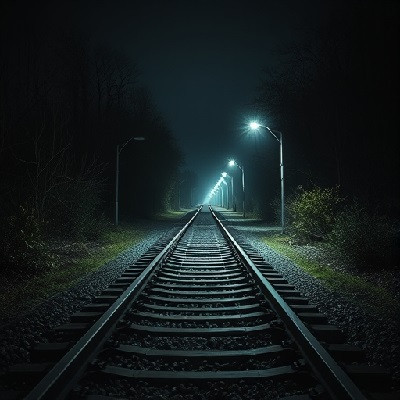
The old railway tracks crossed one another in a lonely intersection. Rust covered much of the iron, while weeds pushed stubbornly through the wooden sleepers. Nature had slowly begun reclaiming what people had abandoned.
An unnatural silence surrounded the place. It was not peaceful but heavy, as though the land itself carried memories of unbearable sorrow. Even the birds seemed unwilling to come near.
A cold sensation crawled along my spine.
Although the sun had not yet set, the area somehow appeared darker than the countryside around it. Standing there, I was overwhelmed by a sadness that felt larger than any one person.
We carefully spread out to examine the surroundings.
Diljeet reached into his backpack and removed the EMF detector.
“Let’s see if there’s anything unusual,” he muttered.
He switched the device on.
At first, nothing happened.
Then, without warning, the lights on the meter began flashing rapidly. The instrument vibrated violently in his hand.
All of us stopped moving.
“There’s no electrical source anywhere near here,” Peter whispered.
Diljeet looked around nervously. “No power lines… no transformers… nothing.”
The detector continued reacting as though invisible energy surrounded us. Its readings climbed to the highest level.
At that exact moment, a blast of icy wind swept across the tracks. Strangely, the tall grass nearby barely moved.
The atmosphere suddenly felt heavier. It was impossible to explain, but each of us sensed that we were no longer alone.
For an instant, I thought I noticed a pale figure standing far down the railway line. I turned quickly, but there was nothing there.
Only empty tracks disappearing into the distance.
Gradually, the detector stopped vibrating and returned to normal.
No one said a word.
The place remained silent, yet it seemed filled with an unseen presence. It did not feel threatening or angry. Instead, it carried an overwhelming sadness, as though countless forgotten memories still lingered there.
Peter slowly walked to the exact point where the tracks crossed.
He stood quietly for several moments before speaking.
“This is where everything happened.”
His words hung heavily in the cold air.
A faint sound drifted toward us. It was so distant that I could not tell whether it was real or simply my imagination. It resembled a long, sorrowful sigh carried by the wind.
We spent some time taking photographs, recording environmental readings, and carefully observing the area. Every movement felt strangely deliberate, as if we were walking across ground that remembered the past.
Even in daylight, the cold refused to leave.
Once we had completed our first investigation, we gathered together near the center of the junction. The EMF detector was quiet now, but none of us could forget what had happened.
“We’re coming back,” Abdul finally said.
No one argued.
The walk back to the car seemed longer than before. Just before getting inside, I looked over my shoulder one last time.
The Junction T stood exactly as we had found it—silent, abandoned, and burdened by history.
During the drive home, none of us felt like talking.
When we finally reached Peter’s house, the warmth of the lights and familiar surroundings brought some comfort. Yet deep inside, I could not shake the feeling that the place had left a mark on us.
Our first visit had ended.
But the sorrow hidden within the old railway junction remained with us.
Dear readers, hope that you are enjoying my work. Kindly do comment or like16Please respect copyright.PENANAKjXZwmX6Jg
Author’s Note: This chapter was edited with AI assistance for grammar, readability, and flow.
ns216.73.216.134da2

 and then Add to home screen.