

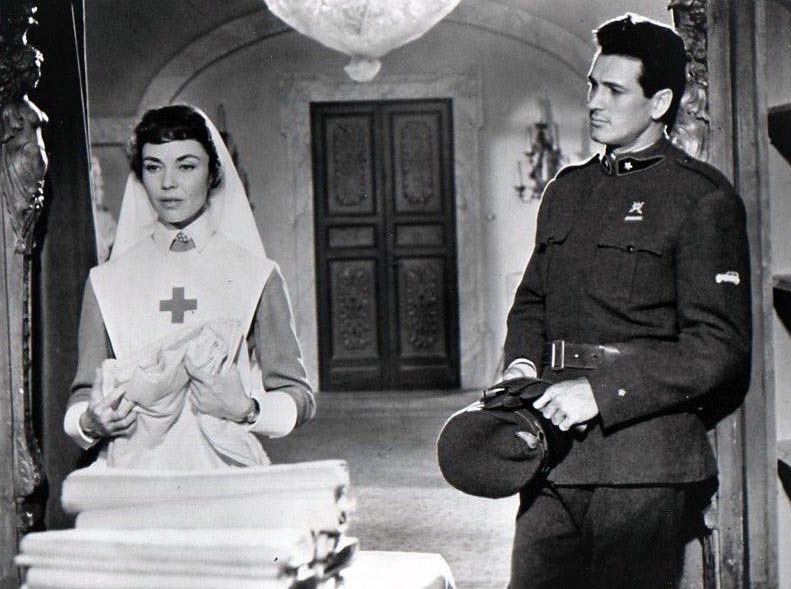
In A Farewell to Arms by Ernest Hemingway, symbolism conveys the challenges and ups and downs World War I soldiers faced in battle.
A Farewell to Arms was first published in 1929 and tells the story of a young Lieutenant, Frederic Henry, serving as an ambulance driver in the Italian campaign during WWI, who falls in love with a young nurse named Catherine Barkley (Hutchison). The story wraps around the two lovers’ journey during the war and the journey many WWI soldiers took as well. Ernest Hemingway uses symbolism to represent the challenges and ups and downs soldiers experienced during the war. Symbolism is the use of symbols to represent different ideas, things, and people in a book, magazine, play, etc. In A Farewell to Arms, weather (mainly rain and sun) is the main symbol. Throughout the novel, there are lots of references to weather, rain, and sun. Hemingway was obviously using it as a symbol. Weather was used to represent the war itself and its different effects on the soldiers (challenges, ups and downs, etc.).
The first symbol, one of the main weather symbols Hemingway uses in A Farewell to Arms, is rain. By definition, rain is condensed moisture that falls in drops of water and is sometimes accompanied by thunder and lightning. It can be both peaceful and terrifying, depending on how you look at it. Rain, with or without thunder, can symbolize many different things. Rain, of course, symbolizes something in A Farewell to Arms, or else it wouldn’t have been used as many times as it was.
Rain in the novel symbolizes three different things. It symbolizes the great challenges soldiers faced, the horrors of the war, and, since it is sometimes accompanied by thunder and lightning, the aggression of it.
During World War I, soldiers experienced the horrors of war in general and of the war itself. They went through a lot. One of the horrors of war that rain can symbolize is the loss of life. World War I was one of the bloodiest wars in all of history (Casualties). There were a total of thirty-five million casualties (Casualties). 16.5 million were killed, and another twenty million were wounded (Casualties). However, these are just human casualties. There were also lots of amputation casualties. Many soldiers who survived the war returned home with a partially or fully amputated body part (Most terrible year). Casualties were only one of the many horrors soldiers faced. There were many more.
Another horror of WWI was suicide. Lots of soldiers committed suicide. They would run out onto no-man’s land and throw themselves in front of shell fire (Copping). They would let themselves get hit. Some of this was caused by soldiers just going insane. They were so tired of war that it made them mad. WWI veteran, Benjamin Richards, explained it as, “It was quite common to see people… get up and run round in circles like sheep, and they ran round until they met shell fire which finally finished them.” (Copping)
One more horror of WWI that the soldiers faced was no-man’s land. No-man’s land is defined as an area (open) between two opposing armies. No-man’s land was what the soldiers ran across when they went into battle. After major battles, they were forced to leave the trenches and run onto the battlefield where they would pick up the dead and wounded (Jones). That seems pretty scary. Even though the battle was over, soldiers would still have to face shelling off in the distance or maybe even surprise attacks. That was one of the true horrors of WWI. In A Farewell to Arms, the horrors are shared throughout the entire novel. As a symbol, rain represents the darkness, challenges, and horrors the soldiers endured.
Aside from horrors, there are also lots of challenges involved when you head off to war. Rain also symbolizes these challenges. Most of these challenges were pretty dark, like rain that comes with thunder or lightning. One of the main challenges soldiers faced was isolation. Soldiers were isolated and stuck in the same country for a long time. Their lives were shaken and blurred, and they prayed to the Lord for help. (Holmes) That’s a pretty big challenge.
Another challenge was the risks. Soldiers take significant risks when they decide to enlist in the military. They are well aware of the complications, but they still go. (Holmes) When accompanied by thunder or lightning, rain can be pretty nasty, and that can represent the aggressiveness of WWI.
WWI was very aggressive. In 1916, when A Farewell to Arms took place, fighting was very brutal. There were waves of political, economic, and social upheavals. (Most terrible year) During 1916, most fighting took place in Eastern Europe. People were encouraged to “challenge the imperial status quo and assert their right to national self-determination.” Overall, people became a lot more forceful. (Most terrible year) Hemingway did a good job of explaining the war’s aggressiveness in the novel.
In conclusion, Hemingway used rain to symbolize the many different dark aspects of WWI. He did a good job explaining it and representing it.
Aside from downs, there were also lots of ups to the war. This is where the second symbol, the sun, comes in handy. The sun symbolized both the ups and downs of WWI. By definition, the sun is a large star in space, a ball of gas that rotates around our planet. (NASA) If we didn’t have the sun, then life on Earth would be simply impossible. (NASA) Like rain, the sun can symbolize many things. In A Farewell to Arms, it also symbolizes many things. Like rain, it symbolizes the challenges soldiers faced, but it also symbolizes the hope, a rise out of the war. Hope was a main thing soldiers had to hold on to during the war. Without hope, they probably would’ve never made it home.
As mentioned before, during WWI, soldiers faced many challenges. Some challenges could be represented by rain, but many others could be represented by the sun. One of these challenges was heat. During WWI, heat was a major challenge for soldiers. Even in the shade of their tents, temperatures rose to about 120°F. Going onto the battlefield, it was even hotter. A main cause of death during the war was dehydration. (Bucks) If soldiers ran out of water during the hot summer months, then they were forced to drink water that had been collected in tracks left by the artillery. (Bucks)
Another challenge soldiers faced during the war, represented by the sun, was trench warfare. Trench warfare was a new style of fighting during the modernism period. (Jones) “Troops were supposed to spend roughly equal amounts of time rotating between the front lines, in support, reserve, or resting miles to the rear, spending up to a week in each sector.” (Jones) I consider that a very big challenge. Where the sun comes into play here is what soldiers experienced once they went over the trench walls. The second they went over it, everything, from artillery fire, machine guns firing, and mustard gas, showed up. (Copping) The death, fumes, and guns unfolded between their very eyes. All this craziness lit up the entire battlefield like the sun, which is why the sun represents trench warfare. However, it doesn’t just represent the negatives of the new style of fighting. It also represented one upside of trench warfare and one upside of WWI itself. It represents the food. Even though the trenches were nasty, they did have decent food, which symbolized hope, just as the sun is sometimes depicted. In the trenches, soldiers would eat sandbag duff, beef, stew, and bacon. (Jones) Tea and alcohol were also served. (Jones)
Although WWI was a pretty nasty war, not everything about it was negative. In fact, there were some upsides to it. Hope was one of the main upsides. Hope was prevalent in A Farewell to Arms. The sun comes into play here. Even though doubt and denial were a big Easter egg of WWI, there was a lot of hope, bright hope, as bright as the sun.
By 1916, people believed that the war was steadily slowing down and coming to an end. (Most terrible year) Soldiers would write letters to their families and loved ones, sharing their hope. (Jones) “Yet at the time of the battle, which continued until November, was not regarded as a disaster… the Allies believed the Somme was a ‘strategic victory in a war of attrition’ which they would eventually win.” (Most terrible year) Signs of hope are seen in a few places in A Farewell to Arms, but none as well as in this place. In the novel, even though Catherine and Frederic knew the war was disastrous, they still had hope that it would soon be over. They shared these hopes with the other nurses, soldiers, and ambulance drivers. All felt the same way. They were tired of the war, but they knew it would end soon. The sun symbolizes all the feelings these people had.
In conclusion, weather is a main symbol used in Ernest Hemingway’s A Farewell to Arms. He uses these symbols very well in the novel. He uses them right at the right time, and they symbolize everything about the war. Everything the soldier went through, everything the people went through, and the entire war itself.
I personally really liked this novel. I thought the writing was amazing. Ernest Hemingway is an amazing author.
When I read the novel, I went on the journey he took during the war. I saw myself sitting right next to Frederic and Catherine the entire time. I saw the challenges and fun they had during the war. I saw everything. In my opinion, A Farewell to Arms was written in an impressively cinematic way, almost like a movie. While reading it, the amazing imagery and word choice definitely give you a feeling that you’re watching a one.
Aside from the movie-like feeling, it was also really enjoyable to go through the book and identify the two most important symbols that represent the book and WWI itself. A Farewell to Arms is a time machine. Reading it, you go back in time. You see everything. Once you come back, it makes sense why Hemingway used weather as the main symbol. Thank you, Ernest Hemingway. Honestly, A Farewell to Arms is definitely a book I would recommend to anybody interested in learning more about WWI, symbols, and how weather can be used very impressively as a theme.
ns216.73.216.38da2


 and then Add to home screen.