

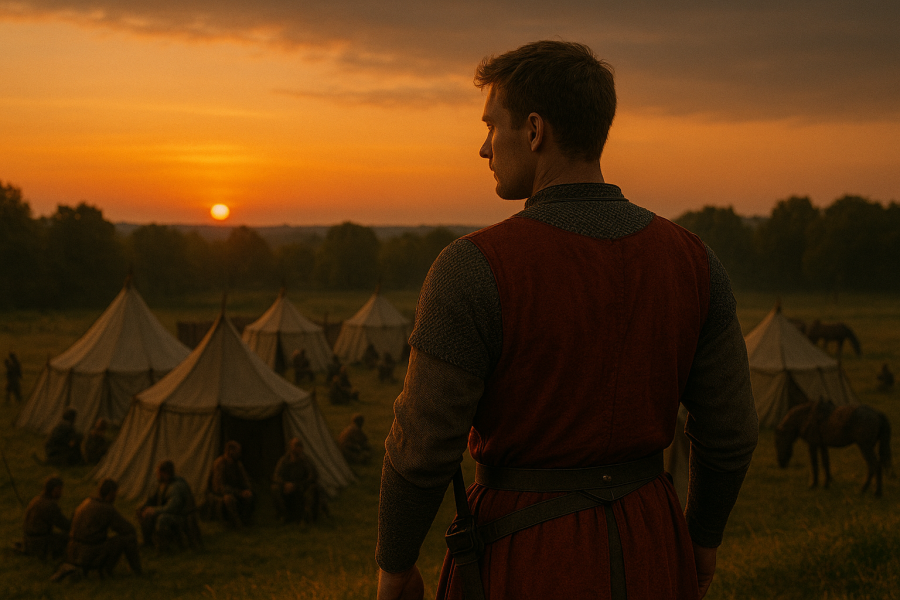
Baudouin feeleth himself borne by the gentle pace of Mars. The English plains be swept by cold winds in this beginning of January. Dark clouds cloth the sky. The moors have been forsaken. The folk have fled the strife and feareth as much the hosts of Stephen as those of Henry. Men driven by hunger and the strain of battle make little difference betwixt their own people and their foe. Some scruple not to pillage in villages as in towns, to bear away jewels, Italian silks, candlesticks of gold… deeds that Baudouin deploreth.
The knight’s thoughts turn toward his own lands and toward Aloïs. The memory of her skin, of her kisses both tender and eager, of her head resting upon his breast as she had fallen into sleep, hath accompanied his long days of travel. He would fain have remained beside her, remained to watch over the castle, over those folk who have placed themselves under his protection. Mayhap he shall have the chance to return once Henry be upon the throne of England.
Yet Baudouin knoweth full well the nature of man and is not deceived. Man ever seeketh to possess, to extend his power and his wealth. When one quarrel seemeth settled on one side, on another a new enemy revealeth himself. And as touching the English crown, they be but at the beginning of a long and wearisome strife.
He casteth a glance upon the host that spreadeth about him. Before them rideth Henry and the great lords with their milites. Companies of mercenaries, summoned by the count, have swollen their ranks. Then come the lesser knights such as he with their servants, whose time of service hath fallen in this season of war, and the footmen who trudge painfully behind with wagons laden with provisions. Winter addeth to the hardship of war. They have crossed the Channel upon a raging sea, so that they feared shipwreck. The troops thereafter went unto Malmesbury, which they took with little resistance. The soldiers of King Stephen had not had time to reach this first town set not far from the coasts.
Henry hath chosen to ride unto Wallingford, which is, it would seem, besieged by the battalions of their adversary. The lord of that place hath pledged his support unto the Angevin, which hath drawn upon him the wrath of his suzerain. Yet for Henry, the need is urgent to succour his ally.
Yvain draweth near unto the count upon his sumpter horse.
— Sire, I was a-wondering… shall we verily fight against the English?
— Unless I be mistaken, we are here for that very end. Wherefore askest thou such a question?
— ’Tis that King Stephen is older. Some say he desireth not the battle.
— Yet he hath a son unto whom he would yield his crown. He shall not suffer Henry to take it from him so lightly.
Yvain seemeth to hesitate.
— I know not what be best.
— What meanest thou by that?
— A fight, it is swift: there is one victor and one…
He draweth a line across his throat and thrusteth forth his tongue.
— Whereas a bench…
— A siege.
— Aye, a siege, that may be long…
Baudouin keepeth silence, thoughtful, and scratch eth the beard that beginneth to cover his cheeks. The shape of a great castle standeth out afar. From where they be, the men may descry the milites of Stephen set about the walls. Trebuchets stand like silent warders. Tents have been pitched farther back and mark the bounds of the enemy’s ground.
The column sloweth by degrees until it cometh wholly to a halt.
— I deem thou shalt soon have answer to thy question.
The host spreadeth out to set their camp. Baudouin receiveth orders from one of the knights of the count’s close guard to form with all haste another line, to bar the passage unto the enemy’s troops.
The soldiers seem all relieved to rest, though the scent of battle already hangeth in the air.
A fine rain falleth suddenly upon the plain. Cold and piercing, it soon weareth upon the spirits of the fighters. Be that as it may, the clash shall not be this night. Fires are kindled and warmeth both soul and limb. Baudouin taketh time to greet his men, filling them with words of cheer.97Please respect copyright.PENANAJomXnOIOos
Losses have been reckoned at Malmesbury, yet none among the band under Baudouin’s command.
He seateth himself beneath a stretched cloth to shield him from the rain, nigh unto the flames. Several footmen have gathered there and swalloweth their supper: dry bread and water wherein cabbages have been set to boil—a feast that shall soon be replaced by rats or other vermin should the strife endureth.
One among them, a certain Macé, shifteth aside to grant him space and offereth him a piece of bread. Baudouin accepteth it willingly.
— I would not have thought the weather so foul in this land, grumbleth he.
The knight draweth a faint smile.
— Hast thou already come hither to fight, sire Baudouin?
— Aye, with Count Geoffroy, father unto Henry.
— I hope we shall have better fortune this time.
— I hope so as well…
— For I would fain return home ere the little one showeth his face.
— Thou art to be a father?
Macé swelleth with pride.
— My third. And I mean not to cease there. ’Tis no displeasing task…
A merry laughter runneth through the company and wringeth a smile from Baudouin.
— And moreover, it giveth more hands for the farm.
The knight can but understand such words, though the thought of begetting children for labor hath never pleased him. Belle is yet small and helpeth at the castle, yet Aloïs taketh care that she may also play. She teacheth her to read and to write, a gift many youths shall never know.
— And thou, sire? Hast thou heirs? asketh another man-at-arms.
Baudouin lifteth his head, somewhat taken aback.
— Nay… I have none as yet.
— It shall come, assureth Macé. Once thou art returned, I am full sure God shall send thee a child.
A sudden thought passeth through the young man’s mind: what if Aloïs beareth his child? The chances be small, yet truly they exist.
If it be so, then hath he yet another cause to hasten home with all speed—hoping only that, ere then, Aloïs committeth no rash deed…
97Please respect copyright.PENANAkgM1bBfZmA
*
97Please respect copyright.PENANASrlIMxfj86
Aloïs hath not closed her eyes the whole night. Sleep hath fled from her, yielding place to dark thoughts. The cold also keepeth her wakeful—the cold and the foul reek mingled with other stench.
The young woman had never deemed she should be taken by men-at-arms. She believed she wrought for the good of her own, and never imagined it might turn against her.
Raoul’s words concerning the dishonor that might fall upon Baudouin tormenteth her. He is in no wise to blame. He judged her not when he learned what she truly was. Her husband’s sole desire was to shield her. Aloïs had sworn to act with prudence—yet she hath failed in that vow.
Yet another thought turneth without cease within her mind: where was the true thief? Since the vicar had shut him in ere coming to warn her, and but one exit lieth within the little church, by what path had the man escaped?
When she arrived, the door was still fast locked. Thus either another held the key and freed him, or… there had never been any bandit. Could Father Gauzbert have imagined it? Or worse, feigned it? But to what end?
He knew naught of her deeds—proof thereof being his astonishment when Raoul tore away her mask. And yet, there cannot be a thousand explanations.
The sound of footsteps maketh her rise. She standeth, knowing the provost’s shape. Raoul’s stern countenance bringeth her no comfort. He biddeth her follow, and she obeyeth at once.
She knoweth not whether her trembling cometh from the cold or from fear as she draweth near the comital palace. They ascend into the aula, which may bode well. Geoffroy, brother unto the Count of Anjou, mayhap desireth not to make public the deeds of Aloïs. Will he show mercy?
Casting her eyes upon her attire, doubt assaileth her: her short and tight-sleeved bliaud presenteth her poorly. It may well stir the noble’s wrath the more. Yet Raoul’s bearing giveth her no will to question aught.
As she entereth the great hall, she starteth upon seeing Enguerrand near the entrance. The young sergeant beareth the marks of a sleepless night, and his pallor striketh her. As she draweth toward the dais, she beholdeth Anselme beside the bishop, which straightway comforteth her. Another man draweth her gaze—her father! Sir Aldebert standeth there, his face undone, his eyes heavy with care.
The seneschal standeth stiff, and beside him sitteth Geoffroy, the count’s younger brother. He doubtless keepeth watch over his brother’s lands in his absence—or perchance pursueth designs less noble. Yet the court is small, which lightneth somewhat Aloïs’ burden.
Raoul presenteth her before the seneschal and the lord of Chinon, recounting the cause that led him to seize the young woman.
— Dame Aloïs hath declared she sought to apprehend one of these thieves that trouble the land, and this I do readily believe.
The accused’s shoulders sink somewhat, eased of part of her dread. He seemeth not to plead against her. Geoffroy casteth upon her a scornful gaze.
— What proveth to me that thou art not the cause of all these thefts? Thou wearest even now the garb of the bandits.
— My lord, beginneth Aloïs, her voice as steady as may be, I give thee my word that I have never stolen aught.
— Why then clothe thyself thus and quit thy domain alone by night? thundereth the count.
— I did so only to strive to seize the outlaw whom Father Gauzbert had shut within.
— Could not thy guards have done this? wondereth the seneschal.
— My guards be but simple freeholders, come in fulfilment of their duty unto us. They know not the art of war.
— Yet thou dost? exclaimeth Geoffroy, in disbelief.
Aloïs trembleth. His words draw her toward a perilous path.
— I did not bethink me, sire; I sought only to aid in bringing these thefts to an end.
The lord rubbeth his cheek.
— What assureth me that thy husband and thou art not the very heads of this band that hath plagued our lands and folk these many years?
— Naught, sire, save my word and my oath upon the Holy Scriptures that we are innocent. My husband fighteth even now beside thy brother to win back the crown that is his due.
Geoffroy riseth, his hands clasped behind his back, and descendeth from the dais to draw near the young woman.
— Aye, he aideth him… Yet shall he remain faithful should my elder brother fail in his promise?
Aloïs parteth her lips, feeling the snare tighten about her.
— I have heard tell, continueth the seneschal, that thou wert grievously wounded not long since, when thy castle was assailed.
Aloïs answereth with a nod.
— An attack that targeted merchants whom thou hadst bidden rest for the night, by the provost’s account.
The seneschal’s eyes narrow. The young woman feareth she knoweth whither this leadeth. From the corner of her eye, she beholdeth Enguerrand draw near. She giveth him a silent command: be still. If she must fall, let her fall alone, without dragging Baudouin and her people with her.
— Aye, we were set upon by thieves.
— A strange happenstance, grindeth the man of law.
Fear suddenly gripeth Aloïs.
— Messire, I beseech thee…
— Enough! thundereth the count. This whole matter seemeth most strange unto me.
He turneth back and seateth himself once more.
— It seemeth to me it would be of interest to question thy husband upon these matters.
— He was absent when the castle was attacked, observeth Anselme.
The archdeacon’s words bring comfort unto Aloïs.
— Be it so—we accuse him not of being among these thieves. Yet if he knoweth not the dealings of his wife, I wonder whether he be fit to hold governance of his lands.
The young woman trembleth.
— Sire, Sir Baudouin is innocent. He protecteth his people and seeth that each liveth aright. He is neither brigand nor weakling.
Aloïs’ voice breaketh. Geoffroy regardeth her with a strange look.
— I cannot yet discern whether I should deem thee a sinner, or but a wife who hath sought to guard her husband’s fiefs in his absence. A sharper questioning might loosen thy tongue—what sayest thou?
He turneth toward the seneschal, when suddenly a cry ringeth out.
— Nay!
The voice of Sir Aldebert riseth in the great hall, striking terror into Aloïs’ heart. She clutcheth the folds of her bliaud, knowing not what might soften the count’s wrath.
— Sire…
Anselme, calm and composed, steppeth forth.
— My sister-in-law hath ever borne herself as a lady of honor. I suggest that, in my brother’s absence, and until this matter be made clear, his wife be entrusted unto the care of a convent. There she may ponder her deeds, for she should never have comported herself thus.
The seneschal draweth near the suzerain and bendeth to whisper words unheard by the rest. The lord draweth a deep breath, never taking his eyes from the young woman.
— I am agreed…
Then, in a loud voice:
— Let her be sent unto my aunt at Fontevraud. Should it be found that thou hast indeed partaken in these thefts, thy punishment shall match thy crimes.
— In that case, addeth Anselme, and that my brother’s honor be preserved, I would request that their marriage be annulled.
Aloïs turneth swiftly toward her brother-in-law. He stirreth not, nor doth he look upon her. He standeth upright, his arms hidden within the sleeves of his robe.
Geoffroy considereth the prisoner long, then answereth coldly:
— It pleaseth me. I am certain my brother shall be of like mind.
He draweth back and casteth his gaze upon the young woman.
— Madam, thou shalt be led unto the abbey of Fontevraud, where thou shalt await thy final judgment. Use this time to repent, and may God guide thy words.
Aloïs lifteth a lost gaze toward the count. How shall she prove her innocence without imperiling Baudouin, Enguerrand, and Jehan? This matter seemeth without escape. She standeth condemned, either unto death, or unto a cloistered life, that no shame fall upon her husband.
— Sire, I beseech thee…
Geoffroy signeth to the guards to take her away. Sir Aldebert hasteneth toward his child and graspeth her hands in his own. The anguish upon her father’s face striketh Aloïs to the heart. Tears run down the furrowed cheeks of the old lord. His lips tremble.
— My daughter…
A guard thrusteth him back, forcing him to withdraw. He stumbleth and near falleth. Suddenly, his face twisteth in pain. He bringeth his right hand unto his heart, gasping for breath. Aloïs feeleth all her limbs tense.
— Father!
The man clingeth to his child’s gaze, then swayeeth and falleth into the provost’s arms.
The young woman crieth out and striveth to break free, yet the guards’ grasp holdeth fast. She is dragged forth from the hall. Her eyes remain fixed upon her father’s body, lying upon the ground. Raoul seeketh to aid him, in vain. And as she is thrust beyond the aula, she beholdeth Sir Aldebert’s eyelids close for the last time.
ns216.73.217.114da2

 and then Add to home screen.