

Aloïs entereth the aula and biddeth the voyer follow her. Enguerrand bringeth up the rear.
— Our round of the domains yieldeth us no further knowledge. All accord that they have been prey to this band, yet I have the sense they entrust me not with all.
Jehan lowereth his head, an ironical smile playing upon his lips. Aloïs letteth forth a small, bitter laugh.
— You think, as well, that Baudouin would have drawn more tidings.
— Doubtless. Yet for now, we know that the misdeeds be wrought all about the town of Angers.
The lady biddeth Enguerrand fetch one of the parchments that Anselme hath brought. She then marketh a central point and addeth places round about.
— We have gone to question the lord of Andard, of Sorges, of Saint-Symphorien, of La Papillaie, of the castle of Iscarbot.
— The monks of the abbey of Saint-Aubin have likewise spoken of thefts upon lands that be theirs not far from Saint-Symphorien, addeth Jehan.
Aloïs sigheth.
— Not one holding seemeth spared round about Angers. They take all: be it harvests, iron, the gold of holy houses, or the tools of husbandmen. They shrink not from strife and smite those who have the mischance to withstand them. This may no longer endure.
The young woman beginneth to pace the chamber, troubled.
— I doubt not the provost doeth his utmost. Yet I cannot fathom why he thus keepeth me apart.
She casteth a glance toward Jehan.
— Though I be a woman, I am likewise charged with my husband’s domain in his absence. I cannot suffer these men to go on in terrorising the land without acting.
She falleth silent. Enguerrand keepeth his eyes upon his young mistress, yet dareth not speak.
— I have begun to train certain peasants and craftsmen of the village and the neighbouring hamlets in the art of combat, saith Jehan. Many would fain defend themselves.
— ’Tis well, yet it sufficeth not.
— Have you a thought? asketh the voyer.
His words sound rather as a certainty and draw a faint smile from the young woman. Aloïs presseth her lip, then turneth to those who, at this hour, be her only allies.
— It seemeth to me we may no longer abide their assaults and content ourselves with striving only to save our lives.
Jehan and the sergeant exchange a questioning look.
— What else may we do? asketh the voyer.
— We might lay a snare for them.
The man starteth.
— I have essayed such before, and keep but a poor memory of it.
Aloïs steppeth toward the table and setteth her hands firmly upon the wood.
— Nay, I speak of a snare more bold, and in a place we might defend, and wherein we might take them.
She fixeth her gaze upon Enguerrand. The young man wideneth his eyes.
— You mean to draw them unto the castle?
— Even so.
— But how? If they have not yet assailed us, we cannot foresee their deeds.
A knowing smile lighteth Aloïs’s face.
— It chanceth that we may have a most precious aid.
She telleth them of the merchants who shall soon come for the fair. Their wares might well stir the covetousness of thieves.
— If we offer the travellers lodging within the castle for the night, and cause the tidings to spread, we may suppose they shall dare seek their prey.
Enguerrand groweth pale.
— ’Tis madness, Dame Aloïs! We lack men-at-arms to secure the place—save we call upon the provost’s aid.
— By no means! answereth the young woman.
The memory of Raoul’s last request suffereth not that she should seek his help.
— We shall have enow with the volunteers of the countryside, thou, Enguerrand, and… and all the guards now within the castle. In sooth, they be never many at their thefts—three or four fellows, by the tellings.
— They might come in greater force, suggesteth Jehan. With such a lure, they will not wish to fail their stroke.
— Doubtless. Yet we shall still have more means than they. What think ye?
The two men look one upon the other again, as troubled as they be thoughtful.
— We shall not twice have such an occasion to put an end to these robberies and violences.
— We might await the return of sire Baudouin, proposeth Enguerrand.
Aloïs casteth aside the counsel.
— By Raoul’s word, the parleys have not even begun. The end of the strife may take days, or even weeks. I will not risk that others be hurt—or worse yet…
— But you, asketh the sergeant, you shall not abide here, shall you? I will not set you in peril.
Aloïs exchangeth a glance with Jehan.
— I might indeed remain in the village, if it ease thy mind.
The man’s shoulders sink, relieved.
— I would fain it be so.
A noise within the bailey maketh them start upright. A rider seemeth to have come in haste.
The lady goeth forth from the hall as Marie hasteneth toward her. Her cheeks flushed, the maid can scarce frame her words.
— What passeth?
The image of Baudouin ariseth before Aloïs’s eyes. May it be that what she feareth most hath come to pass? Is her husband dead?
She graspeth Marie by the shoulders.
— Speak—what hath befallen?
— ’Tis dreadful, my lady…
A sob choketh her anew, and she snuffleth.
— Your mother…
A weight presseth upon Aloïs’s breast.
— My mother? But she was mending…
The maid draweth a deep breath ere she whispereth:
— Nay… ’tis the end…
96Please respect copyright.PENANAspjMaKDVK0
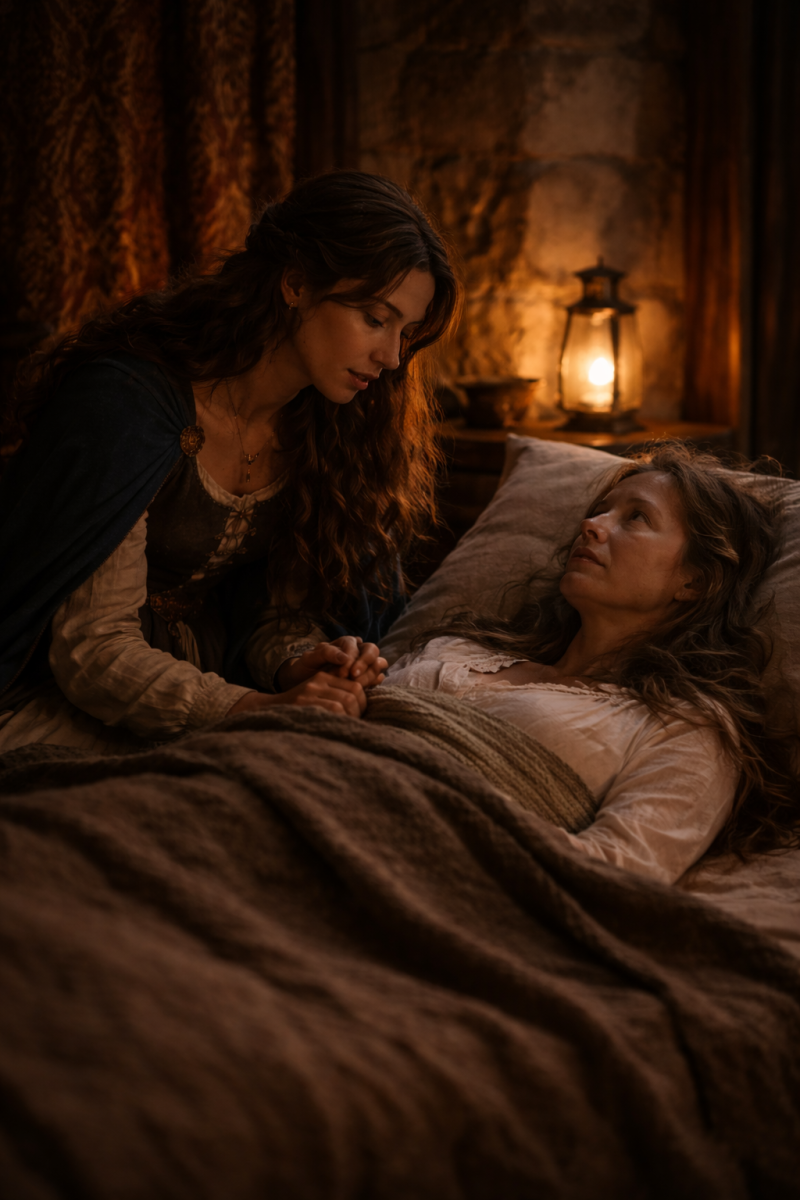
Aloïs hasteneth to the bedside of Dame Hersende. The wasted and pallid face of the dying woman striketh her at once. Her grey lips seem to move, yet no word is heard. A smell of herbs mingled with urine and sweat layeth hold upon the throat. The darkness is but faintly broken by a few candles that yield dim halos of light.
Her father standeth upright near the door. The maid and the servants keep back. A few sobs pierce the silence. The breath of the sick woman is but a faint and stifled thread. Marie hath halted at the threshold and holdeth back her tears as best she may. Aloïs kneeleth beside the bed and gently lifteth her mother’s hand. The woman openeth her eyes a little and turneth toward her child.
— My daughter… thou hast come as well…
— I am here for thee. Thou shalt recover.
Dame Hersende shaketh her head heavily.
— Nay, Aloïs, my path endeth here.
She striveth to draw breath, yet it seemeth a great labour unto her.
— I would ask thy pardon…
The sick woman’s voice breaketh suddenly. Sire Aldebert biddeth all to depart the chamber. He closeth the door behind the servants and turneth again toward his wife, much moved. Aloïs frowneth.
— You owe me no pardon, she reassureth her.
— Yea, I do. I prepared thee not for that which awaiteth thee. I was… undone by the death of Berthe.
A tear glisteneth at the corner of her mother’s eye.
— I shielded thee not as I ought.
Dame Hersende swalloweth.
— Thy uncle did it better than I.
Aloïs starteth. The blood fleeth from her face. She turneth swiftly toward her father, who meeteth her gaze.
— What mean you? asketh the young woman, her stomach knotted.
— I knew… that he taught thee to fight.
Aloïs casteth down her eyes, unable to face her mother.
— He sought only to aid me.
— I know it well… I spake not, for I wist not how to answer. My brother showed good sense. After what befell Berthe…
Once more her breath quickeneth. Then her breast scarce riseth. Dame Hersende speaketh again, her voice grown low:
— Thy uncle would not that such a tragedy befall again.
Aloïs claspeth her mother’s hand more tightly. In her turn, she feeleth a pricking beneath her eyes, and tears well up. Her throat tighteneth.
The woman turneth and graspeth her daughter’s wrist.
— Aloïs, thou couldst not save thy sister. Thou art in no wise to blame.
A sob breaketh from Aloïs’s lips. She presseth her fingers upon her mouth lest her grief pour forth. Tears now run down her cheeks. Dame Hersende wipeth them away with her palm.
— I am proud of the young woman thou hast become…
Suddenly, the lady’s muscles slacken. Her eyes close, then open again a moment after. She fixeth the shut door and frowneth.
— Berthe? Pierre?
Aloïs turneth, yet beholdeth only her father, still unmoving. Both seem alike bewildered to hear her name her two elders, dead these years past.
The woman stretcheth forth her arms toward the phantoms she yet calleth, her mouth half-parted and her gaze made peaceful, ere her eyelids fall. Her hands drop heavily upon the bed.
— Mother!
Aloïs falleth upon the shoulder of the departed, whose breast now stirreth no more. The chill of her cheeks striketh her daughter to the core. She yieldeth at last to her grief—regrets for all that went unsaid, for words of hurt, and for foolish trifles that took their place.
Aloïs feeleth her father’s hand rest upon her shoulder. When she lifteth her pale eyes toward the old man, she perceiveth the boundless sorrow of him who hath shared Hersende’s life.
Sire Aldebert loveth his wife. He loveth her as Aloïs loveth Baudouin.
ns216.73.217.114da2

 and then Add to home screen.