
 98Please respect copyright.PENANAHIJipFup5r
98Please respect copyright.PENANA9yQrQLHX2Q
Benedict came up on deck in his shirtsleeves.
The English coast was receding, the white cliffs dissolving into the morning fog, growing smaller, paler. It was cold, despite the end of June. He shivered. Someone behind him draped a coat over his shoulders. He turned. Caspian was standing beside him, looking at the shore.
Benedict reached out his hand. Caspian took it without a word, without looking. Benedict drew him close and put his arms around him from behind.
They stood like that and watched England disappear.
"Do you regret it?" Caspian asked, his voice low, not turning.
"No," said Benedict.
He held him closer and pressed his cheek to his temple.
"They are my family. I love them."
He spoke quietly, steadily.
"But you are something else. Without you I don't know how to breathe. That isn't a choice, Caspian. It simply is."
Caspian turned his face away.
Benedict saw it anyway. The brightness in his eyes, quickly concealed.
He said nothing. He only held him tighter.
And soon the shore disappeared from view entirely.
***
Rome received them with a warmth that London could not have managed even in July. The air was different: dense and fragrant, smelling of old stone and roasting garlic and something floral that Benedict could never quite name. They stepped out of the carriage on a narrow street in Trastevere, and Caspian stopped and tipped his head back and looked at the sky for a long time.
Benedict looked at him.
"What?" said Caspian, without turning.
"Nothing. Memorising."
"Memorising what?"
"The way you look at the sky for the first time."
Caspian turned with that expression Benedict knew: slightly amused, slightly at a loss, the one he had never learned to manage and had eventually stopped trying to.
"You are insufferable," said Caspian.
"I know." Benedict smiled. "Come. The city is waiting."
***
They found a house in three days.
Trastevere: an old neighbourhood, popular, loud, nothing like London respectability. Streets so narrow two people could barely pass each other. Ochre and terracotta walls, faded and warm. Laundry strung between the buildings. Cats everywhere: on windowsills, on doorsteps, on the hot cobblestones.
The house was modest. On the ground floor: a drawing room with high ceilings, a kitchen, a small study with one window opening onto a tiny courtyard where an orange tree grew. On the upper floor: two rooms and a staircase to the roof. The landlady, Signora Bruno, was an elderly woman with sharp eyes and a way of speaking so quickly that Benedict could not keep pace with her Italian. Caspian answered her evenly, with almost no accent, and she looked at him with respect.
"She is asking whether we have family," Caspian said afterwards.
"And what did you tell her?"
"That we are brothers."
Benedict looked at him.
"Brothers," he repeated.
"It is simpler," said Caspian. "For now."
***
The first morning Benedict woke to light.
London's light had been grey, diffuse, apologetic in its arrival. Roman light was different. It poured through the window uninvited, lay in strips across the floor, reached the bed and his face, and there was no retreating from it.
Benedict lay still and looked at this light.
Caspian was asleep beside him, turned toward the wall, his hair spread across the pillow. His breathing was steady and deep: that rare stillness Benedict had rarely seen in him before.
For a while Benedict lay without moving. Then he leaned carefully forward and touched his lips to Caspian's temple.
Caspian stirred slightly but did not wake.
Benedict rose quietly. From below came the sounds of the street: voices, a cart, someone singing. From somewhere the smell of coffee drifted up.
He went through to the study. He set up his easel at the window. He took out a canvas. He stood before it for a long time without beginning.
Then he picked up a brush.
And started.
He painted all day. Not Caspian, but simply the light. The way it lay against the wall. The way it fell across the orange leaves. How it changed by midday, by three in the afternoon, by dusk. In London there had never been enough of it to study properly.
That evening Caspian looked into the study and stopped at the threshold.
"That is good," he said, looking at the canvas.
"It is an exercise."
"Exercises don't look like that." He came in and stood closer. "You see light differently from other people."
"You hear music differently from other people."
"Music cannot be seen."
"When you play it can."
Caspian said nothing to that. He simply sat beside him.
***
Two weeks passed.
Caspian woke earlier. He rose carefully, trying not to disturb Benedict, finding his shirt by touch in the half-dark.
One morning, as he was about to get up, a hand settled on his waist.
"You think I'm asleep," Benedict murmured, drowsily.
Caspian smiled faintly.
"I was hoping."
Benedict propped himself on one elbow and looked at him with the unfocused gaze of someone barely awake. He pulled him closer and kissed him lazily, without opening his eyes.
"Go," he said, releasing him.
Caspian stayed a moment, looking at him. Then he got up quietly and left. Benedict turned his face back into the pillow and was asleep again almost immediately.
Every morning Caspian went out. Benedict never asked where.
He came back at midday, sometimes later. He smelled of warm street air and tobacco and ink. One day he brought back a sheaf of sheet music and set it on the table as matter-of-factly as if it had been a loaf of bread. On another occasion, a thick Italian dictionary, though his Italian was better than half of Rome's.
Benedict raised an eyebrow but said nothing.
He painted. He sat at the window for hours, working on a canvas, sometimes setting down the brush and simply listening to the house. Below, a door would close, footsteps, sometimes the sound of Caspian's voice, brief and low. And Benedict would pick up the brush again.
One evening the study door creaked softly.
Caspian looked in. He stopped at the threshold and looked at the canvas in silence for a moment, with the expression of a man turning something important over in his mind.
Benedict did not turn. He went on moving the brush across the canvas.
The silence held for a few seconds.
"I found a place," Caspian said at last. "Palazzo Ronconi. On Friday evenings they hold musical gatherings. I spoke with the steward: they are looking for a pianist."
"And?"
"I played something for him." A pause. "He said to come on Friday."
Benedict set down his brush. He turned.
"You're nervous."
"No."
"Caspian."
"A little," he admitted. "It has been a long time since I played for strangers."
"You played for me."
"You are not a stranger."
"You thought I was, at first."
Caspian smiled faintly.
"Do you remember the first evening at Granville's?"
"I remember everything."
"You watched me all evening."
"You were more interesting than everyone else in the room."
"You didn't know me."
"I watched you listen to the music." Benedict lifted a shoulder. "That was enough."
Caspian was quiet for a moment.
"Come on Friday. To the palazzo. If you'd like."
"I'll be there."
***
Palazzo Ronconi was an old house with crumbling plasterwork and magnificent ceilings. The host, a count of about sixty, small and quick, with hands perpetually smeared with paint, turned out to be a painter himself, and he and Benedict immediately found themselves deep in conversation in a corner while the guests took their seats.
Caspian came to the instrument without preamble.
He sat. He placed his hands on the keys. He was still for a moment.
Then he began to play.
Benedict knew this music; he had heard it in the Chelsea house, late in the evenings when the city had gone quiet. But here, in this high-ceilinged room, with the silence of twenty people who had stopped speaking the moment the first notes fell, it sounded different. Larger. Fuller.
Count Ronconi stopped mid-sentence. He turned. He listened.
Caspian played as he always did: not for an audience, not at an audience. Simply played. As though the room were empty. As though this were a conversation with only two participants: himself and the instrument.
When he finished, the silence lasted several seconds.
Then applause.
Caspian rose. He bowed: brief, restrained. He searched the room for Benedict. He found him.
Benedict said nothing. He only looked at him.
Caspian gave a small nod, as though to himself.
After the evening Count Ronconi shook his hand and spoke at length and at speed in Italian. Caspian listened, nodded, answered. Then he came to Benedict.
"He is offering a permanent place. Every Friday."
"Did you accept?"
"Yes."
"How do you feel?"
Caspian considered for a moment.
"Strange," he said. "And good. At the same time."
The room gradually emptied.
Caspian was the last to leave the palazzo. The night was warm, the street nearly empty. The stone still held the heat of the day; the air smelled of wine and dust.
Benedict was waiting for him at the foot of the steps, leaning against the railing.
"Well?" he said.
Caspian stopped beside him.
"I think it went rather well."
Benedict raised an eyebrow.
"You think?"
Caspian lifted a shoulder, as though he were talking about something of no particular consequence.
Benedict looked at him for a few seconds. Then he stepped forward, caught him by the lapel, and kissed him: quickly, decisively, before Caspian could say anything.
Caspian went still with surprise.
Benedict was the first to pull back.
"That is for pretending you don't know how you play," he said.
Caspian looked at him for a moment. Then he smiled, slowly. He took Benedict's hand.
"Let's go home."
They went down the steps and along the quiet street, from whose open windows music was still drifting.
***
Life arranged itself quietly, without effort.
Benedict painted every day. In the mornings in the study: light and the orange tree. In the afternoons he went out to the piazzas, the markets, the fountains. Rome was inexhaustible: every corner, every wall, every face. He painted everything indiscriminately, with the hunger of someone who had lived too long in scarcity.
Count Ronconi introduced him to several people. One turned out to be an art dealer, who bought three works on the spot and asked for more. Another was an English traveller of the kind who tours Europe and brings something beautiful home as a keepsake: he commissioned a portrait of his wife.
The money was modest, but it was enough.
Caspian gave music lessons, having found two pupils through Ronconi. He played on Fridays. Occasionally he was invited to other houses. Gradually, in this city, he acquired a name.
Not the name he had carried before. A new one.
His own.
***
One evening they were walking home through Piazza di Santa Maria when Caspian stopped at the fountain. It was a warm evening, and the square was alive: children, old men, couples. The lamps were lit. Water splashed.
"I was here once," said Caspian. "Long ago. I was about nineteen; I came with friends for a month." He was looking at the fountain. "We sat right here one evening. A woman was eating ice cream and telling her companion that Rome was the only city that knew how to be beautiful without trying. I remembered that."
"Why?"
"I don't know." A pause. "I suppose because it was true."
He was quiet for a moment.
"I thought then that I would come back. That I would have time." A brief pause. "Then I stopped thinking about it."
"But you came back."
"I came back." He turned to Benedict. "With you."
Benedict said nothing.
They stood at the fountain a little longer. Then they walked home.
***
A month later the first letter arrived from Violet.
Benedict read it aloud in the kitchen while Caspian made coffee. His mother wrote at length, as she always did: about Anthony, about Daphne's children, about Gregory having got into some fresh mischief, about the weather, which had been dreadful, about a good tailor she had found for Colin and Colin's resistance to the whole enterprise.
And at the end, a few lines:
*How are you settled, my dear? And how is Caspian? I hope you are both well, eating properly, and that you are not driving yourself into the ground with work and are managing to sleep occasionally. V.*
"She wrote 'both of you'," Caspian observed.
"Yes."
"She included me."
"Of course she did."
Caspian set a cup in front of him. He sat down opposite.
"Write to her today. Tell her about Palazzo Ronconi and the Count. She will like that."
"You want me to write to my mother about your performance?"
"I do." Simply, without explanation. "I think she would be glad to know."
Benedict looked at him: at that face, calm and faintly self-conscious, bearing no resemblance to the closed face of the man who had not been permitted to leave the Chelsea house.
"All right," he said.
He wrote that same day. A long letter. About Rome, about the light, about the orange tree in the courtyard. About Palazzo Ronconi, and how Caspian had sat down at the instrument and the room had gone silent within four bars. About how Count Ronconi had paint on his hands and understood painting better than half the critics in London.
About how everything was well. Genuinely well.
***
Eloise's letter arrived a week later. Three pages in close handwriting, with the questions numbered: she always numbered them when there were many. About Rome, about the Italian language, about whether Caspian had read the modern Italian philosophers and what he made of them, about whether there were good bookshops in Rome and if so what was the address.
Caspian read the letter with the expression of someone simultaneously baffled and moved.
"She wants to know my opinion of Leopardi," he said.
"Then answer her yourself."
"Me?" Caspian looked up.
"She is asking you. So you reply." Benedict kissed him on the temple. "And add a few lines for me while you're at it."
Caspian looked at the letter. Then he reached for a sheet of paper.
He and Eloise began a correspondence that lasted for years.
***
October brought rain.
Not the London kind: that had been grey and unending. Roman rain was brief and violent, arriving without warning, hammering the roof tiles and vanishing, leaving wet shining stones and the smell of damp earth.
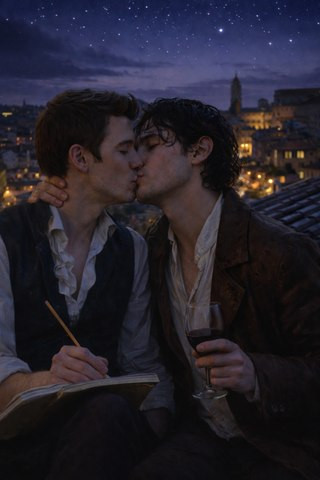
One such evening they were sitting on the roof.
The rain had just stopped. The tiles still gleamed. Above the city hung a deep blue sky, almost violet, with the first stars appearing. Below, Trastevere was alive: voices, laughter, music from a tavern somewhere nearby.
Benedict sat with a sketchbook on his knee. Caspian was beside him, looking at the city, holding a glass of wine he was barely drinking, simply holding. His hair still damp from the rain. His profile in the lamplight.
Benedict picked up his pencil. He began.
Caspian felt the gaze, and turned.
"Again," he said.
"Again."
"You have drawn me so many times I lost count long ago."
"So have I," said Benedict, without looking up from the page. "But it is different every time. You are different every time."
Caspian was quiet. Then he said, looking out at the lights below:
"I used to think a life like this didn't exist."
"Like what?"
"Simply living. Simply being. Without the fear of someone watching from around the corner. Without names that aren't yours." A pause. "For five years I told myself this was impossible for me. That there are people to whom ordinary life is given, an ordinary morning, an ordinary day, and there are people to whom it isn't." He turned to look at Benedict. "I thought I was one of the second kind."
"And now?" Benedict asked.
Caspian looked at that face: so dear, so painfully familiar, with ink on the fingers and pencil marks on the wrist.
"Now it turns out it does exist," he said.
Benedict smiled. He looked back down at the page.
Caspian watched him for a moment. Then he leaned forward and kissed him quietly, unhurriedly, as though it were the most natural continuation of the conversation.
Benedict held his breath for a moment. Then he answered.
When they drew apart, he picked up his pencil again.
"Don't move," he said.
"I wasn't moving."
"You always move."
Caspian smiled and turned back to the lights of the city.
Benedict went on drawing.
Rome breathed around them in the warm evening. The roof tiles were drying. The stars were multiplying. From the tavern on the next street music spilled out, fast and joyful and entirely unfamiliar.
Caspian listened to it for a moment. Then, quietly, almost soundlessly, he began to whistle along.
Benedict heard it. He did not look up. He only smiled, at the corner of his mouth, and went on drawing.
They were home.98Please respect copyright.PENANAIiAQrlw6Vv


 and then Add to home screen.