

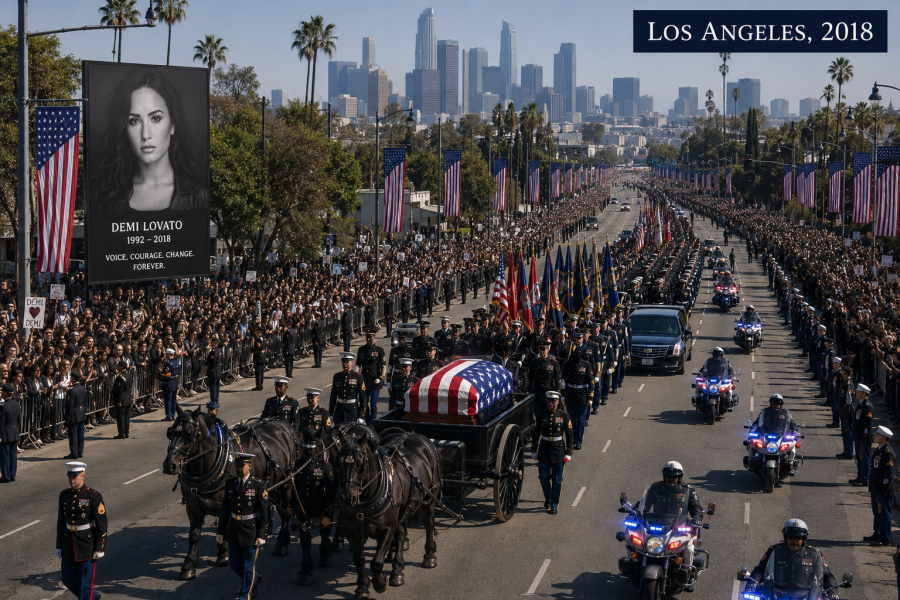
So vast was the procession on the autumn morning when Demi Lovato came home that the crowds lining the streets of Los Angeles could scarcely comprehend what they were seeing. For three weeks the world had watched the search unfold across the Maasai Mara, had listened to rumors and denials, had followed the reports of Kurdish horsemen, Kenyan rangers, federal agents, and the stubborn Chicago private investigator Jack Malloy as they combed the grasslands beneath the African sun. Then came the message none had wished to hear. Found. Identified. Returning home.
Now they stood in silence as the cortege emerged beneath a cloudless California sky. Military honor guards marched in perfect cadence beside the caisson. Behind them rode police commanders, governors, ambassadors, cabinet secretaries, generals, admirals, tribal elders from Kenya, representatives of nations great and small, and delegations from every corner of a world that had somehow become invested in the fate of a single missing singer. Flags hung at half-staff from government buildings. Church bells tolled from distant neighborhoods. Helicopters circled high overhead. Cameras transmitted every movement to hundreds of millions across six continents. The mourners represented dozens of nations and countless causes, united for a few brief hours by grief, curiosity, reverence, or the uneasy sense that they were witnessing more than a funeral.
To those gathered along the route, it seemed the culmination of a tragedy. To history, it would appear something else entirely. The body that Kurdish riders and Jack Malloy had found among the grasses of the Mara had not merely ended a search. It had set in motion forces that governments would soon struggle to control. As the procession moved slowly toward Forest Lawn and the roar of the crowd fell silent, few understood that they were not only burying Demi Lovato. They were burying the last certainty of the world that had existed before she disappeared.
Among the foreign delegations were ambassadors from nations that scarcely maintained relations with one another and representatives of governments that only months before had exchanged threats across contested frontiers. The Kurdish community of Los Angeles was represented by the aging horsemen whose persistence upon the Mara had helped bring the search to its conclusion. Kenyan officials who had overseen the recovery stood beside American investigators who had spent sleepless weeks pursuing every rumor and every false lead. Detectives from Los Angeles shared a quiet conversation with federal agents. Military officers exchanged nods with journalists who had followed the case from the first frantic hours after Demi's disappearance. For a single morning, enemies, rivals, allies, and strangers occupied the same ground.
No figure attracted more attention than Jack Malloy. Uncomfortable beneath the attention and visibly ill at ease among presidents, ambassadors, and television celebrities, the Chicago private investigator remained the accidental hero of the affair. His suit lacked the precision of the diplomats around him, and his weathered face bore the marks of long days beneath the African sun. Yet cameras followed him wherever he moved. The public had transformed him into something between a detective, an explorer, and a folk hero. He neither sought nor welcomed the distinction. Friends later remarked that Malloy spent much of the ceremony staring at the casket and avoiding the cameras, as if unable to understand how the lonely search through the grasslands of Kenya had ended here amid the assembled authority of half the world.
Near him stood members of the search party whose names had become familiar to millions through weeks of relentless media coverage. Rangers, pilots, trackers, intelligence officers, and volunteers found themselves thrust into a spotlight they had never expected to occupy. Their presence served as a reminder that the ceremony's central figure had not died in a hospital, a hotel, or a home. She had been found far from civilization, amid the immense silence of the Mara, where the search had become a global obsession and where, for a brief period, the world's attention had converged upon a patch of African grassland.
The mood among the mourners was not entirely one of grief. Beneath the solemnity lay uncertainty. Rumors persisted regarding the circumstances of Demi Lovato's death. Intelligence services guarded their conclusions. Politicians avoided direct accusations while carefully preparing their audiences for what might follow. Military planners, though invisible to the crowds lining the streets, had already begun revising contingency plans in capitals thousands of miles apart. Few among the spectators understood this. To them, the day belonged to remembrance. To the governments represented in the procession, it was increasingly becoming something else.
As the cortege advanced through Los Angeles beneath a blue sky, television cameras lingered upon the faces of the assembled dignitaries. Years later, historians would study those images with extraordinary care. They would identify future presidents, generals, revolutionaries, and future architects of war standing together in apparent harmony. The world they inhabited still believed itself at peace. Yet many of the forces that would shape the coming crisis were already present along the route to Forest Lawn, hidden behind black mourning clothes, diplomatic smiles, and carefully rehearsed expressions of grief.
The future source of tragedy was not immediately apparent among the dignitaries assembled that morning. The television cameras, like the crowds lining the boulevards, naturally gravitated toward the famous. They lingered upon presidents, senators, governors, celebrities, and military commanders whose names already occupied headlines. Few paid much attention to the younger officials standing several rows back, to the intelligence analysts quietly exchanging observations, or to the officers whose responsibilities had little apparent connection to a funeral. Yet it was among these less celebrated figures that history would later find many of the architects of the age that followed.
Years afterward, journalists and historians would examine the footage frame by frame. They would identify future cabinet secretaries, future intelligence chiefs, future commanders of expeditionary forces, and future opposition leaders who stood together that day in apparent harmony. Some would eventually advocate restraint. Others would demand retaliation. Several would become bitter rivals. A few would later deny that the funeral had influenced their thinking at all. The record suggests otherwise. Again and again, in memoirs, speeches, and private correspondence, participants returned to that day in Los Angeles and to the emotions it had awakened.
Most striking among the mourners was the contrast between public certainty and private confusion. The crowds believed the essential facts were known. Demi Lovato had vanished in Kenya. An immense search had followed. Kurdish riders and the Chicago investigator Jack Malloy had found her. She had come home. The story, though tragic, seemed complete.
It was not.
Behind the scenes, governments were struggling with questions for which no satisfactory answers yet existed. Intelligence agencies possessed fragments but not conclusions. Diplomats had suspicions but lacked proof. Military planners were receiving reports whose implications remained uncertain. The search itself had uncovered anomalies that could not be easily explained and which responsible officials were reluctant to discuss publicly. The gap between what the public believed and what governments feared was widening by the day.
President Trump, while maintaining the solemn dignity expected of the occasion, had already received a series of classified briefings whose contents would remain disputed for years. Members of his administration emerged from those meetings with sharply different interpretations. Some regarded the matter as a criminal investigation of extraordinary scale. Others believed they were witnessing the opening phase of a deliberate international provocation. The disagreement remained hidden from public view, concealed beneath the outward unity displayed along the funeral route.
Among foreign delegations, the uncertainty was even more pronounced. Representatives from allied nations sought reassurance that the United States would proceed cautiously. Others quietly wondered whether Washington already knew more than it was willing to disclose. Ambassadors exchanged pleasantries for the cameras while dispatching increasingly urgent reports to their capitals. Every government present understood that an event capable of drawing such an assembly of power possessed significance beyond mourning alone.
No one embodied this uncertainty more completely than Jack Malloy. Unlike the officials around him, he possessed neither a staff nor an intelligence service. He had no access to satellite imagery, intercepted communications, or classified assessments. Yet he carried something many of them lacked: firsthand knowledge of the final days of the search. He knew what had been found. He knew what had not been found. Most importantly, he knew how many questions remained unanswered. While statesmen discussed consequences and journalists searched for meaning, Malloy remained troubled by details that refused to fit neatly into any official narrative.
The funeral, therefore, unfolded in two dimensions. In one, visible to millions of viewers, it was an act of collective mourning for a woman whose life had touched an extraordinary number of people. In the other, visible only to a handful of participants, it marked the beginning of a struggle over facts, responsibility, and power whose consequences had yet to reveal themselves. The two realities coexisted uneasily throughout the day, intersecting only in the polished casket moving slowly toward Forest Lawn.
For the moment, however, grief still prevailed. The bells continued to toll. The honor guards maintained their measured pace. Along the route, people wept openly, held flowers aloft, and stood in silence as the procession passed. Whatever storms might gather afterward belonged to the future. On that day, Los Angeles concerned itself only with saying farewell.
History, however, had already begun taking notes.
The gathering at Forest Lawn possessed no royal genealogy to rival that of Edward VII's Europe, yet it was linked by ties no less intricate. The mourners belonged not to dynasties but to institutions, governments, movements, and media empires whose influence stretched across continents. Their connections were forged not by blood but by politics, commerce, intelligence, celebrity, and the instantaneous communications of the twenty-first century.
Among those present were figures who had spent years denouncing one another on television and in legislative chambers. There were governors who would soon become presidential candidates, cabinet secretaries destined to leave office under controversy, military officers who would later command armies, and journalists whose reporting would shape public understanding of the crisis. Future allies and future enemies stood shoulder to shoulder beneath the California sun, united for a few brief hours by ceremony and uncertainty.
The entertainment industry, from which Demi Lovato had emerged, was represented in numbers never before seen at a funeral. Actors, musicians, producers, broadcasters, and executives occupied entire sections reserved for invited guests. Some had known her personally. Others had met her only in passing. Still others attended because her death had become something larger than the loss of a performer. As with the politicians and diplomats, few among them understood what role they would later play in the events to come. Yet many would eventually discover that they had attended not merely the end of a life but the beginning of an era.
Particularly striking was the uneasy coexistence of official authority and public sentiment. The assembled dignitaries possessed immense power, yet much of the momentum driving events originated elsewhere. Millions of ordinary people had followed the search from its first days. They had watched the reports from Kenya, argued over theories, organized vigils, contributed funds, and transformed an individual tragedy into a shared international experience. Governments could influence policy, but they could not easily control the emotions that now surrounded the case.
The result was an atmosphere unlike that of any previous American funeral. It combined the solemnity of a state occasion, the publicity of a major media event, and the emotional intensity of a national mourning. Historians would later struggle to categorize it. Some compared it to the funerals of presidents. Others likened it to the public mourning that followed national tragedies. None of the comparisons proved entirely satisfactory. The event occupied a category of its own.
As the procession advanced, commentators repeatedly observed the diversity of those in attendance. Veterans stood beside activists. Police officers stood beside civil-rights advocates. Religious leaders shared space with celebrities. Delegations arrived from countries that disagreed on nearly every major issue confronting the international system. Yet for one day, these differences receded into the background.
The harmony was real enough, but it was temporary.
Beneath the outward unity lay competing interpretations of what Demi Lovato's death meant. To some, it represented a criminal act demanding justice. To others, it suggested a failure of governments and institutions. To still others, it was evidence of deeper forces at work in the international system. These interpretations remained largely unspoken during the funeral itself, but they would emerge with increasing force in the months that followed.
Looking backward, historians identified many future turning points among the mourners gathered that day. They pointed to officials who would later advocate intervention and to politicians who would insist upon neutrality. They noted future presidents, opposition leaders, intelligence chiefs, and military commanders. They observed that some of the loudest voices urging restraint were already present, though few paid them much attention at the time.
One of those voices belonged to a senator from California named Kamala Harris.
At the funeral, she was the only figure among hundreds of distinguished attendees. Cameras occasionally captured her in the crowd, but she attracted little special notice. Years later, that obscurity would seem remarkable. When the conflict in East Africa expanded and pressure mounted for American involvement, it would be Harris who most clearly articulated the position favored by much of the public. The war, as it was then known, was an African war. America, she insisted, must not allow grief, anger, or speculation to draw it into another distant conflict.
At Forest Lawn, that argument still belonged to the future.
For the moment, the bells continued to ring, the honor guards maintained their measured pace, and the assembled nations watched as the casket moved toward its final resting place. The great questions that would dominate the next decade had not yet been asked aloud. They waited, like unseen guests, beyond the cemetery gates.
Yet neither the scale of the funeral nor the shock of Demi Lovato's death fully explained the extraordinary international response. Deaths of famous entertainers, however tragic, did not ordinarily bring presidents, ambassadors, military commanders, and foreign delegations together in such numbers. Nor did they provoke weeks of continuous global coverage, emergency diplomatic consultations, and the deployment of resources on a scale normally reserved for international crises. Something more was involved.
Part of the explanation lay in Demi herself.
For more than a decade she had occupied an unusual position in public life. She was not merely a singer, actress, or celebrity. Through candor about addiction, mental illness, recovery, and personal struggle, she had established a relationship with audiences unlike that enjoyed by most public figures. Millions who had never attended a concert or purchased an album nevertheless felt that they knew her. Her life had unfolded before the public not as a succession of triumphs but as a series of battles, setbacks, recoveries, and reinventions. Admirers who agreed on little else often agreed about her.
The effect was not political in the conventional sense. Demi held no office, commanded no army, and represented no government. Yet she possessed something increasingly rare in the fragmented world of the early twenty-first century: the ability to attract attention across ideological, national, and generational boundaries. Conservatives and progressives, Americans and foreigners, celebrities and ordinary citizens, all found reasons to follow her story. Few public figures could unite such disparate audiences even briefly. Fewer still could do so after death.
As a result, the search across Kenya became more than a missing-person investigation. It evolved into a global narrative. Each development was reported in real time. Every rumor traveled instantly across continents. Satellite channels interrupted programming. Newspapers devoted front pages to events occurring thousands of miles away from their readership. Social-media networks carried eyewitness accounts, speculation, misinformation, and genuine news in equal measure. By the time Kurdish riders and Jack Malloy discovered the body on the Mara, hundreds of millions of people already felt emotionally invested in the outcome.
Governments soon discovered that they, too, had become participants in the story.
What began as consular assistance expanded into diplomatic engagement. What began as police cooperation evolved into intelligence cooperation. Agencies that ordinarily shared little information suddenly found themselves exchanging reports. Foreign ministries monitored developments with unusual care. Political leaders who had never met Demi Lovato nevertheless found themselves answering questions about her disappearance and its implications.
No one intended this outcome.
Indeed, many officials initially regarded the affair as a temporary media obsession that would fade once the facts became known. Experience suggested that public attention was fleeting. Crises emerged and disappeared with remarkable speed. Yet the expected decline never occurred. Each answer generated new questions. Each revelation intensified interest rather than satisfying it.
The phenomenon puzzled contemporary observers. Historians would later find it easier to explain. They argued that the world of 2018 possessed all the mechanisms necessary to create a truly global emotional event but had little experience managing the consequences once such an event occurred. Technology allowed billions of people to witness the same story simultaneously. Political institutions, designed for an earlier age, struggled to adapt.
The result was a curious imbalance. Public emotion surged ahead while governments struggled to determine what, if anything, should be done. The gap widened steadily throughout the months following the funeral.
At first, this produced only confusion.
Later, it would produce policy.
Still later, it would produce war.
Yet on the day of the funeral, these possibilities remained largely invisible. The crowds gathered along the route did not cheer military action. The dignitaries assembled at Forest Lawn did not speak of mobilization. The most commonly expressed hope was that the tragedy would soon come to an end and that the world might return to its ordinary concerns.
In retrospect, this hope appears touching in its innocence.
The funeral that marked the conclusion of the search proved, in fact, to be only the beginning.11Please respect copyright.PENANAbG9guHlmx2

The comparison was imperfect, yet contemporaries searching for an explanation often arrived at a similar conclusion. Demi Lovato possessed no formal authority and exercised no influence over state policy. Nevertheless, through the peculiar mechanisms of modern celebrity, she had helped create connections that governments themselves frequently struggled to establish.
Her influence was neither diplomatic nor ideological. It was cultural. Through music, interviews, advocacy, and an unusually public struggle with personal adversity, she reached audiences divided by nationality, language, religion, and politics. Fans in countries whose governments distrusted one another often found themselves participating in the same communities, consuming the same media, and discussing the same events. The bonds were informal and intangible, but they were real.
This became particularly evident during the search in Kenya.
Long before her body was found upon the Mara, the disappearance had begun generating cooperation among groups whose paths seldom crossed. American investigators worked alongside Kenyan authorities. Kurdish horsemen rode beside local trackers. Journalists shared information with diplomats. Volunteers arrived from multiple continents. Social-media networks translated developments into dozens of languages almost instantaneously. What began as an effort to locate one missing woman gradually evolved into an international undertaking whose participants often struggled to explain why they had become involved.
The phenomenon puzzled officials.
Several governments privately concluded that the emotional response far exceeded anything rationally justified by the circumstances. Yet those same governments found themselves responding to public pressure generated by the affair. Ministries issued statements. Legislatures held hearings. Intelligence agencies devoted resources. Political leaders who had never previously mentioned Demi Lovato discovered that reporters asked about little else.
The cumulative effect was subtle but significant. Relationships formed during the search persisted afterward. Information-sharing arrangements established temporarily became more permanent. Personal connections survived the conclusion of the operation. Individuals who had met in Kenya remained in contact. Networks created by tragedy acquired a life of their own.
At the time, few observers regarded these developments as historically important.
Indeed, many considered them temporary and largely sentimental. Once the funeral concluded and public attention shifted elsewhere, the expectation was that the world would return to normal. Governments would resume their usual concerns. The search teams would disperse. The media would find another story.
Events did not proceed as expected.
Instead, the disappearance and death of Demi Lovato became a reference point. Politicians invoked it. Activists organized around it. Journalists continued investigating it. Intelligence agencies continued examining it. Every new revelation attracted fresh attention. Every unanswered question generated further speculation.
What Edward VII had accomplished through personal charm and royal prestige, Demi Lovato achieved through the mechanisms of a global media age. Neither intended to alter the relationships among nations. Yet both became focal points around which larger forces organized themselves.
The consequences would prove difficult to foresee.
Standing beside the grave at Forest Lawn, the mourners believed they were witnessing the end of a story. Historians later concluded they were witnessing the beginning of one. The search had concluded. The funeral was underway. Yet the political, social, and international repercussions of the affair were only beginning to emerge.
Many of the men and women gathered there would spend the next decade attempting to manage those repercussions.
Some would succeed.
Most would fail.
And several, though they did not yet know it, would help transform what was still commonly called the War in Africa into something vastly larger and far more dangerous.11Please respect copyright.PENANACnNHAN2K90
11Please respect copyright.PENANAjDVgcRqEhK
11Please respect copyright.PENANAwZgn48bsDT
The significance of Demi Lovato's death lay not in any immediate political consequence but in the manner by which it rearranged perceptions. Like many events later described as historic turning points, its importance was not obvious at the time. No declarations were issued. No armies marched. No governments announced dramatic policy changes. The world that gathered at Forest Lawn still regarded itself as fundamentally stable.
Yet certain assumptions had begun to change.
Before the disappearance in Kenya, relations among many of the individuals, organizations, and governments involved had been limited, routine, or occasionally hostile. The search altered these relationships. Participants who might otherwise never have encountered one another found themselves working toward a common objective. Information flowed through channels previously unused. Temporary partnerships emerged. Professional rivalries softened. New friendships formed.
Most of these developments appeared insignificant.
History often disguises itself in this fashion.
Observers searching for dramatic causes are frequently disappointed. The larger transformations occur quietly, hidden beneath routine decisions and apparently temporary arrangements. Years later, participants struggle to identify the precise moment when circumstances began to change because no single moment existed. The change emerged from accumulation.
So it was after the funeral.
American investigators remained in contact with counterparts abroad. Journalists who had covered the search continued exchanging information. Charitable organizations expanded operations in regions that had previously attracted little international attention. Legislators demanded reports. Diplomats requested briefings. Intelligence services maintained an interest in developments whose significance remained unclear.
None of this appeared unusual.
What appeared unusual was the persistence of public attention.
Convention suggested that interest would fade. A funeral ordinarily marked the end of public engagement. Yet in this case, the opposite occurred. The ceremony at Forest Lawn did not close the story. It transformed it. Millions who had followed the search now began asking why the tragedy had occurred. Governments found themselves under growing pressure to provide answers they did not possess.
The result was not agreement but divergence.
Different groups drew different conclusions. Some believed the affair demonstrated the dangers faced by travelers in unstable regions. Others interpreted it as evidence of broader geopolitical failures. Still others viewed it primarily as a humanitarian tragedy. Each interpretation carried implications, and each attracted supporters.
The emerging debate crossed national boundaries.
What had begun as an American celebrity story increasingly became an international discussion. Newspapers in Europe, Asia, Africa, and Latin America devoted extraordinary attention to developments. Political leaders discovered that questions concerning Demi Lovato could not easily be dismissed as entertainment news. The subject had entered public life through a different door.
Looking backward, historians identified this period as one of growing uncertainty. Looking forward, contemporaries saw only confusion.
The distinction is important.
There existed, as yet, no consensus regarding what the future would bring. The phrase "War in Africa," later so familiar, had not yet entered common usage. Most observers expected tensions to diminish rather than increase. The prevailing assumption was that governments, once supplied with sufficient information, would resolve outstanding questions and move on to more pressing concerns.
Among those holding this belief were many of the same political leaders who stood beside Demi's grave.
Future President Kamala Harris would later build part of her national reputation upon the conviction that America must avoid foreign entanglements arising from the affair. She was hardly alone. Across the political spectrum, influential figures assumed that whatever difficulties emerged would remain regional, limited, and ultimately manageable.
Few predictions have aged more poorly.
Yet at the time, they appeared entirely reasonable.
The mourners departed Forest Lawn convinced they had witnessed the conclusion of an extraordinary tragedy. None could know that historians would eventually identify the funeral not as an ending but as a beginning—the moment at which countless separate threads, political, cultural, diplomatic, and personal, began slowly converging toward a future no one yet imagined.
No comparable appetite for conquest animated the world that gathered after Demi Lovato's death. The powers represented at Forest Lawn were not preparing for war. Indeed, most were attempting to avoid one. Yet they suffered from a different affliction: the conviction that they understood events better than they actually did.
Governments believed they could manage public expectations. Intelligence services believed they could separate fact from rumor. Journalists believed that enough investigation would eventually reveal a coherent explanation. Political leaders believed that patience would calm emotions and restore perspective.
In this, they were united.
In this, they were mistaken.
The difficulty lay not in the known facts but in the unknown ones. By the conclusion of the funeral, the world possessed an abundance of information and a shortage of certainty. The disappearance, the search, the discovery upon the Mara, the return to Los Angeles—these events were established. Their meaning was not.
As a result, every institution began constructing its own interpretation.
Law-enforcement agencies regarded the affair as a criminal matter. Diplomats treated it as a sensitive international question. Intelligence services searched for hidden actors and concealed motives. Politicians viewed it through the lens of public opinion. Media organizations transformed it into an ongoing narrative followed by millions. Each perspective captured part of the truth. None captured the whole.
The resulting confusion created strange and unexpected alignments.
Individuals who ordinarily disagreed found themselves advocating similar positions. Political rivals reached identical conclusions for entirely different reasons. Governments that distrusted one another nevertheless exchanged information. Organizations with no previous relationship discovered common interests. The process was subtle and often invisible, yet it steadily altered the landscape in which future decisions would be made.
Particularly noteworthy was the emergence of a broad consensus, extending across much of the political spectrum, that the United States must avoid becoming excessively involved in whatever consequences followed. The prevailing view held that the tragedy, however heartbreaking, remained fundamentally a regional matter. Kenya was distant. East Africa was distant. The search had become global because Demi Lovato herself was global, not because the underlying events possessed significance.
This assumption appeared self-evident.
Future President Kamala Harris would later give voice to it more effectively than most, but she was far from alone. Editorial boards, congressional leaders, foreign-policy specialists, and ordinary citizens frequently arrived at the same conclusion. Sympathy required no intervention. Mourning required no military commitment. Justice, whatever form it eventually assumed, could be pursued through law and diplomacy.
To many observers, this seemed the lesson of the affair.
Others drew a different lesson.
Among intelligence officials, security planners, and certain diplomats, concern persisted that important elements of the story remained concealed. These concerns did not yet amount to a coherent theory. They were instincts rather than conclusions, fragments rather than a narrative. Nevertheless, they existed, and they prevented the matter from being entirely laid to rest.
What distinguished these observers was not superior knowledge but uncertainty. While others felt confident enough to explain events, they remained troubled by questions for which no satisfactory answers had emerged. They occupied an uncomfortable position. Possessing insufficient evidence to persuade others, they nevertheless doubted the prevailing optimism.
The tension between these two outlooks would become one of the defining characteristics of the years that followed.
One side believed the world was witnessing the aftermath of a tragedy.
The other suspected it was witnessing the beginning of something larger.
Neither side could prove its case.
The funeral, therefore, closed amid an unusual combination of unity and disagreement. The mourners agreed that Demi Lovato deserved remembrance. They agreed that her loss was significant. They agreed that the search and recovery had touched millions of lives.
Beyond that, certainty faded rapidly.
History often grants later generations the illusion that great events announce themselves clearly. In reality, they rarely do. More often, they arrive disguised as something smaller, understood only imperfectly by those living through them.
Such was the atmosphere in the months after the funeral.
The world had not yet entered a period of conflict.
It had entered a period of questions.
11Please respect copyright.PENANARdfMR13PvC
11Please respect copyright.PENANA245KU8Ebog
The years immediately following Demi Lovato's funeral were marked not by crisis but by confidence. If anything, the dominant mood among governments, commentators, and ordinary citizens was reassurance. The tragedy had been immense, the public response unprecedented, but the prevailing assumption held that the affair would gradually recede into memory.
This belief rested upon arguments that appeared entirely sensible.
The modern world, observers pointed out, was too interconnected for serious international confrontation. Nations traded with one another on an unprecedented scale. Information moved instantly across borders. Financial markets linked continents together hour by hour and minute by minute. No responsible government would jeopardize prosperity over an event that, however emotionally powerful, remained fundamentally non-strategic.
The argument possessed considerable appeal.
Editorials appeared in newspapers across Europe and North America emphasizing the same theme. Whatever questions remained concerning Demi's death, they were questions for investigators, diplomats, and courts—not armies. Public sympathy was universal. Political interests were diverse. No government possessed either the desire or the incentive to transform mourning into confrontation.
Many experts considered the matter settled.
The search itself was frequently cited as evidence. Hadn't governments cooperated? Hadn't agencies shared information? Hadn't people from dozens of countries worked together toward a common goal? If anything, the tragedy seemed to demonstrate humanity's capacity for collaboration rather than conflict.
The conclusion appeared obvious.
What many failed to appreciate was that the same event could support entirely different interpretations.
To some observers, the international cooperation surrounding the search represented proof that existing institutions were functioning effectively. To others, it revealed how fragile those institutions had become. They noted that many of the arrangements established during the search depended upon personalities rather than procedures, improvisation rather than structure. Cooperation had occurred, certainly. Yet it had often occurred despite bureaucratic obstacles rather than because of them.
The distinction attracted little public attention.
What attracted attention instead was the remarkable growth of what journalists began calling the "Mara generation"—millions of people whose political awareness had been shaped by following the disappearance and search in real time. They crossed national boundaries, belonged to no party, and rarely agreed among themselves. Yet they shared one characteristic. They believed the story was unfinished.
This conviction exerted a subtle influence upon public life.
Questions continued to be asked. Investigations continued. Books appeared. Documentaries were produced. Congressional committees requested reports. Parliamentary inquiries were convened abroad. Each new effort promised final answers. None entirely satisfied public curiosity.
The result was not instability.
It was anticipation.
The world entered a period in which many people sensed that important facts remained undiscovered. It was believed that those facts, whatever they might be, would eventually emerge through normal channels. Confidence in institutions remained largely intact. Trust had been strained but not broken.
From the perspective of later generations, this confidence appears remarkable.
Those who lived through the period experienced it as common sense.
Among the strongest advocates of restraint were rising political figures who regarded demands for more dramatic action as emotional excess. Future President Kamala Harris belonged to this camp. So did many Republicans, Democrats, Europeans, and Africans. They differed on countless questions but generally agreed on one point: grief was not a foreign policy.
The proposition seemed self-evident.
No one wished to see Demi Lovato's memory exploited for political advantage. No one wished to see public sorrow transformed into a justification for recklessness. The responsible course, most believed, was patience.
And for a time, patience appeared entirely justified.
The years that followed the funeral produced no immediate catastrophe. No mobilizations occurred, no alliances formed in response to the affair. No government announced revolutionary policies. Markets rose and fell according to ordinary concerns. Elections were fought over familiar issues. Life continued.
Looking backward, historians would describe this period as one of gathering assumptions.
The participants called it peace.11Please respect copyright.PENANAoOjEWYVCO9
11Please respect copyright.PENANAjlhnQv16Gj
The comparison was made repeatedly in the weeks after the funeral, though seldom aloud and never with complete confidence. Something important had ended. No one could agree precisely what it was.
For some, the loss was personal. They had grown up with Demi Lovato's voice on the radio, her face on television, and her struggles conducted with a candor unusual among public figures. Her career had unfolded alongside their own lives. The disappearance in Kenya and the recovery on the Mara seemed to close a chapter not merely in popular culture but in their own memories.
For others, the significance appeared broader.
The years immediately preceding her death had been marked by a curious optimism despite mounting tensions beneath the surface of society. Economic uncertainty, political polarization, technological disruption, and cultural conflict had all intensified, yet many still believed that the fundamental institutions of public life remained capable of absorbing shocks and restoring equilibrium. The search for Demi, extraordinary though it was, initially appeared to confirm that belief. Governments cooperated. Private citizens volunteered. International organizations assisted. Millions of people from different countries followed the same story and shared the same hope.
The funeral seemed to celebrate that unity.
Yet some participants departed Los Angeles with a less comfortable impression.
What troubled them was not what had occurred but rather the realization of how much had been invested in a single event. The search had mobilized resources across continents. The funeral had assembled an astonishing concentration of political, cultural, and institutional influence. Television audiences numbered in the hundreds of millions. Public attention remained fixed upon the affair long after custom suggested it should have moved elsewhere.
The phenomenon possessed no obvious precedent.
Previous generations had experienced political crises, military emergencies, assassinations, and national tragedies. The Demi Lovato affair belonged entirely to the age of global communications. It demonstrated the capacity of a connected world to focus upon a single story with extraordinary intensity. Whether this represented a strength or a vulnerability remained unclear.
Most preferred not to consider the question.
Indeed, the dominant mood of the period was reassurance. Commentators emphasized resilience. Public officials urged patience. Analysts predicted that investigations would eventually resolve remaining uncertainties. The prevailing expectation was that time would diminish emotion and restore perspective.
Perhaps no belief was more widely shared.
Looking backward, historians often found this confidence remarkable. Not because it was irrational but because it was so nearly universal. Conservatives and progressives, diplomats and journalists, academics and business leaders frequently disagreed about causes and consequences, yet they generally agreed on one point: whatever happened next, the world would remain fundamentally recognizable.
The assumption seemed obvious.
The global economy was thriving. International travel expanded every year. Communications technologies connected societies with unprecedented speed. Political disputes remained sharp but manageable. Major powers competed, certainly, but none appeared eager for confrontation. The future promised challenges, not catastrophe.
Books, lectures, and conferences celebrated the interdependence of nations. Economists argued that prosperity depended upon cooperation. Political scientists pointed to international institutions as evidence that old patterns of rivalry were gradually giving way to more sophisticated forms of competition. Business leaders spoke confidently of integration. Universities taught students that globalization had permanently altered the calculations that once produced great conflicts.
Many intelligent people believed these arguments.
Most had good reason to do so.
Yet beneath the confidence, another mood was beginning to emerge—harder to define, easier to feel than to explain. This took the form of persistent questions, unresolved suspicions, and the growing conviction among portions of the public that important truths remained hidden. The feeling lacked organization and possessed no agreed-upon objective. It was not a movement. It was not even a coherent opinion.
It was simply a sense that the story was unfinished.
For the moment, that feeling remained secondary to grief.
The mourners returned home. The dignitaries resumed their duties. Governments turned their attention to more immediate concerns. The world moved on, or believed it had.
Yet years later, each participant would remember leaving Los Angeles with an impression difficult to articulate.
Not that a disaster was approaching.
Not that conflict was inevitable.
Only that one of the familiar landmarks by which they had oriented themselves had disappeared, and the landscape somehow looked different afterward.11Please respect copyright.PENANAelBoJdaCWj


 and then Add to home screen.