
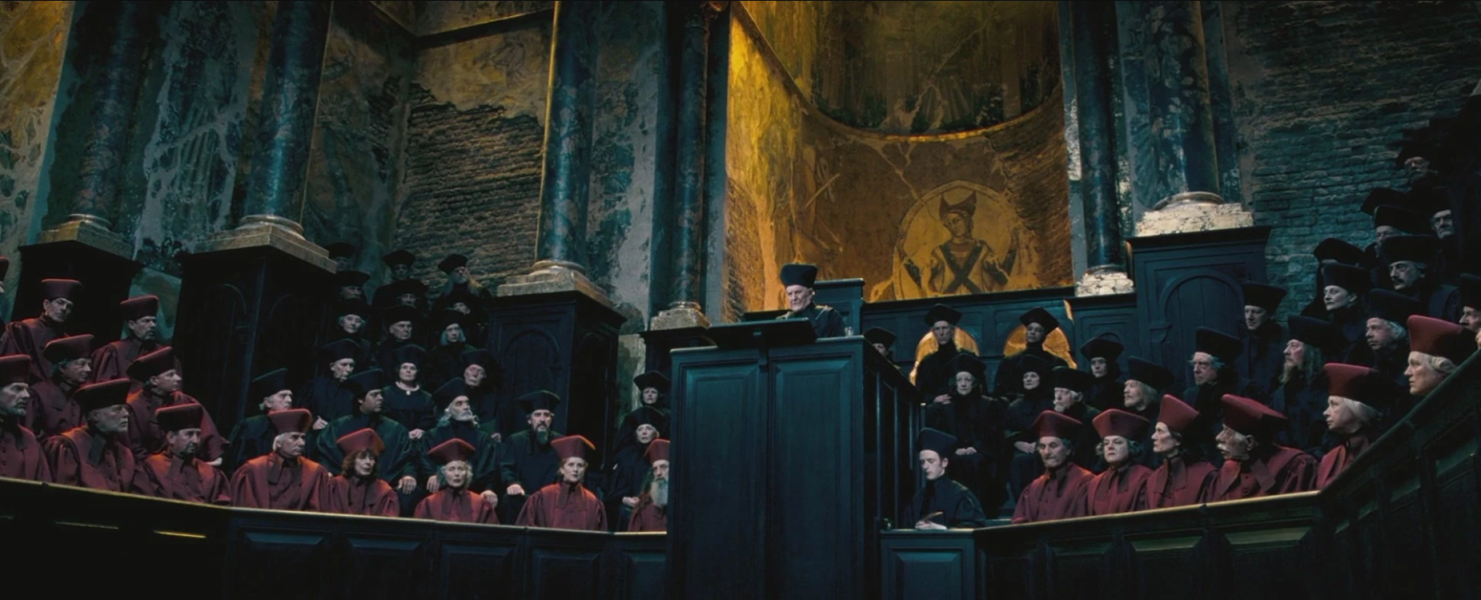
The Wizengamot Chamber possessed a unique kind of silence.
It was not the silence of emptiness.
Nor the silence of peace.
It was the silence that came before decisions.
Ancient stone walls rose high overhead, engraved with centuries of magical governance. Golden torchlight flickered across polished marble floors while enchanted banners hovered between towering columns like patient witnesses. Tier upon tier of seats circled the chamber, filled with witches and wizards whose families had shaped British magical society for generations. But today, something broader than Britain was present.
Delegations from the International Confederation of Wizards observed from specially warded tiers.
Representatives from the French Ministère des Affaires Magiques sat with composed precision.
A German Magical Council envoy studied the room with clinical interest.
Even a quiet observer from the Nordic Magical Union remained still, rune-inscribed notes hovering beside them.
This was no longer a purely British discussion.
It never had been, not after the Blood Curse Cure and Magical Core Restoration Cure had quietly begun circulating through international channels under strict review. Those breakthroughs had already shifted political gravity across continents. And now, Mira Silverthorne’s newest inventions had drawn that gravity even tighter.
Expectations were no longer local.
They were international.
Lucius Malfoy and Theodric Rowlehart stood at the center of the chamber with composed stillness.
Yet even Lucius felt it now—that subtle pressure of foreign eyes.
Not just the Wizengamot.
Not just the Ministry.
But the wider wizarding world watching how Britain chose to proceed.
Lucius lifted his silver-tipped cane slightly, the sound echoing once against marble before dissolving back into silence.
“We are gathered today,” he began smoothly, “to review two inventions developed by Miss Mira Silverthorne following consultation with the Auror Office, and preliminary interest from several International Magical Law Enforcement Attachés.”
That final phrase changed the room’s tone almost instantly.
International attachés leaned forward.
British officials straightened.
Even the enchanted banners above seemed to still.
Lucius continued.
“The inventions in question are known as the Whisperlinks and the Auror Spy Snitch.”
Theodric gestured, and the chamber responded.
Floating diagrams expanded above the floor—now mirrored with translated annotations appearing in multiple magical scripts: English, French, Germanic runes, and ICW-standard sigil shorthand.
Whisperlinks.
Auror Spy Snitch.
The designs rotated slowly in the air like living blueprints.
At once elegant.
At once unsettling in their potential reach.
Lucius allowed the international delegates a moment to absorb them.
Then he added carefully, “Several foreign ministries have requested observation privileges due to potential cross-border operational applications.”
That statement shifted the air again.
Because “cross-border operational applications” in wizarding politics was never casual language.
The French delegate exchanged a brief glance with the ICW observer.
The German envoy tapped a quill once against parchment.
The Nordic representative did not move—but the runes beside them brightened faintly.
Theodric activated the first demonstration.
“Forma Susurris.”
Silver light rippled outward.
The Whisperlink transformed repeatedly—brooch, ring, earring, pendant—each form stabilizing perfectly, as though the magic understood identity as something fluid rather than fixed.
A faint murmur spread through the chamber.
International delegates reacted differently than British officials.
Not surprise.
Calculation.
Immediate projection into field doctrine.
Lucius spoke again.
“The Whisperlinks allow secure telepathic communication across teams, independent of verbal transmission.”
A French attaché raised a hand slightly.
A translated charm activated.
“Including cross-language interpretation?”
Theodric nodded.
“Built-in adaptive cognitive translation matrices.”
That was enough to shift the tone of the foreign observers from interest to intense attention.
Because that meant something simple and profound:
Interoperability.
Across borders.
Across ministries.
Across doctrines.
Then the Auror Spy Snitch was revealed.
A silver sphere hovered.
Light blue runes pulsed softly.
Then—
It vanished.
Not hidden.
Not cloaked.
Gone.
Even the ICW observer leaned forward slightly.
Seconds passed.
Then it reappeared.
And the viewing crystal activated.
The chamber saw itself.
From above.
From angles no one had physically occupied.
Real-time.
Unfiltered.
Immediate.
A low exhale moved through the international tier.
Lucius continued.
“The Spy Snitch integrates directly with Whisperlink networks, allowing synchronized visual intelligence sharing.”
At that, the German envoy finally spoke.
“This is not merely Auror-level utility,” they said slowly. “This is national security architecture.”
No one contradicted them.
Because it was true.
Theodric confirmed field testing results.
And now, for the first time, international ministries were explicitly referenced in the trial summary.
Joint observation had been conducted under ICW compliance oversight protocols.
British Auror Office.
International Liaison Division.
And advisory representatives from France and select ICW research bodies.
The results were identical across jurisdictions.
No communication failure.
No surveillance compromise.
No operational delay.
Perfect synchronization.
Then came testimonies.
Amelia Bones appeared first, her voice steady as ever.
“This is not an incremental improvement,” she said. “It is a restructuring of how coordinated magical enforcement can function.”
The ICW observer wrote that down immediately.
Kingsley Shacklebolt followed.
His words were translated in real time through charmwork embedded into the chamber itself.
“Every ministry struggles with delayed intelligence during joint operations,” he said. “These devices remove that delay entirely.”
A French Auror liaison nodded once, slowly.
Remus Lupin spoke next.
His tone carried no political framing—only field experience.
“In multinational operations, communication breakdown is the most common cause of failure.”
A pause.
“These reduce that risk to near zero.”
The Nordic representative’s runes pulsed again.
Sirius Black, ever blunt, added:
“If international teams ever have to work together under pressure, they’ll want these.”
A few chuckles followed—even some of the foreign delegates allowed faint smiles.
Then came Nyx Silverthorne.
His amethyst emerald eyes briefly met the international tier.
“This changes intelligence sharing frameworks entirely,” he said. “Not just within ministries, but between them.”
That statement landed heavily.
Because it implied something many governments preferred not to accelerate:
Cooperative intelligence infrastructure.
Korrin Silverthorne followed.
“I don’t care what flag you work under,” he said simply. “If you’re in the field, and this saves your team, you use it.”
Even the ICW observer paused at that.
Trust, expressed without diplomacy.
Alaric Silverthorne was last.
And the chamber, international observers included, quieted further.
“I’ve worked alongside Aurors across regions,” he said. “Different training. Different procedures. Same dangers.”
He looked briefly toward the foreign delegations.
“These tools do not erase those differences.”
A pause.
“But they allow people to survive them.”
Silence followed.
Not political silence.
Understanding silence.
Even across languages.
Even across ministries.
When the presentation concluded, the chamber did not immediately return to debate.
Instead, international delegates began conferring quietly with their domestic counterparts.
The French envoy spoke in rapid undertone.
The ICW observer reviewed projected compliance frameworks.
The German council member requested technical schematics for standardization review.
Lucius observed all of it with faint detachment.
He had seen British politics shift.
But international alignment shifting this quickly was something rarer.
Theodric closed the final report.
“This,” he said quietly, “will not remain a domestic matter for long.”
And he was correct.
An elderly British witch finally rose, breaking the extended contemplation.
“When Britain presented the Blood Curse Cure,” she said carefully, “we were forced to reconsider what innovation meant.”
She glanced briefly toward the international tier.
“Now we must reconsider what cooperation means.”
Murmurs followed—this time not just British agreement, but multilingual acknowledgment.
The debate that followed lasted longer than usual.
But its shape was different.
No longer “should we adopt.”
Now:
“How do we align with international standards?”
“How do we regulate cross-ministry usage?”
“How do we ensure ICW compliance without limiting effectiveness?”
“How do we prevent misuse while preserving interoperability?”
These were not objections.
They were infrastructure questions.
High above, Dumbledore watched in quiet reflection.
The presence of international observers did not surprise him.
Only the speed of alignment did.
Progress, when it truly worked, rarely respected borders.
Amelia Bones noted how naturally the discussion shifted toward cooperation frameworks rather than resistance.
Kingsley quietly observed that joint operations with European ministries would become significantly safer.
Moody muttered something about “finally getting everyone on the same cursed page,” which, in his language, was approval.
Eventually, the chamber settled again.
Dumbledore rose.
Silence returned instantly.
“The proposal concerns adoption of the Whisperlinks and Auror Spy Snitches for use within the Department of Magical Law Enforcement,” he said.
A pause.
“And conditional integration into International Magical Law Enforcement cooperation frameworks under ICW oversight.”
That addition mattered.
It formalized what everyone already understood:
This would not stay within Britain.
Votes were cast.
Golden light rose.
But now, additional enchanted channels opened—allowing ICW liaison validation markers to appear alongside domestic votes.
The tally climbed.
Faster than before.
Because international observers were not voting directly—
but their presence influenced alignment approvals embedded within cooperative treaties already in place.
Finally—
APPROVED.
The word appeared in brilliant golden script.
Now accompanied by a secondary seal:
ICW COOPERATION ACKNOWLEDGED
For a moment, the chamber did not react.
Because the significance settled first.
Then applause began.
British officials.
Foreign delegates.
Liaison representatives.
Even the ICW observer gave a single, formal nod of approval.
Not celebration.
Recognition.
Lucius exhaled quietly.
Theodric allowed himself a rare, satisfied smile.
Amelia Bones closed her notes.
Kingsley looked toward the international tier thoughtfully.
Moody simply grunted.
And above them all, Dumbledore watched with a faint, knowing expression.
Because what had just happened was larger than invention approval.
It was the beginning of synchronized magical cooperation across nations—triggered not by treaties or diplomacy alone, but by a young witch’s work quietly solving problems everyone had accepted as permanent.
Far away, beyond the Ministry walls, Mira Silverthorne likely continued her day unaware that her designs had just passed not only a national vote—
but the first step toward international standardization.
And somewhere within the Wizengamot chamber, that realization settled quietly among all present:
The wizarding world was no longer responding to innovation one country at a time.
It was beginning to respond as one.
ns216.73.216.86da2

 and then Add to home screen.