

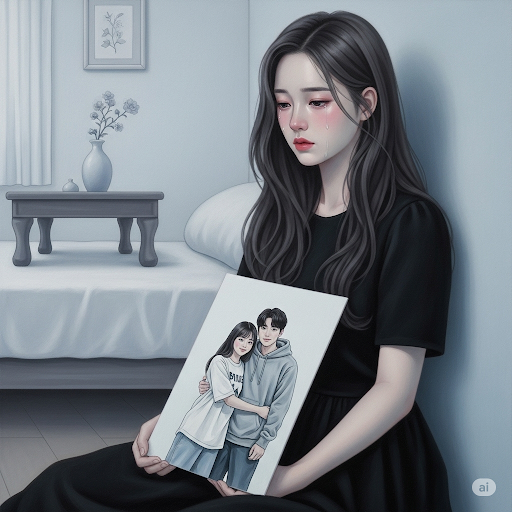
She was discharged from the hospital, but she was not free. Her body was mended, but her mind remained a prisoner, chained to two things she desperately wanted to forget. Her brother was the first. He wasn't just a brother; he was her entire world. He was the anchor she clung to in every storm, the laughter in every shared joke, the secret keeper and the true friend. He was her family—her mother, her father, her everything.
The world was suffocating. Every breath was a reminder that he could no longer take one. Her eyes were perpetually red, not just from weeping, but from the raw, exhausted ache of grief that had consumed her. She couldn't eat; the food on her plate felt like an insult to the memory of the one who had died for her. She wore a black dress, a second skin of sorrow, and spent her days in front of the single framed photograph of them together, as if she could step into the picture and back into a time where he still lived.
She was isolated not just by her pain, but by the deafening silence of her family. They had been on that train, too. They had watched the bullies' cold eyes, seen the glint of the gun, and heard her brother's final, defiant words. But they had not spoken. Fear had kept them mute, and now their silence was a betrayal she could not forgive. She never spoke to them, her quiet contempt a fortress around her grief.
And then there was the second memory, a fractured nightmare that haunted her dreams. It was that tragic night in the meadow, after the train. She could still feel the cold ground and the terror of being alone. She remembered the person with red eyes, wrapped in a black cloak, who appeared like a phantom. He had killed the bullies without even touching them, a silent, powerful act that seemed like magic, or something far older and more sinister. Then, the blackness. The next thing she remembered was waking up in the hospital, the nurses telling her the police had found her in a cave. Who was he? What did he want? Was he a savior or a captor?
Her mind replayed the scene endlessly: the red eyes, the cold damp of the cave, the feeling of being a helpless object. He had saved her from the bullies, but for what "greedy purpose"? The mystery was another wound that wouldn't heal.
Even the person who loved her was kept away. Usama, her classmate, was more than a friend; he was another soul who would have fought for her without hesitation. But by a cruel twist of fate, he was home that night, caring for his sick mother. It was a good thing, she knew, but it didn't lessen her pain. Had he been there, he would have died, just like her brother, because he would never have let anyone harm her. She was a survivor, but her survival was proof that everyone who truly loved her was gone, or had been spared by a fate that only compounded her loneliness.
She was a ghost in her own home, a whisper of a person haunting the stillness of her room. She knelt on the cold floor, the black fabric of her dress a stark contrast to the pale wood. Her entire world was a small, silver frame. Inside was his face—her brother’s face—radiant with the easy smile that had been the sun in her sky. She ran her fingers over his cheek in the photograph, her touch a silent prayer to a god who no longer answered.
She began to speak, her voice a fractured whisper, a sound that held all the sorrow the world could contain.
“Brother…” Her voice cracked, a single tear escaping and falling onto the glass, distorting his image. “I will die. Please, look at me. Look how I’m weeping. How could you let your flower weep so? Don’t you care that I’m hungry and sad? No one cares. No one… cares.”
Her voice rose into a choked sob, the tears now a torrent, blurring her vision. She pressed her face to the cool glass of the frame. “I am your flower, and your flower is now going to die. Your light is dimming now…” She repeated the words like a broken mantra, each syllable a fresh cut of pain.
On the other side of the wall, Usama stood frozen. He had been coming to the house every day, a silent vigil to the girl he loved. He knew her family wouldn’t let him in, but he couldn't stay away. He would wait in the corridor, pretending to be busy on his phone, just to be close to her.
Her words, muffled by the wall, were a knife to his heart. He could hear the ragged catch in her breath, the crushing despair in her voice. He closed his eyes, his fists clenching at his sides. He couldn’t see her, but he could imagine her, a fragile bird with broken wings, weeping in front of a photograph. The love he had for her was a fierce, protective thing, but now it was a source of pure helplessness. He couldn’t go to her. He couldn't wipe her tears. He couldn't hold her. He was a witness to her pain, and that was all. It was an agony that mirrored her own, a shared torment that kept them separated by only a thin wall.255Please respect copyright.PENANAT3XEQDAr9F



 and then Add to home screen.