

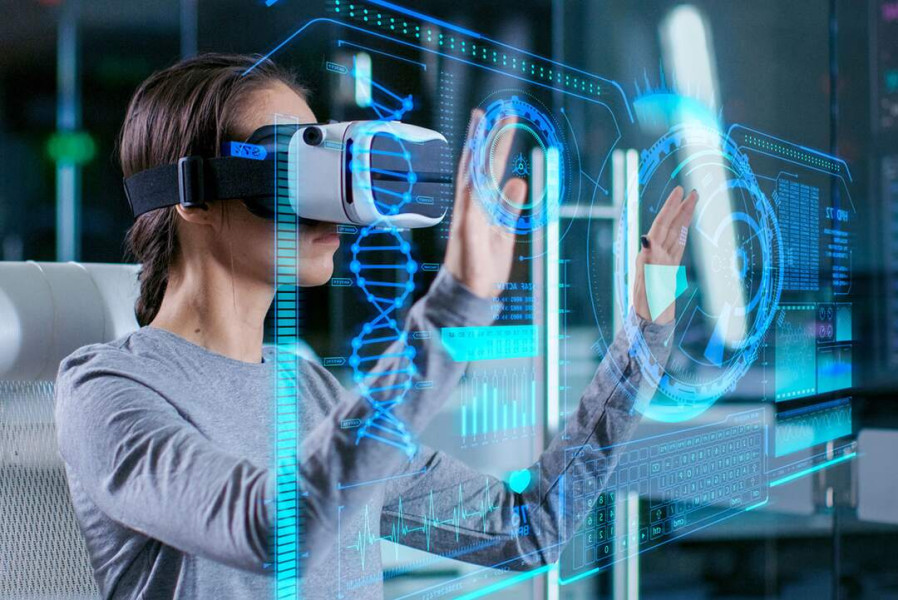
Augmented reality is no longer a futuristic concept reserved for gaming and entertainment. In 2026, AR has become a critical layer of enterprise strategy, transforming how businesses train employees, serve customers, deliver healthcare, and manage complex operations. When artificial intelligence is woven into the AR experience, the result is a new class of application that perceives, understands, and responds to the physical world in real time. To build at this frontier, you need to hire AR app developers who combine spatial computing expertise with deep knowledge of AI integration, 3D rendering, and platform-specific development frameworks.
This article outlines what AI-powered AR development involves, the specific skills required, the industries benefiting most, and how to find and evaluate the right talent for your project.
1. What AI-Powered AR Development Means in 2026 34Please respect copyright.PENANAadhk01ERlu
Traditional AR simply overlays digital content onto a camera view. AI-powered AR goes significantly further — it enables applications that understand the environment they are placed in, recognize objects and people, adapt content dynamically, and learn from user interactions over time.
Core Capabilities of AI-Powered AR Applications:
- Real-time object recognition and scene understanding using computer vision models
- Semantic segmentation that distinguishes surfaces, objects, and spatial relationships
- Natural language processing enabling voice-controlled AR interfaces
- Generative AI integration for dynamic 3D content creation within live environments
- Predictive overlays that surface contextual information before the user requests it
- Persistent AR anchors that remember spatial positions across sessions using machine learning
- Gesture and gaze tracking interpreted through neural network models for hands-free interaction
Building these capabilities requires developers who understand both the AR rendering pipeline and the AI engineering layer beneath it. This dual expertise is precisely why businesses that hire AR app developers with AI experience gain a decisive advantage in product quality and time-to-market.
2. Industries Driving Demand for AI-Powered AR Applications
Across sectors, organizations are discovering that AI-powered AR delivers outcomes that neither technology can achieve alone. The following industries are leading adoption and creating the strongest demand for specialized AR development talent.
Healthcare and Medical Training
- Surgical AR overlays that display patient vitals, anatomy maps, and procedural guidance during operations
- AI-assisted diagnostic tools that highlight anomalies in medical imaging through AR visualization
- Immersive training simulations for medical professionals that adapt difficulty based on performance
- Remote patient monitoring where AR surfaces real-time health data in a clinician's field of view
Manufacturing and Field Operations
- AI-guided assembly instructions that overlay step-by-step guidance directly onto physical components
- Predictive maintenance overlays that identify equipment failure risks before they occur
- Quality inspection systems that use computer vision to flag defects in real time
- Remote expert assistance where field technicians receive AR annotations from specialists elsewhere
Retail and E-Commerce
- Virtual try-on experiences for fashion, eyewear, and cosmetics powered by face-tracking AI
- Spatial product visualization allows customers to place furniture and appliances in their own homes
- In-store AR navigation that guides shoppers to products using real-time path optimization
- Personalized promotional overlays driven by AI analysis of customer behavior and preferences
Education and Corporate Training
- Immersive learning environments where AI adapts content complexity based on learner performance
- Interactive 3D simulations of scientific concepts, historical events, or engineering systems
- Onboarding experiences that guide new employees through processes using spatial AR annotations
3. Key Skills to Look for When You Hire AR App Developers34Please respect copyright.PENANA5Pv01tBkgF
The skill set required for AI-powered AR development spans multiple disciplines. When you hire AR app developers for immersive projects, evaluate candidates across both the AR engineering layer and the AI integration capability.
AR Platform and SDK Expertise:
- ARKit (iOS) and ARCore (Android) for native mobile AR with world tracking and plane detection
- Unity with AR Foundation for cross-platform AR development across mobile and headset devices
- Unreal Engine for photorealistic AR experiences requiring high-fidelity 3D rendering
- Microsoft HoloLens and Mixed Reality Toolkit (MRTK) for enterprise headset deployment
- Apple Vision Pro development using visionOS, SwiftUI, and RealityKit
- WebAR frameworks including 8th Wall, A-Frame, and Three.js for browser-based AR delivery
AI and Computer Vision Integration:
- Integration of on-device AI models using Core ML, TensorFlow Lite, or ONNX Runtime
- Computer vision pipelines for object detection, pose estimation, and scene segmentation
- Cloud AI service integration — Google Cloud Vision, AWS Rekognition, Azure Computer Vision
- Large language model integration for conversational AR interfaces and contextual content delivery
- Generative AI pipelines for dynamic 3D asset creation and environment adaptation
3D Development and Spatial Computing Skills:
- 3D mathematics including quaternions, matrix transforms, and spatial coordinate systems
- Shader programming and GPU optimization for real-time AR rendering performance
- Spatial anchor management and persistent world-scale AR experiences
- Physics simulation and collision detection for believable AR object interaction
Essential Soft Skills:
- Creative problem-solving to design intuitive user experiences in three-dimensional space
- Cross-disciplinary communication with designers, UX researchers, and business stakeholders
- Performance optimization mindset essential for maintaining 60fps on resource-constrained devices
4. Engagement Models for Hiring AR App Developers34Please respect copyright.PENANAAezFnkHavv
The structure of your AR development engagement should match the complexity and duration of your project. When you hire AR app developers, three primary models are available.
Freelance AR Developers
- Suitable for proof-of-concept builds, specific feature development, or short-term prototyping
- Available through platforms such as Toptal, Upwork, and specialized AR talent communities
- Requires strong internal technical direction to ensure AI integration decisions are architecturally sound
Dedicated AR Development Teams
- Best for ongoing AR product development requiring deep context and iterative improvement
- Dedicated teams build institutional knowledge about your platform, AI models, and user behavior
- Ideal for enterprise AR deployments where reliability, performance, and continuous refinement matter
- Provides full accountability and integration with your internal product and engineering teams
Full-Service AR Development Studios
- Offer end-to-end capability: concept design, 3D asset creation, AI integration, testing, and deployment
- Best for organizations without internal AR expertise who need a complete product delivered
- Structured milestones and quality assurance processes reduce risk in complex multi-platform projects
For enterprise-grade AI-powered AR applications, the dedicated team model consistently delivers the best outcomes. The complexity of training AI models, tuning spatial anchors, and optimizing for diverse hardware requires sustained engagement, not a rotating roster of contributors.
5. How to Evaluate AR App Developers Before Hiring
Given the specialized nature of AR development, standard technical interviews are insufficient. When you hire AR app developers for AI-powered projects, a structured evaluation process is essential.
- Review a portfolio of shipped AR applications — prioritize developers with live apps on the App Store, Google Play, or enterprise deployment
- Assess AI integration depth: ask how they have combined computer vision or language models with AR rendering pipelines
- Test spatial computing knowledge: ask candidates to explain world tracking, occlusion, and persistent anchors in plain language
- Evaluate platform breadth: confirm experience with at least one native SDK (ARKit or ARCore) and one cross-platform engine (Unity or Unreal)
- Request performance optimization examples: AR at 60fps on mobile requires expert-level GPU and memory management
- Check for device fragmentation experience: AI-powered AR must degrade gracefully across varying hardware capabilities
- Validate communication skills: AR developers must translate spatial concepts into clear product requirements
| Also read: RAG, Chatbots, or Workflow Automation? Choosing the Right AI Approach
Conclusion
AI-powered augmented reality represents one of the most technically demanding and commercially rewarding frontiers in modern software development. The applications being built today — from AI-guided surgical overlays to adaptive retail experiences and intelligent industrial maintenance tools — are reshaping how businesses operate and how people engage with the physical world.
To build at this level, you must hire AR app developers who bring the full combination of spatial computing expertise, AI engineering capability, platform-specific knowledge, and creative problem-solving to your project. The investment in the right talent is not simply a technical decision — it is a strategic one. In a landscape where immersive AI applications are rapidly becoming competitive differentiators, the quality of your AR development team will determine whether your product leads the market or follows it.
ns216.73.216.69da2

 and then Add to home screen.