

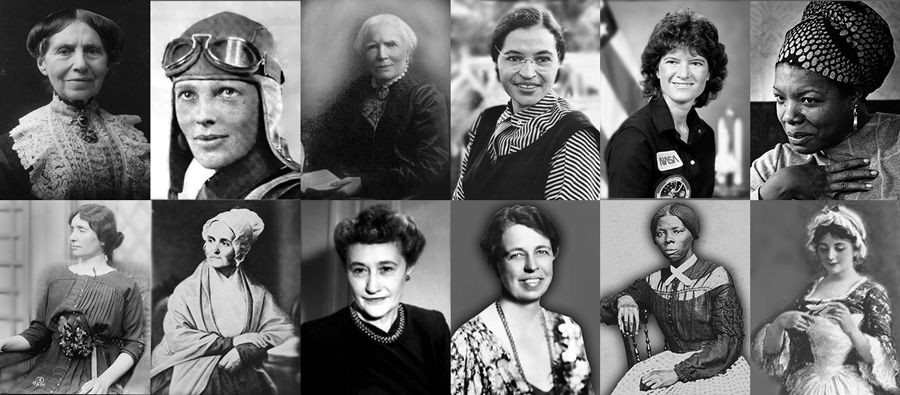
The first women in the United States were Native Americans. Some worked in the fields, but their primary work was caring for children. Even in the Colonial Period, women were seen as merely housewives. According to the book, preparing even the simplest meal “required both judgement and skill (Women’s America pg. 29).” Women made fires to simplify the cooking process, for cooking and baking were “year-round tasks (Women’s America pg. 29).” They relied on cattle for milk and apples for cider (Women’s America pg. 30). Early housewives also washed and sewed clothes, to save the hassle from visiting a tailor (Women’s America pg. 32). Spinning was especially prevalent in northern New England (Women’s America pg. 35). A symbol of the housekeeping role in the early Colonial Period was the pocket, except they were viewed more as pouches than pockets. This was because they hung from the outside of a woman’s dress (Women’s America, pg. 36). Every day, women would collect objects that would help them throughout the day. They put them in their pocket and took them home. Pockets were symbols. They illustrated what a woman’s role in society was.
As history progressed, the perspective of women’s work changed. They moved away from their housekeeping selves and became doctors, teachers, pilots, etc. This required sacrifices, as well as a long-time war for women’s rights. These two ideas, women’s work and women’s rights, will be the focus of this essay. Women have had their wins and losses, but at the end of the day, they are still fighting for their freedom. They would not be where they are today if it weren’t for their ancestors. These ancestors are the ones who changed women’s history forever in an unbelievable, fantastic way.
During the Revolutionary War (1775-1783), women sought to prove they were more than just housewives. They collected war donations from houses and used them to help the soldiers (Women’s America pg. 87). They "bought materials and made them clothes (Women’s America pg. 87).”
This was a major stepping stone for women who wanted to enter politics. Women even joined the army. While they weren’t able to fight, they did help with cooking and cleaning for the troops. There were records of women posing as men to fight in battle (Women’s America, pg. 91). One such example is Deborah Samson. She was able to keep her gender a secret until she ended up in the hospital with a fever. However, the physician said they would keep her identity secret, and because of this, Deborah survived the war (Women’s America, pg. 91). She was a brave and independent soldier who gained great admiration from her peers, even though she was a woman. Deborah’s story is a remarkable example of how women were willing to sacrifice themselves in order to win their freedom.
As America entered the nineteenth century, women began working in textile factories during the Industrial Revolution.
Work for women was much more difficult than for men. Segregation was a huge issue. Men were always the supervisors, while women remained in the dark. As a whole, the only work they could do was spinning and weaving (Women’s America pg. 133). Women were always paid less than men, and they worked at least ten hours a day. They were given almost no breaks and very little to eat. Even a simple conversation with another worker could have devastating consequences.
In the 1830s, women “developed strong support networks (Women’s America pg. 133).” At the time, their pay was worse, and their already lengthy hours increased. As a result, women came together and began protesting (Women’s America, p. 133).
Aside from working in factories, women also owned slaves. They inherited slaves and land from their parents. Slaves were forced to call them “master” and “mistress,” and women were not always friendly with them. The most common form of punishment, even if the slave did nothing wrong, was beating. This mostly included whipping. Witnesses who experienced the whipping first-hand said that it crushed most of the bones in their bodies (Women’s America pg. 140).
Given that women lived very different and dangerous lives from men, it is no wonder that Seneca Falls was such an important event in history. An early form of women’s activism, Elizabeth Cady Stanton invited a group of women to Seneca Falls in order to sign her version of the Women’s Declaration of Independence, or the Declaration of Sentiments. In it, women argued for women’s rights compared to men’s. They wanted the right to vote and the right to do more than just work in a factory. They wanted to be seen not as housewives, but as equals to their male counterparts. Seneca Falls and the Declaration of Sentiments were early forms of feminism that shaped the way women lived in society from 1848 onward. If not for Seneca Falls, modern feminism would have never evolved.
When the early 1900s rolled around, women faced something that changed their perspective of factory work forever: the Triangle Factory Fire. Fire broke out one day while hundreds of young women were working. Fearful, they tried to escape, but they were trapped behind locked doors. While women burned and suffocated inside, others jumped to their deaths from windows. All in all, 146 women died (Women’s America pg. 327). After the fire, laws were passed requiring safer working conditions for women.
In the year 1920, the Nineteenth Amendment was passed. After a long struggle, women could finally vote. Getting there was no easy task. Women gathered in crowds and held signs up to the White House for Woodrow Wilson to read, asking when he would finally grant them the right to vote. After years of struggle, he finally passed the Nineteenth Amendment, under the eyes of Alice Paul (a long-time supporter of women’s activism). Though not easily accomplished, women’s suffrage happened thanks to brave women who sacrificed everything for women’s sake.
As the twentieth century progressed, more women started to find jobs and fight for their rights. An example is the women of the Ku Klux Klan, where half a million women were members. Women believed that they could purify the country if they showed that they were active in both politics and social movements (Women’s America pg. 368). Those women part of the clan spoke out for women’s rights. According to the book, they “challenged men’s power (Women’s America, pg. 368).”
Aside from speeches, women also worked with newspapers and novels, and some even ran for a local office. Women joined the KKK through “churches, clubs, and sororities (Women’s America pg. 369).” As a result, most men saw them as feminists, but they weren’t. Women just wanted to prove they were as capable as men (like when a child wants to show their parents they are mature).
During World War II, women proved to the community that they were effective workers. Even though many men still opposed women working, campaigns were launched to support women in the workforce (Women’s America, p. 431). As more women left home to work, daycare centers became common to help care for their children. Women felt that if their husbands were fighting in the war, then they needed to do something to support them.
In areas of America where labor was short, women were hired for part-time and full-time jobs. By the mid-1940s, many women were earning wages. Most of these women did not have jobs before the war. Even black women began working, making this a huge milestone for them, both positive and negative. Black women were finally working, but there was still much discrimination against them. However, by the end of the war, many women quit their jobs (Women’s America, pg. 434) because they no longer had to support their husbands. Despite this, large groups of women continued to urge the public and the government for better jobs. They also protested against better pay, since many were taking “men’s” jobs (Women’s America pg. 436).
Thanks to the women of the past, the perspective on women’s rights has changed dramatically over the past one hundred years. What started off as them working in factories with terrible working conditions is now a thing of the past.
Nowadays, women are running for politics, becoming teachers and doctors, and proving that they are just as capable as men. However, the fight for equality remains. The war has staggered, but it is not over. The battle will continue as history progresses until one day, women will overcome men in both the political and working world.
ns216.73.217.54da2


 and then Add to home screen.